Showing posts with label Sherlock Holmes. Show all posts

Monday, October 17, 2016

A STUDY IN TERROR

James Hill, 1965
Starring: John Neville, Donald Houston, John Fraser My knife's so nice and sharp, I want to get to work right away if I get a chance. Good Luck. Yours truly, Jack the Ripper.” In late nineteenth century London, prostitutes are being murdered in the seedy district of Whitechapel. The city’s most renowned detective, Sherlock Holmes, is soon on the case along with his associate Dr. Watson and the scant clues — including a case of personalized surgical instruments left at a pawn shop —  lead them towards the missing son of the illustrious Duke of Shires. Holmes’ own brother Mycroft encourages him to find the killer, dubbed Jack the Ripper by the press, before the madman strikes again, sending Holmes into an increasingly complex web of lies, family secrets, and past violence, all revolving around a local asylum. It might seem a little off track for me to cover a Sherlock Holmes film for my British horror series, but — as with Hammer’s earlier The Hound of the Baskervilles (1959), starring Peter Cushing and Christopher Lee — this film does have some connection to the horror genre. I’m a massive Sherlock Holmes fan and it’s really a shame that this film and Hammer’s effort didn’t kick of a string of horror-tinged Conan Doyle thrillers. That bit of wishful thinking aside, A Study in Terror did have an interesting impact, both in terms of cinema and fiction; even though it’s relatively ignored and received mixed critical attention, it’s worth remembering because it was influential in two ways. First, it pitted the world’s most famous fictional detective against a historical, unsolved case; secondly, it was (as far as I can tell) the first work of fiction to pin the Ripper murders on a member of the British aristocracy, implying that a government-wide conspiracy is at foot. This theme began to reappear somewhat regularly, including in Murder by Decree (1978), which I’ll discuss more later, and Alan Moore’s masterpiece, the comic From Hell (1989-1996). The film’s connection to the horror genre is further highlighted in the fact that it was penned by Donald and Derek Ford of The Black Torment, and implied more sex and violence than the censors were apparently comfortable with; really it has nothing on, say, a Pete Walker film, but there are some brutal death sequences and a few implied seductions. And in his own way, Saucy Jack has become as much of a classic horror genre figure as Dracula or Frankenstein’s monster. It’s always felt a bit weird to me to cut Ripper-themed films out of horror genre discussions and include them with thrillers instead; after all, this is about a series of crimes where an unidentified person literally guts prostitutes and spills their entrails all over the street. The film’s twist — which I am going to reveal here, so look out, spoilers ahead — focuses on the same core plot element as Murder by Decree and From Hell: a rebellious aristocrat had a relationship with a woman of questionable morals and his family attempted to cover it up, leading, in a roundabout way, to the murders. In this case, Lord Carfax (John Fraser), Michael’s brother, became obsessed with covering up a scandal. The murder of several prostitutes was just a ruse, a diversion, in order to distract from his real plan, to locate and then murder Angela (Adrienne Corri). The plot is sort of hard to follow and improbable: While Michael (John Cairney) was studying to be a doctor, he met and married a beautiful prostitute, Angela. He learned that she was unfaithful to him — with Max Steiner (Peter Carsten), the owner of the inn — and in an ensuing fight, she tried to throw acid in his face, but only wound up hideously scarring herself. Steiner keeps her hidden away in a room above the inn, while Michael went mad from the incident and is similarly hidden away in the asylum by his former mentor, Dr. Murray (Anthony Quayle), who has let everyone believe that he’s dead. Sherlock’s deductions are a bit groan-worthy at times and his logical leaps make the head spin, but some of this is expected and the rest is made up for by a number of wonderful performances. Gilliam’s Baron Munchausen himself, John Neville, is absolutely divine as Holmes and I really wish he had been given his own run as the sleuth, like Peter Cushing or Jeremy Brett (though admittedly no one can compare with the latter). Donald Houston’s blustering Watson provides a nice counterpoint, as he is generally always affronted about something, adding a subtly comic twist to the grim proceedings. I know this use of Watson as comic relief annoys a lot of Conan Doyle purists, but when it’s done well, I’m afraid I can’t agree. It actually spares the film from being obsessed with its own cleverness, a fate that Bob Clark’s Murder by Decree suffers from. And while I think the latter is a better film, overall, it stands firmly on the shoulders of A Study in Terror and isn’t quite as entertaining in a diverting way. Also look out for Robert Morley (Theatre of Blood) as a wonderful Mycroft Holmes. The prolific Frank Finlay is probably my favorite Lestrade, a role he happily returned to for Murder by Decree (A Study in Terror’s Anthony Quayle also returned for that film, though not as a recurring character). And in an interesting sidenote, a young Judi Dench plays Murray’s niece and confidante. Her brief turn here reminds me a little of Angela Lansbury’s role in The Picture of Dorian Gray (1945); both actresses are now so well known that to see them so young and relegated to supporting roles is a bit distracting. Overall, I have to recommend A Study in Terror, if only because of my Sherlock Holmes love. If you don’t feel the same way about fictional consulting detectives, or have a fascination with Jack the Ripper films, this might be something to pass over. The concluding exposition is pretty teeth-grinding, but the film’s presentation of issues like classism and misogyny blended with some good old fashioned inherited insanity and religiously-inspired paranoia make for a deadly cocktail, though one that A Study in Terror serves up with mixed results. The loose implication that Carfax could murder Angela by murdering every prostitute in Whitechapel is something I wish had been brought to the screen a bit more exuberantly, but I will be forever spoiled by Moore’s From Hell (though I refuse to acknowledge that the horrific film adaptation even exists). Though it’s available on DVD, a cleaned up Blu-ray release would be nice, preferably in some sort of Holmes-themed box set, or, even more amazingly, a Ripper set.

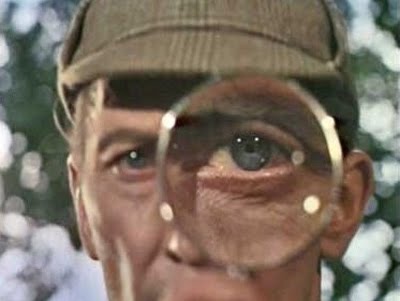
Thursday, February 11, 2016

THE HOUND OF THE BASKERVILLES (1959)


Terence Fisher, 1959
Starring: Peter Cushing, Christopher Lee, Andre Morell, Marla Landi, David Oxley

The cruel Sir Hugo Baskerville hosts an extravagant party at his family estate and sadistically kills a young girl when she rebuffs his advances. In return, he is killed by an enormous dog, allegedly a hound of Hell, and it becomes a local legend that this hound kills male members of the Baskerville line when they wander out on the moors alone. Hugo's distant descendant, the young Sir Henry, contacts Holmes after his father's sudden death, because he fears that he will be the next victim of the curse. Holmes entrusts Sir Henry to Watson's care for a few days, warning them to avoid the moors at all costs. One night Watson and Henry see a light shining on the moors and go to investigate, but they hear menacing howls. Will Holmes arrive in time to save Sir Henry from the spectral beast?

If memory serves me correctly, this is the first Sherlock Holmes film adaptation I had the fortune to see. As a young Sherlockian and rabid horror fan, it seemed perfectly natural that my beloved Hammer Horror would round up the usual suspects — director Terence Fisher and stars Peter Cushing and Christopher Lee — to adapt one of Conan Doyle's more horror-influenced tales. And though it remains the most adapted Conan Doyle story, this version is of historical interest because it was the first of any Holmes adaptation to be shot in color. Hammer’s trademark sense of Gothic style goes a long way towards bringing Conan Doyle’s suspenseful, and often richly detailed, world to life.

Unsurprisingly, The Hound of the Baskervilles has the same flavor as most of the Hammer Dracula films and is more representative of traditional Gothic horror than contemporary genre films replete with gore and brutality. This will not appeal to everyone, as it’s definitely a period piece, and though there are many scenes of suspense, nothing actually frightening occurs. The film is rich with a wonderful sense of atmosphere and is worth watching just for the typically beautiful Hammer setting with foggy moors, ancestral mansions, and the lovely if melancholic English countryside.

Though the villain is clearly not a homicidal ghost dog, I'm going to avoid spoilers, because the film's ending deviates in an interesting way from the novel. Most of the plot changes occur to spice up action and pace, giving it a more typical Hammer feel. Sir Henry is attacked by a tarantula — though this is normally one of my biggest pet peeves, the script offers a somewhat plausible explanation, as tarantulas don’t possess enough venom to do any damage to humans — and Holmes is nearly trapped in a cave-in while investigating, plus the ending is more violent than Conan Doyle’s somewhat wistful romantic conclusion.

Cushing and Lee are two of my favorite actors to see together and they are absolutely delightful here. Despite Hammer’s reliance on creating film series — as exemplified by Dracula, Frankenstein, The Mummy, the Karnstein trilogy, and so on — I’ve always been disappointed that there were no more followup films. I’m not quite sure what the explanation is, but it’s one of my biggest Hammer-related laments. Cushing's Holmes is similar to his Professor Van Helsing. He excels at playing asexual, aloof characters more interested in scientific procedure than human relationships. This was his first appearance as Holmes — he was apparently such a Holmes fanatic that his knowledge helped out on set — and he would later go on to star as the great detective in a long running TV series for the BBC. 

AndrĂ© Morell's Watson is calm and unaffected, generally more likable and less comic than other portrayals of Watson from the period. Though he’s warm and likable, he’s not quite able to keep up with the energy Cushing. And you might be surprised to see a young, but no less serious Christopher Lee as Sir Henry, the proud but persecuted victim. Unlike Cushing, Lee had less of an involvement with Conan Doyle’s famous character, but his turn as Mycroft Holmes in Billy Wilder’s excellent The Private Life of Sherlock Holmes is not to be missed.

There is a basic DVD available from MGM, which includes some nice, Lee-heavy special features. He gives a lengthy interview about his relationship with Peter Cushing and also reads excerpts from “The Hound of the Baskervilles" in his wonderful voice. Coming highly recommended, of course, The Hound of the Baskervilles is definitely an underrated effort, both as a Holmes adaptation and as a Hammer mystery/suspense/horror film.

Wednesday, March 21, 2012

THE ADVENTURES OF SHERLOCK HOLMES


Granada Television, 1984 - 1985
Starring: Jeremy Brett, David Burke, Rosalie Williams

Jeremy Brett was and remains to be the greatest actor to portray Sherlock Holmes, no disrespect intended to Basil Rathbone. Brett starred in a number of Holmes-themed TV series and feature films produced by the British company Granada Television from 1984 to 1994. Production ceased when Brett fell ill, dying of heart failure soon after. Based on his excellent performances, these films and episodes became wildly popular in the UK and the US, ensuring that the series has been frequently re-broadcast over the years, is available in a wide number of formats for home viewing and is currently streaming on Netflix.

Though the show is known both as The Adventures of Sherlock Holmes and Sherlock Holmes, Adventures technically refers to the first season, which ran two years and spans 13 episodes, each 60 minutes long. This season was produced by Michael Cox and was written and developed by John Hawkesworth. The title The Adventures of Sherlock Holmes refers to the first published collection of Holmes short stories written by Conan Doyle. Not all of the 12 stories are represented in the first season, however. About half the stories are excluded in favor of more beloved works and "The Adventure of the Noble Bachelor" was later adapted as a feature length film. I highly recommend this collection, which is available in its entirely at Project Gutenberg.

The Adventures of Sherlock Holmes features the following episodes, which are named after corresponding stories. Note: the episode titles drop "The Adventure of..." which every story title in this season contains, with the exception of "A Scandal in Bohemia."

1. "A Scandal in Bohemia" is based on the first Holmes story to be published in the famous magazine where Conan Doyle got his start, The Strand, and was later published in the Adventures collection. Holmes has a run in with Irene Adler, who is one of the only characters to outwit him and certainly the only woman to do so. He is hired by the future King of Bohemia to retrieve some blackmail photographs taken by Adler, who he had an affair with and who is threatening to ruin his impending marriage.

2. "The Dancing Men" appears in the later collection The Return of Sherlock Holmes, which is the first book published after Conan Doyle attempted to kill off Holmes, but failed due to his immense popularity. Holmes and Watson visit the Norfolk countryside to solve a case involving a series of strange stick figures written all over an estate. A local lord's young American wife is on the brink of nervous hysteria over the figures, which resemble dancing men. Holmes realizes the men are a cipher, but can he crack the code in time? This episode is one of my favorites and is a welcome inclusion.

3. "The Naval Treaty" was featured in the story collection The Memoirs of Sherlock Holmes. Watson's old friend, Percy Phelps, needs help when a naval treaty is stolen from the foreign affairs office he works in. It seems impossible that someone could have stolen the treaty, based on the construction of the building and location of his office, as well as the suspects apprehended after the fact. Can Holmes find it before Phelps's life and reputation are ruined?

4. "The Solitary Cyclist" is from Return and concerns a young girl named Violet who has become involved in a curious set of circumstances. After her father's death she is contacted by two men who have recently arrived from South Africa. They claim to have known her deceased uncle, who supposedly said he wanted his surviving family provided for. The nicer of the two men offers her an unusually well-paying job as a music teacher and governess for his young daughter. The second man is rude and repulsive, frequently making unwanted advances on her. In addition to this, a mysterious bearded man has begun to follow her whenever she rides her bicycle. Can Holmes unravel the mystery in time to save Violet?

5. "The Crooked Man" appears in Memoirs and is an oddly tragic tale. Holmes is investigating a case in which a woman is believed to have killed her soldier husband and brings Watson in for some medical advice. Partly due to a missing key and some claw marks at the scene, Holmes thinks a third party is responsible. He tracks down the "crooked" man, who relates his sad story.

6. "The Speckled Band," one of my favorite stories, is part of the Adventure collection and is one of the few Holmes stories than can be considered a "locked room mystery." A young woman hires Holmes to investigate the death of her twin sister. The girls' stepfather is increasingly unpleasant, probably due to the fact that if either of the girls married, they would take a considerable chunk of their mother's fortune with them. As Helen, the surviving twin, is due to be married, she fears for her life. When her stepfather forces her to move out of her bedroom and into a different room in the house, Holmes intervenes with the hope of saving her life.

7. "The Blue Carbuncle" is included in the Adventures collection and is basically a Sherlock Holmes Christmas story. Holmes is investigating a Christmas goose that was on its way to be eaten until a carbuncle (or gemstone) was found in its throat. The only clue is a battered old hat. He tracks down the hat's owner, who is ignorant of the crime and Holmes realizes the jewel belongs to a visiting Countess. Can Holmes find the culprit with so few clues?

8. "The Copper Beeches" is also in the Adventures collection and is another one of my favorite stories. A young lady named Violet gets advice from Holmes about a governess position with curious conditions. She will be paid an enormous salary, but has to cut off her beautiful hair, among other odd things. Ultimately her employer seems pleasant enough, so she takes the job at his estate, the Cooper Beeches. After a short time she contacts Holmes, who brings Watson to investigate the increasingly bizarre things Violet is asked to do. One of the most genuinely creepy stories, this is an excellent adaptation.

9. "The Greek Interpreter," found in Memoirs, is the first time we encounter Mycroft in either the series or Conan Doyle's stories. I love Mycroft. He contacts Holmes about his neighbor, a Greek interpreter, who was hired for a very suspicious job by a man named Latimer. The interpreter was asked to translate for a Greek man who has obviously been kidnapped. Latimer wanted the man to sign some papers and the interpreter secretly discovered his unfortunate plight during their conversation. The man refused to sign over property to Latimer and said something about a woman being in trouble. Intrigued, Holmes agrees to get to the bottom of things and places an advertisement in the paper that leads he and Watson down a dangerous path. This is the first time that the TV series makes some significant plot changes in order to better suit running time and a dramatic conclusion.

10. "The Norwood Builder" appears in Return and concerns Jonas Oldacre, a missing builder who appears to have been murdered during a fire. The main suspect is his lawyer, John McFarlane. He gets arrested, but Lestrade agrees to hear his tale where he insists on his innocence. Holmes notes that there is something suspicious about the different drafts of wills and his investigation paints an increasingly blacker portrait of Oldacre.

11. "The Resident Patient," which is included in Memoirs, is another one of my favorite mysteries. A young doctor, Trevelyan, consults Holmes about his investor, a man named Blessington, who is obsessive about the doctor's books and goes over the accounts religiously. Blessington has become paranoid about theft around the same time Trevelyan acquires a new patient, a Russian who is disposed to have fits. The Russian and his son disappear, but return the next day with a plausible story. Blessington insists someone has been in his rooms. Holmes tries to investigate, but Blessington refuses to help him and is later found hanged in his bedroom. Though the police believe it to be suicide, Holmes knows otherwise and begins to hunt for a murderer.

12. "The Red-Headed League" is from Adventures and is not only my favorite Conan Doyle story, but is also the greatest Holmes story with a comic flavor. Though the episode takes certain liberties with the plot, it is still close to the original, which concerns a red-headed businessman named Jabez Wilson. He consults Holmes and Watson after being fired from a part time job. This job was suggested to him by his assistant and he was hired out of a large pool of red-haired men. He did meaningless office work for a large sum of money every week, until he received a notice saying "The Red-Headed League is dissolved." It turns out that there never was a Red-Headed League and, according the the landlord, his employer didn't exist. Though he laughs at Wilson, Holmes discovers a plot involving bank robbery. This adaptation changes things by involving Moriarty as the mastermind behind it all.

13. "The Final Problem" appears in Memoirs and is the famous story that pits Holmes and Moriarty against each other once and for all. For some reason this has never been one of my favorites, probably because Conan Doyle attempts to kill off the world's greatest consulting detective and the Napoleon of crime all in one go. Essentially Moriarty has had enough of Holmes's interference and attempts to kil him when he is getting close to turning Moriarty over to Scotland Yard. Holmes sneaks off to Europe with Watson in tow and Moriarty follows them. They wind up at the Reichenbach Falls in Switzerland, where Moriarty distracts Watson with a ruse and he and Holmes duke it out over the Falls.

The first season is the best and if you're going to take the time to watch any episodes, it should be from Adventures. Though there is a strict degree of faithfulness through out the entire show, the first season represents some of the best stories and the most direct adaptations. There are excellent production values and immense attention to detail, both in recreating Conan Doyle's world and maintaining period realism. The sets are absolutely beautiful and range between Baker Street, Victorian London and the British countryside. The complete Baker Street replica, built in studio by Granada, was available as a tourist attraction in Manchester until about ten years ago.

The real reason to watch the series, of course, is Jeremy Brett. He provides some warmth and humor to Holmes, particularly in his interactions with Watson. The close friendship between he and the good doctor is at the heart of the show and this was one of the first long running adaptations to give them a more even relationship. Brett also possesses Holmes's manic energy and almost physically palpable sense of intelligence. There have been some criticisms that Brett is too over the top, but Holmes is never what I would call a subdued character, ranging from explosive, manic energy during crime solving to deep depression when stuck at home without a case. 

David Burke's Watson is my favorite of all time, with MURDER BY DECREE's James Mason in second place. He is warm, funny and down to earth, showing a begrudging tolerance for Holmes's more absurd antics. Unfortunately Burke left the show after Adventures and was replaced by an almost equal Edward Hardwicke.

Adventures was followed by several more series and a few feature length films. Immediately after Adventures is The Return of Sherlock Holmes, then The Case-Book of Sherlock Holmes and finally The Memoirs of Sherlock Holmes, all named after different Conan Doyle story collections. It should be noted that Brett was sick and essentially dying during the filming of Memoirs, which many fans have claimed to be the most inferior of the series. As a result of his illness, Charles Gray stepped in more frequently as Mycroft to allow filming to continue. The feature films are The Sign of the Four, The Hound of the Baskervilles, The Master Blackmailer, based on "The Adventure of Charles Augustus Milverton," The Last Vampyre, my personal favorite and based on "The Adventure of the Sussex Vampire," and The Eligible Bachelor, based on "The Adventure of the Noble Bachelor." What is particularly impressive about the series as a whole is that out of 60 Holmes stories written by Conan Doyle, Granada managed to adapt 42 of them.

You can find all of the episodes in The Adventures Of Sherlock Holmes: Boxed Set Collection, which is a reasonably priced 5-disc set released by MPI, though there are limited special features. Also available is the staggering Sherlock Holmes: The Complete Granada Television Series, which contains all four seasons and five feature films. Also released by MPI, there are 12 discs and more special features, including a few commentary tracks and some interviews.

The game is afoot!

Monday, March 19, 2012

MURDER BY DECREE


Bob Clark, 1979
Starring: Christopher Plummer, James Mason, David Hemmings, Susan Clarke, Anthony Quayle

"Justice howling at the moon."

Though Murder by Decree is widely ignored, I think it is one of the greatest Sherlock Holmes films ever made. It is not derived from any Conan Doyle story, but pits the world's great detective against the world's most infamous serial killer, Jack the Ripper. When Saucy Jack starts gutting prostitutes around Whitechapel, London is in an outrage. Scotland Yard fails to contact Holmes for help, but a group of disgruntled citizens "hire" him to take the case. He uncovers a link to the Freemasons, a royal scandal, a love affair gone bad, and a woman wrongly committed to an asylum. Though I generally hate the subgenre, this is a conspiracy film at heart. To give any more of the plot away would spoil Murder by Decree and we can't have that.

Helmed by Bob Clark, one of my favorite directors, this would make an interesting double feature with his slasher flick Black Christmas. Both films are heavy with atmosphere, though in Murder by Decree Clark is incredibly restrained, maintaining thrills and scares with suspense and mood rather than gore or violence. The tension and mystery are both helped along by some very claustrophobic POV shots, refusing to show us Jack even though we are forced to witness his crimes. It is truly a beautiful film, full of fog and darkness. Clark uses the impressive Victorian London set design almost as a stand alone character, framing as many shots as possible with gnarled trees, wrought iron fences, gas lamps, and other period staples.

This was an English/Canadian co-production and in addition to the Canadian Clark, the strong cast is almost evenly divided between the two countries. I would recommend the film simply for the dream team of Plummer and Mason as Holmes and Watson. Plummer's Holmes is not lifted directly from Conan Doyle's text. He presents a more sensitive, human Holmes, who is not afraid to mix humor with his trademark arrogance and icy resolve. James Mason is the absolute Watson. Mason doesn't play him as a bumbler or below-average intelligence sidekick, rather he emphasizes his medical skills and his steadfast, trustworthy nature, frequently providing Holmes with a dose of common sense. The rest of the cast is rounded out with some wonderful performances by Genevieve Bujold, Donald Sutherland, John Gielgud, and David Hemmings.

The Holmes-Ripper plot was semi-popular at the time and Murder by Decree has a number of connections to other works of film and literature from the period. It has a close plot similarity with 1965's inferior A Study in Terror. There is another film from the same year that pits H.G. Wells against Jack the Ripper, Time After Time, though this is more of a sci-fi thriller than a murder mystery. Plummer also played Holmes two years previously in the '77 made for TV film Silver Blaze, which is an adaptation of the Conan Doyle story of the same name.

Murder by Decree's original script by John Hopkins is said to be based on Elwyn Jones and John Lloyd's book The Ripper File, but it also bears similarities to Jack the Ripper: The Final Solution by Stephen Knight. Both books examine existing Ripper clues and attempt to connect the crimes to the upper echelons of British society, dipping all the way into Freemasons and royalty. These books and Murder by Decree were an obvious inspiration for Alan Moore's absolutely sublime comic From Hell and the abominable film adaptation starring Johnny Depp. For Sherlockians out there, also check out The Last Sherlock Holmes Story, a poorly named pastiche novel from the '70s by Michael Dibdin, which also sets Holmes against the Ripper, but manages to tie in Moriarty. There is a well-received more recent attempt at the same, Dust and Shadow: An Account of the Ripper Killings by Dr. John H. Watson, by Lyndsay Faye.

Though unavailable to movie-lovers and Sherlockians alike for many years, there is a fairly good Anchor Bay DVD available. It has a restored print, though there are still some scratches and the sound is occasionally muddy. This DVD includes a handful of extras, namely a nice commentary track with Clark, who is more than eager to run through the film's production history. Murder by Decree comes highly, highly recommended. If you are only going to see one Sherlock Holmes film, this should definitely be it.

WITHOUT A CLUE


Thom Eberhardt, 1988
Starring: Michael Caine, Ben Kingsley, Jeffrey Jones, Lysette Anthony, Paul Freeman

Sherlock Holmes spoofs are unfortunately as inevitable as they are timeless. So far there are more satirical books than films, but Without a Clue takes an honest stab at turning Holmes and Watson on their heads in this endearing if thoroughly uneven film.

Directed by Thom Eberhardt of Captain Ron fame, the premise is that Dr. Watson is a crime-solving and literary genius. He has invented a literary figure, Sherlock Holmes, who has become so popular that no one will believe Watson's genius and he is forced to hire an actor. Enter Reginald Kincaid, a drunk, gambling, womanizing idiot who cares about no one but himself. He can barely remember the lines Watson carefully scripts for him and frequently comes close to blowing a case. Despite these things, the press, police force, and government love him. When Watson fires him, fed up and jealous, he is forced to drag Kincaid back to solve a mystery that involves counterfeiting pound-notes and the Bank of England. This leads Holmes, Watson, one of the young Irregulars and the jealous, clumsy Lestrade to the countryside, where they team up with a missing bank manager's daughter. Of course, Moriarty is behind it all, but he kills Watson, forcing the blundering Holmes to work through the clues and solve the case.

The major flaw of Without a Clue is that it is based around the concept of a brilliant Watson and a bumbling Holmes -- which is admittedly excellent thanks to two great performances -- but it doesn't go much farther than this. The film starts out strong, but the jokes get old and the middle of the film drags quite a bit. When Holmes/Kincaid is forced to prove his merit, things get interesting again and there is quite an amusing second half. Over all I enjoyed it, but the real reason to see the film is for Kingsley's exasperated Watson and the ever wonderful Michael Caine as Holmes/Kincaid.

There are a lot of flaws. There aren't very strong or compelling side characters, which makes this an interesting but failed attempt. Though Jeffrey Jones (Beetlejuice) is amusing as the frustrated Lestrade, Lysette Anthony (Krull) as the bank manager's daughter is incredibly irritating and provides neither romantic intrigue or comic relief. The film involves lots of scenery chewing, though there are some lovely set pieces to do this on -- Victorian buildings, underground tunnels, abandoned theaters and so on. There is plenty of intellectual humor, witty fast-talking, slapstick and physical comedy, but I would still only recommend it for fans of spoof humor or devoted Sherlockians. There is a basic region 1 DVD available from MGM.

Sherlock, Season One

Created by Mark Gatiss and Steven Moffat
Starring: Benedict Cumberbatch and Martin Freeman

I've been a Sherlock Holmes nerd since I was a kid. Someone, probably my dad, gave me a copy of "Hound of the Baskervilles" and that was the beginning of the end. Since then I've read every Holmes story, many of them multiple times over the years, and have even choked down some cross overs and non-Conan Doyle attempts at the character. As a result, I was nervous about yet another film/TV adaptation of the Great Detective's antics. I'm a huge fan of the long running Jeremy Brett series (The Adventures of Sherlock Holmes) and there is no way anyone can reasonably compare.

To my surprise and delight, the BBC's Sherlock went in a completely different direction. The stories are updated to the present day and include new twists on old favorites, while retaining many of the original, beloved plot details and characters. The fairest thing I can say about this show is that it's a mash up of Conan Doyle and Doctor Who, which makes sense considering creators Steven Moffat and Mark Gatiss also write and produce the current incarnation of Doctor Who. And I absolutely adore anything they create, particularly Mark Gatiss, who co-stars in a few episodes as Mycroft. This is also an excellent example of how to use modern-day technology within suspense fiction.

Season one is made up of three 90 minute episodes, which premiered in 2010. The first episode, "A Study in Pink," is based on Conan Doyle's novel A Study in Scarlet. There are a string of serial suicides all around the city and Holmes is convinced one man is responsible. He meets Dr. John Watson, recently returned from the war in Afghanistan with an injured leg and the need to rent a cheap flat. Holmes and Watson slowly become friends and Holmes takes Watson on the case. There are a lot of great tie-ins to A Study in Scarlet, namely clues found at the scene of the crime.

The second episode is "The Blind Banker," which starts off with a break in at a local bank, where one of Holmes's acquaintances hires him to get to the bottom of things. He discovers a strange, spray-painted code and things quickly escalate to murder, leading Holmes and Watson on the trial of Chinese smugglers. They run into book codes, the Chinese circus, ancient valuables, kidnapping, and more murder. Though still well written, well acted and enjoyable, this is probably the least of the three episodes.

"The Great Game" is the final episode and drags Holmes inexorably towards his arch-nemesis, Moriarty. Holmes is hired by his brother Mycroft to investigate the suspicious death of a government employee, but is distracted by a mysterious assassin playing deadly mind games. He rigs a series of victims with explosives and will only set them free if Holmes can solve a variety of cold cases in time. Holmes and Moriarty have an eventual stand-off, leading to a cliff hanger that may cost Watson his life.

If you are a Holmes fan or like quirky crime drama, the series comes highly recommended. There are a lot of great things about it, particularly the casting. Benedict Cumberbatch is great as Holmes. He plays up the unlikable angle, even suggesting that the character suffers from Asperger's Syndrome. Eventually we learn through Watson that he is a decent, caring person and has welcome moments of humor. The series also gives Holmes a dark side, presenting him as a barely contained sociopath who fits into society only because he has complicated problems and puzzles to solve. Martin Freeman is a welcome inclusion as Watson, giving the character a warm, Everyman sort of appeal and making him seem like less of a dunce than other adaptations have. Watson is still a doctor returning from the traumas of a war in the Middle East, which has a freshly topical appeal given the current, ongoing conflicts in Iraq and Afghanistan. And though there are only light touches of it, he remains to be a charming womanizer.

There are also regular appearances from Lestrade, played by Rupert Graves, who gives the character a serious angle and removes the bumbling humor of past adaptations. Una Stubbs's Mrs. Hudson is also very likable. Her close relationship with Holmes provides the character with a much needed human element, though he is also a source of comical irritation for her. Mark Gatiss is an excellent Mycroft: arrogant, brilliant and frequently charming, but is entirely too physically active. During Mycroft's first appearance there are some in jokes about how he is on a diet. At first I was uncertain about Mycroft's character, but Gatiss has completely won me over, particularly after re-watching the season and finishing season two. The somewhat secret linchpin to the whole series, for me, is Moriarty. At first I disliked Andrew Scott's Moriarty, but he has completely won me over. Like Sherlock, he is brilliant and calculating, but here, unlike other adaptations, he is a complete psychopath. He has an irritating high-pitched voice and some bizarrely feminine habits, but overall he is an adequately terrifying villain.

Sherlock comes highly recommended, not only by me. The show received great critical reception and won a BAFTA award for Best Drama series in 2011. Season one is available on DVD, Season two is finished and a third is slated for sometime in early 2013. Also look out for Freeman and Cumberbatch in Peter Jackson's long-awaited fantasy epic, The Hobbit.