Showing posts with label Hammer Horror. Show all posts

Friday, March 18, 2016

FEAR IN THE NIGHT (1972)

Jimmy Sangster, 1972
Starring: Judy Geeson, Joan Collins, Peter Cushing

Robert, a school teacher in the English countryside, has just married an innocent young woman named Peggy. She relocates to the boys’ boarding school where he works, but has an uneasy transition: she’s recently recovered from some sort of psychological collapse and is convinced that an unseen man is attacking her. Because of her mental health, no one believes her, though the attacks continue at the school. When Robert goes away for a conference, she’s left alone with just the creepy headmaster and his beautiful, but cold wife, and someone seems to be trying to drive her completely mad.

Written, directed, and produced by Jimmy Sangster, this was originally supposed to be made in the mid ‘60s as part of Sangster’s black and white suspense series for Hammer but was (fortunately, in my opinion) delayed to the early ‘70s. Sangster will certainly never be remembered as the studio’s strongest director — though he was definitely their best writer — and he only stepped into the director’s chair for three films: The Horror of Frankenstein (1970), Lust for a Vampire (1971), and Fear in the Night. Sadly, The Horror of Frankenstein is widely regarded as one of the worst in Hammer’s Frankenstein series — probably due to the fact that it’s essentially a black comedy and is the only film not to feature Peter Cushing — while Lust for a Vampire suffered a similar fate. I have to admit that I really enjoy both films, though this is largely due to the presence of later-era Hammer star Ralph Bates.

SPOILERS AHEAD: Here Bates co-stars as Robert, Peggy’s doting new husband. Admittedly, I prefer Bates when he’s allowed to be campy and over the top — he’s sort of a more handsome precursor to someone like Jeffrey Combs — as he is in films like the fantastic Dr. Jekyll and Sister Hyde. But part of the strength of his performance is that he has to show restraint for the first 70 minutes of the film. In a sense, if you’ve seen one Sangster suspense film, you’ve seen them all, but that curiously doesn’t take away from the ability to enjoy them. Yes, this is yet another script about a psychologically fragile woman who is left alone with someone trying to drive her mad. Yes, it is also a film where the person she trusts most double-crosses her and has been withholding a secret motivation: her husband is having an affair with Molly, the headmaster’s wife, and the two have conspired to drive Peggy to murder Carmichael, so they can get away with his money.

Peter Cushing is sparsely used as Headmaster Carmichael, but is as fantastic as ever and makes the most of his totally bananas character — though it could be said that what makes the film great is the fact that it essentially pits four totally bananas characters against each other. Of course you have the obviously disturbed Peggy, played by Judy Greeson, (10 Rillington Place, Goodbye Gemini) who should annoy me but somehow is perfect for the film. Everyone makes a huge deal about how beautiful she is and even though she’s a grown woman (allegedly her character is 22), it feels like they’re all hitting on a 14 year old. It also becomes quickly apparent that Carmichael is off his rocker when he proudly displays a room full of nooses and knots; tying and untying them is apparently his passion and he makes quite a meal out of taking a scarf from around Peggy’s hair in an effectively uncomfortable scene.

The film’s real twist — which I am going to ruin right now, so skip this paragraph if you don’t want to know about it — is that Carmichael was the headmaster of a school, which burned down years ago. He used his considerable wealth to restore it, has hired Robert as a fake teacher, and maintains the illusion that he runs a packed school. He even plays recordings of his old classes over the loudspeakers, so the school is full of the sounds of children. I wish I was making that up, but it’s genius and, as I said earlier, fucking bananas. And you also have to consider the two “sane” characters, Robert and Carmichael’s wife Molly (Joan Collins, who is just as bitchy as ever). Robert seems normal enough, but, with a completely straight face, refers to Peggy as “the most normal person I’ve ever met.” Though he seems to find violence personally distasteful, he seems unfazed by the fact that Molly is an obvious sadist and makes disturbing sculptures in her spare time.

I could probably go on forever about my love for this film, so needless to say it comes highly recommended and is thankfully available on DVD — though you have to be a little patient with it. One one hand, the plot is easy to figure out, but it’s still full of surprises and is one of my favorite later era Hammer films thanks to a really strong cast and great performances all around. There’s no gore, no nudity, and very little violence, but if you can stick with the central mystery, Fear in the Night is more than worth it for the last ten minutes, when Peter Cushing’s unhinged headmaster has the last laugh and Ralph Bates has a total meltdown while screaming “you mad bastard!” I was also relieved to find a delightfully dark ending that manages to be redemptive — both the schemers wind up hoisted on their own petards, as it were — but with nothing really resolved, as Peggy and Michael are both left totally mad

Wednesday, March 16, 2016

DEMONS OF THE MIND

Peter Sykes, 1972
Starring: Gillian Hills, Robert Hardy, Patrick Magee, Michael Hordern

The Baron Zorn locks up his two children, Emil and Elizabeth, who are both young adults, because he believes they will go mad as their mother did when they were children. Since her suicide, the household has been in disarray with Emil and Elizabeth kept as prisoners, though they are desperate to be in each other’s company. Zorn enlists the aid of Dr. Falkenberg, a self-proclaimed genius whose methods are unreliable at best. Meanwhile, a raving priest and a band of local villagers are trying to find a murderer in their mist, as young girls keep disappearing in the woods near the Zorn estate…

Along with Hand of the Ripper, with which this makes a solid companion piece, Demons of the Mind is one of Hammer’s most hallucinatory, bleak films with some inspired visual flourishes from director Peter Sykes. He was allegedly chosen for this film based on his work on Venom — which is one of my favorites and I can’t really express how excited I am by this fact — but it’s nice to have a fresh perspective, despite the fact that this is late in the game for Hammer. The film’s main problem, but part of what I like so much about it, is that it veers back and forth between the studio’s somewhat formulaic earlier Gothic horror films and the sort of Freudian psychological horror that Hammer flirted with in their later years. 

There is a fairytale element and the lush forest setting of some of Hammer’s best films, as well as a misguided ending that involves a mob of villagers getting fiery vengeance on the Baron, the overused theme of villainous aristocracy, and even a bizarre pagan ritual that the locals refer to as “calling out death.” The beautiful but troubled siblings locked up in a musty castle could just as easily be vampires as they could be mad and it’s a little disappointing that Hammer turns to the same old buxom blondes as victims — though when the reason for this is unveiled, it makes things a bit more interesting. Like Brides of Dracula, the plot hints at incest but, to my dismay, never fully delivers.

Speaking of the siblings, there are subdued but strangely charismatic central performances from  Shane Briant and Gillian Hills. Briant, quite easy on the eyes, was something of an up and coming Hammer star, with performances from around this time also in Straight on Till Morning (1972), Frankenstein And The Monster From Hell (1974), and Captain Kronos: Vampire Hunter (1974). Actress and singer Gillian Hills — amazing replacing Marianne Faithful, who was originally considered for the role — was not only a yé-yé pop icon in France, but was fresh off small but noteworthy roles in Blow-Up (1966) and A Clockwork Orange (1971). I can’t help but wonder why she didn’t develop a bigger cult film following, and she’s great here even though she’s given very little to do.

Briant and Hills are overshadowed — actually completely blown out of the water — by the insane amount of scenery chewing from a fantastic supporting cast. Robert Hardy (The Spy Who Came in From the Cold) as Baron Zorn and Patrick Magee (The Strange Case of Dr. Jekyll and Miss Osbourne) as Dr. Falkenberg chew scenery with a gusto rarely matched throughout Hammer’s years of admittedly superb scenery chewing. They’re matched only by the wonderful Michael Hordern (Where Eagles Dare), who must be seen to be believes as a totally wacko priest, who preaches forgiveness but winds up staking someone to death with a burning cross.

Yes, you read that right.

This is undoubtedly one of the studio’s most unhinged, hysterical films, though it helps that the main theme is madness. Based sort of vaguely on the life of Franz Mesmer, this has more gore and nudity than the studio’s earlier films and those skeptical of Hammer’s restrained Gothic horror may find a lot to love here. I wish they had kept going further throughout the ‘70s, as I love this period where they begin to experiment with their own tropes. For example, they relied firmly on the cold scientist trope — most notably with Peter Cushing’s Baron Frankenstein and Van Helsing — but here there are two versions: an insane, possibly schizophrenic priest capable of brutal violence, and Dr. Falkenberg, who may have some genuine ideas but overall is a brash faker, a man seduced by his own theories and methods, not unlike the psychiatrist in Hands of the Ripper. Demons of the Mind is available on DVD and though you may not love it as much as I do, it comes recommended.

Saturday, March 12, 2016

CRESCENDO

Alan Gibson, 1970
Starring: Stefanie Powers, James Olson, Margaretta Scott

An American graduate student, Susan Roberts, is invited to travel to France to do research for her thesis at the home of celebrate late composer Henry Ryman. Susan will be staying at Ryman’s home, an isolated villa in the countryside, with the composer’s widow and wheelchair bound son, Georges. The household is rounded out by a creepy valet and a rude French maid, who has a strange hold over Georges. As Susan and Georges grow closer, a number of strange events occur around the villa: a piano plays by itself at night, Susan finds a smashed mannequin that disappears, and she learns that she’s identical to Georges’ former girlfriend. 

Crescendo is sort of a strange throwback to writer Jimmy Sangster’s run of 1960s suspense films for Hammer — titles like Taste of Fear, The Maniac, Nightmare, and Hysteria — which were nearly the complete opposite of the studio’s lushly colorful Gothic horror films. Sangster’s thrillers were primarily all contemporary, black and white affairs set in Europe and involving stories of past trauma, disturbed families, and protagonists being driven to madness. The project was actually in development for a few years before it actually went into production and was supposed to be directed by Michael Reeves (Witchfinder General), but instead later-era Hammer regular Alan Gibson (Dracula A.D. 1972, Satanic Rites of Dracula) took the helm.

And while Crescendo has much in common with Taste of Fear, Nightmare, and Hysteria — at least on the surface — it is really a failed attempt at the weird sort of ‘70s horror themes that would appear in more obscure giallo films like Lisa and the Devil (1973) and even Macabre (1980). Like the earlier Hammer suspense films, there is a lack of nudity or gore, though Crescendo had to compete with a much bustier effort from the same year, The Vampire Lovers. There is really only one key murder sequence, a nicely shot but reserved underwater death that sort of makes you wonder why Gibson thought so much restraint was necessary.

There are also more sleazy elements than your average Hammer film, many of which are exemplified by actress Jane Lapotaire (The Asphyx), who plays the household’s slutty French maid. She plays some strange sexual games with Georges — despite the fact that he later claims to be impotent — which include shooting him up with heroin, and in one scene she prances around the house in a negligee, “practicing” for when she’s going to be the lady of the house. On the other hand, Joss Ackland (The Hunt for Red October) is wasted as a sinister-looking servant who at first seems to be a red herring, but whose role quickly peters out.

Unfortunately, I have to admit that while Crescendo includes a number of elements that should work in its favor, none of them really do. It suffers from a story that’s just not gripping with dull characters and a lackluster twist — SPOILERS, not that you’ll care — involving an evil twin, which just feels impossibly lazy. There’s an interesting dream sequence that opens the film, but this is repeated seemingly any time Sangster didn’t know what to do with the plot. An effectively eerie scene where Susan sees a mannequin with a smashed face that disappears just moments later is a teaser for what the film should have been, but sadly failed to be. It doesn’t help that the protagonist is played by Stefanie Powers, one of my least favorite Hammer actresses, who nearly managed to ruin Fanatic, which she would have done if it hadn’t been for Tallulah Bankhead.

I’m sad to say that I can’t recommend Crescendo, but Hammer completists will definitely want to check it out, if only to appease their curiosity. Luckily it’s available on DVD, though it would be a nice curio to include in the Hammer suspense film Blu-ray box set of my dreams — more as a special feature than as a substantial reminder of Hammer’s lesser seen but still worthy forays into the world of thrillers.

Thursday, March 10, 2016

THE ANNIVERSARY

Roy Ward Baker, 1968
Starring: Bette Davis, Sheila Hancock, James Cossins, Jack Hedley, Elaine Taylor

“If I could stuff you, I’d put you in that cabinet there with my other beautiful possessions, and that’s love.”

A one-eyed, razor sharp matriarch, Mrs. Taggert, brings her family together every year to celebrate her anniversary with her beloved late husband. She has total control over her three adult sons — the submissive eldest, Henry, who lives at home and is a transvestite, the fearful middle child, Terry, who has a wife and five children, and the charming youngest, Tom, who is the only one his mother seems to like — but two of them are announcing their plans to escape from her. Terry and his family declare their plans to move to Canada, partly because Terry’s wife Karen is desperate to get away, while Tom introduces his (secretly pregnant) fiancee Shirley. Will any of them survive the weekend with mommy dearest?

Based on a play by Bill MacIlwraith and with a script from Hammer’s resident screenwriter, Jimmy Sangster, this is quite a departure from the studio’s first “hag horror” effort with Bette Davis, The Nanny. More of a black comedy or dark melodrama than an outright horror film, this is perhaps Davis’s most enjoyable role as an older actress and she obviously enjoyed every minute of the shoot. Her opening scene says it all: she descends the stairs to musical accompaniment — wearing a matching red eyepatch, dress, and lipstick — but trips at the bottom step and mutters, “bloody hell,” as her first line of dialogue.

Sangster actually re-wrote the script just for Davis to come on board and the studio went as far as replacing the original director — Alvin Rakoff of City on Fire — with Hammer regular Roy Ward Baker when Rakoff and Davis clashed on set. It’s a good thing too, as Davis drips glee and malice in equal measures, making for a dialogue-heavy but absolutely delightful 90 minutes. She chews scenery better than probably anyone but Vincent Price, though she never goes completely off the rails as she did in The Nanny. Of course, I’m a huge Davis fan, so I’m biased; I love her in everything from The Letter (1940) to All About Eve (1950) and original hag horror films What Ever Happened to Baby Jane? (1962) and Hush… Hush, Sweet Charlotte (1964), as well as later appearances like Death on the Nile (1978) and The Watcher in the Woods (1980).

Part of what makes her so wonderful here is that she doesn’t completely upstage the rest of the cast and this is far more of an effective ensemble piece than The Nanny. Actors from the stage production such as Jack Hedley (in everything from Lawrence of Arabia to New York Ripper), James Cossins (Fawlty Towers), and Sheila Hancock (Night Must Fall) reprised their roles. Cossins is particularly great as the cross-dressing Henry, who provides some much needed comic relief and manages to be deeply sympathetic at the same time. His scene with the lovely Elaine Taylor (Casino Royale, wife of Christopher Plummer) is one of my favorites in the film: after she catches him in the guest bedroom, wearing her lingerie, they have a sweet moment where she attempts to understand his “affliction.” He explains, in one of the film’s many quotable lines, “If I didn’t do what I do, there’s no saying what I might… do. You know what I mean?”

Be forewarned: this is more of a restrained chamber piece than a horror film and if you’re expecting something as off the rails as Fanatic or The Nanny, you’re going to be disappointed. Apparently the film was a commercial failure, I think primarily because audiences just didn’t know what to make of it. It eventually becomes obvious that no one is actually going to be murdered, though Mrs. Taggert torments the women of the house, nearly driving them to violence. She convinces her daughter in law, Karen, that her five children were in a car accident and are in critical care. Later, in another absolutely off the wall scene, Tom convinces Shirley to have sex on his mother’s bed, but she rolls over and finds one of Mrs. Taggert’s glass eyes, provoking so much hysteria that she nearly has a miscarriage. This the point where I would have liked to see things erupt in violence, but instead there’s a subdued, almost more wicked ending where it’s clear that Mrs. Taggert has just had the time of her life and there will never be any clear resolution for her poor family.

The Anniversary is only going to appeal to a very specific audience — probably one who enjoys black comedies and unusual melodramas — and if you’re expecting one of Hammer’s traditional Gothic horror films, that’s the last thing you’re going to get. Personally, I think this attempt at something new is refreshing and Davis is wonderful to behold; her performance makes the film well worth watching. Pick it up on DVD. 

Friday, March 4, 2016

RASPUTIN: THE MAD MONK

Don Sharp, 1966
Starring: Christopher Lee, Barbara Shelley, Richard Pasco

Rasputin, a depraved monk and healer in rural Russia, begins to move up in the world when he travels to St. Petersburg and hypnotizes, then seduces Sonia, one of the Czarina’s ladies in waiting. He manipulates Sonia to injure Alexi, the Czar’s heir, so that he can worm his way into the palace and the Czarina’s heart. When Rasputin orders Sonia to kill herself, his associate, a down-on-his-luck doctor, meets secretly with Sonia’s brother and friend to plan Rasputin’s destruction once and for all.  

Though known for their horror films, Hammer produced films in a wide ranges of genres, including fantasy, action, sci-fi, and historical drama. Hammer’s 1966 film, Rasputin: The Mad Monk, which piggybacked on the production of their more famous Dracula: Prince of Darkness, is a key example of the dark, historical fantasy the studio occasionally churned out in the 1950s and ‘60s. Due to a series of legal issues, this is not a factual interpretation of the life and assassination of famed mystic and healer Grigori Yefimovitch Rasputin. Instead, the great Christopher Lee channels the mythic elements of Rasputin’s legend, resulting in a lesser seen but impressive character study that blends horror and drama.

Historical accuracy is not a reason to watch Rasputin. The film was originally intended to be an adaption of Prince Felix Yusupov’s Lost Splendor, a memoir about Yusupov’s alleged involvement in the assassination of Rasputin. A number of prior legal issues with Yusupov’s book and other Russian aristocrats suing over portrayals of their lives on stage and screen contributed to Hammer’s growing anxiety with the original plot. Ultimately this became a complete work of fiction with names and events changed. It is easy to be disappointed that this film lacks any exploration of the political climate of Czarist Russia, a deeper understand of Rasputin’s motivations or effect on people, or even a cursory explanation of the court system. The Czarina has a few brief scenes, but bafflingly, the Czar is not mentioned, nor are any of Russia’s political troubles.

The best way to approach Rasputin is as a dark character study. Because of its fantastical elements, this does feel more like a horror film than a historical drama and includes moments of violence and some slight gore (a dismembered hand, a face disfigured by acid, etc). Though the other actors in this small ensemble cast all give solid performances, especially Barbara Shelley, Christopher Lee is the real draw. He does bring a lot of his Dracula into the performance, particularly the hypnotism, sexual allure, and force of personality, though he finally gets the amount of screen time his iconic character deserved, but was denied in Hammer's nine film Dracula series. Lee also allows moments of humor and pathos, making Rasputin just likable enough to carry us towards the violent conclusion.

Rasputin isn’t perfect and suffers from a very limited budget, a constricted set and a flat script, but it remains an enjoyable, compelling piece of filmmaking regardless. The film definitely does not deserve to be so neglected and will appeal to die-hard Hammer fans and anyone who enjoys moody period pieces. Rasputin is out on Blu-ray from Studio Canal in the U.K., so be forewarned that this is a region B Blu-ray and will only play in multi-region or region B players. Rasputin was released as a loose trilogy with two Hammer classics, the superior The Devil Rides Out, where Lee had the rare chance to play a protagonist, and The Mummy’s Shroud. The 2.55:1 aspect ratio looks great and gives a better glimpse of the claustrophobic sets, beautifully designed by Bernard Robinson.

Despite the low budget, the set looks almost opulent and serves to define Rasputin’s character, who appears in nearly every scene. Colors pop, particularly in the detailed costuming. This new aspect ratio does justice to the lovely work by director Don Sharp (Kiss of the Vampire) and cinematographer Michael Reed, both just off Dracula: Prince of Darkness. Reed, in particular, does a breathtaking job with lighting choices and his work is one of the many reasons to seek out this lesser known effort from Hammer.

The disc includes a number of appealing extras. There is a commentary track with actors Christopher Lee, Barbara Shelley, Francis Matthews, and Suzan Farmer, all of whom reflect on fond experiences making the film. Lee discusses his in depth knowledge of the historical Rasputin and relates the time he met two of Rasputin’s alleged assassins as a child. If you were disappointed that the film veered so far into fantasy, definitely give this a listen. Two new documentaries are included, Tall Stories: The Making of Rasputin the Mad Monk and Brought to Book: Hammer Novelisations. Tall Stories further explores the factual Rasputin and how the characters in the film relate to his real history. Overall this is a fascinating look at the making of the film and the legal struggles adapting Yusupov’s book.

Brought to Book is enjoyable, but sort of unrelated to Rasputin. It examines the tie-in novels and novelizations of a number of Hammer films throughout the history of the studio. Also included is The World of Hammer episode, “Costumers” is narrated by Oliver Reed, who takes us through most of Hammer’s historical dramas. He discusses some of the early drama-suspense cross overs like The Stranglers of Bombay, pirate films like The Pirates of Blood River, and even makes fun of his own performance in The Brigand of Kandahar. Finally, a fairly extensive stills gallery includes posters, lobby cards, behind the scene photographs and more.

Thursday, March 3, 2016

THE NANNY (1965)

Seth Holt, 1965
Starring: Bette Davis, William Dix, Wendy Craig

Joey Fane has been in a special hospital since the death of his young sister — where it was suspected he had a hand — but he is eventually sent home to his nervous mother and his arch-nemesis, the family’s longtime nanny. He is convinced that Nanny is trying to kill him or sabotage him in someway, and he refuses to eat the food she cooks him and tries to refuse interacting with her, but his distraught parents just think he’s still suffering the same effects of temper that landed him in the hospital in the first place. Is Joey quite mad or is Nanny really a threat?

Following Hammer’s first foray into “hag horror” or “psycho biddy” films (I hate both of those terms) with Tallulah Bankhead in Fanatic aka Die! Die! My Darling!, the studio snagged an even bigger star — the divine Bette Davis — for this eerie tale of domestic oppression, grief, and terror. Based on a novel by Evelyn Piper, an alias for Merriam Modell who also wrote the source material for Otto Preminger’s underrated missing child mystery Bunny Lake is Missing, this exceeds the normal hysterical, campy bounds of similar films like Whatever Happened to Baby Jane? or Hush... Hush, Sweet Charlotte thanks to a subtle script that takes its time unfolding the central mystery.

It turns out that Joey’s sister drowned accidentally two years ago — because Nanny was out of the house for some unexplained reason (it's explained why later, but no spoilers here) when she should have been watching the children — and finding the little girl dead seemed to have unhinged Nanny, who blamed the whole thing on Joey after failing to kill him too. The household dynamic is pleasantly strange, with Joey’s mother Virginia (Wendy Craig from The Servant) a complete mess after the loss of her daughter, though it’s clear that she has never really emotionally developed beyond childhood and requires Nanny — who took care of her as a girl — to feed, clothe, and emotionally support her.

Joey’s father (James Villiers of Repulsion) is essentially absent from the film, but is a bully in his few scenes. He tells his hysterical, crying wife in the film’s opening sequence that she looks terrible and she should “go and put some makeup on.” The only other major adult character, Virginia’s sister Penny (Jill Bennett from For Your Eyes Only), comes to believe Joey but only it is after too late for her to do anything about it: she has a weak heart and should not risk getting excited. Maurice Denham (an occasional Hammer regular) has a nice cameo as the stern psychologist, who is convinced he’s failed with Joey. He says, “Our job is to search out their little devils and exorcise them, but I’m afraid we’ve quite failed Joey, we’ve failed him miserably.”

The film actually makes quite a meal out of establishing that Joey is disturbed. It’s repeated that he hates middle aged women and is clearly troubled, and he’s even given a brilliant onscreen introduction where he pretends to hang himself, in a nastier version of the same scene from Harold and Maude (1971). While he’s often quite sweet to his mother — a woman who could clearly use a good slap from Peter Cushing — his favorite pastimes include making a hangman’s noose or imagining new ways that Nanny could possibly kill him. The young William Dix actually gives a decent performance as Joey — and I typically hate child actors — but the script has him flip-flopping around too much between cold rationality and childish whining.

it’s redundant to say that Bette Davis is great, but she is and, unlike Bankhead in Fanatic, doesn’t consciously steal every scene out from under the other actors. She’s a constant presence whose quiet demeanor leaves an increasingly grim cast over the film and — SPOILERS, I guess — it doesn’t become clear till quite late that Nanny is obviously as nefarious as Joey claims she is. The films makes the most of a central premise that the child may actually be the murderer, like the wonderful Alice Sweet Alice. With elements of class tension, economic strife, and social rebellion, there’s a pleasant whiff of the themes found in British New Wave films. As a result, it feels so different from Jimmy Sangster’s other suspense scripts for Hammer, but perhaps in a nice nod to those film, it does share some of their common themes: a central female character on the verge of hysteria, a drowning, and past trauma visiting itself upon the present. 

The Nanny definitely comes recommended, particularly for Bette Davis fans, and you can pick it up on DVD. Curiously, the only person who makes as much as an impression as Davis is the delightful Pamela Franklin (The Innocents), who plays a sympathetic, cigarette-smoking neighbor who is a few years older than Joey has a sort of British, teenage Anna Karina thing going on. I would love to see a film with her exploits. Director Seth Holt (Taste of Fear, Blood from the Mummy’s Tomb) does some solid work here establishing tension and it’s a shame he didn’t do more films with Hammer. And if you love The Nanny, keep in mind that Davis would return to Hammer and hag horror with the equally delightful The Anniversary (1968) a few years later.

Wednesday, March 2, 2016

FANATIC aka DIE! DIE! MY DARLING!

Silvio Narizzano, 1965
Starring: Tallulah Bankhead, Stefanie Powers, Donald Sutherland

On the eve of Patricia’s wedding to her boyfriend Alan, she decided to pay a final visit to Mrs. Trefoile, the mother of Patricia’s deceased fiancé, Stephen. Though he died a few years ago in a car accident, Mrs. Trefoile is determined to view Patricia as Stephen’s rightful wife and the older woman is horrified to learn that Patricia is a “modern” woman: she goes about unescorted by a man, smokes and drinks, and so on. An extremely right wing Christian, Mrs. Trefoile decides on a last ditch effort to purify Patricia’s soul, with the help of her two nefarious servants. 

Fanatic — more colorfully known to US audiences as Die! Die! My Darling!, a title popularized by the Misfits song of the same name, which I now can’t get out of my head — comes hot on the heels of a series of black and white, contemporary set thrillers penned by Jimmy Sangster. This is certainly not of that ilk, nearly all of which have an emphasis on inheritances and familial madness, and a series of characters conspiring to drive a central female character insane. With a script from the great Richard Matheson and a tone that ranges from camp to black comedy to hysterical violence, it really reminds me more of the kinds of films Pete Walker would make roughly a decade later, like Die Screaming Marianne (1971), House of Whipcord (1974), or The Confessional (1976). All of these are concerned with moral hysteria, in the sense that a clearly insane, conservative older character torments and often tortures and kills a younger character (generally female) for what are regarded as outrageous offenses.

Based on Nightmare, a novel by Anne Blaisdell, Fanatic also borrows heavily from “hag horror” or “psycho biddy” films like Whatever Happened to Baby Jane? (1962) and Hush… Hush Sweet Charlotte (1964). Hammer actually turned their attention to that subgenre for awhile after Hammer’s suspense films with entries like The Nanny (1965) and The Anniversary (1968), both starring with Bette Davis. And like Davis’s role in those films, Fanatic’s primary strength lies in its casting of theater actress Tallulah Bankhead, coming out of retirement to make what I believe was her first and only horror film. It’s particularly hilarious that Bankhead was cast as in the role of the aging, moralistic spinster, as the real-life actress was known as much for her stage/screen presence as she was for her lifestyle, which involved excessive, drinking, smoking, drug use, speaking her mind, and sexual affairs. She once referred to herself as “ambisextrous” — in reference to allegations about her numerous affairs with famous actresses — and said of herself, “I’m as pure as the driven slush.”

The only problem with casting Bankhead in the film is that everyone else — including actors like Peter Vaughn (Straw Dogs, Brazil, Symptoms), Maurice Kaufmann (The Abominable Dr. Phibes, A Shot in the Dark), and a barely there Donald Sutherland as Mrs. Trefoile’s mentally handicapped handyman — pales in comparison to her. Poor television actress Stefanie Powers is not only stuck with one of Hammer’s typically bland, defenseless heroine roles — if I had a drink for every time Pat could have defended herself from Mrs. Trefoile, I would die of alcohol poisoning — but she’s left with little other option than to sleepwalk through the role. Mrs. Trefoile is simply so over the top that Matheson would have had to make Patricia a great deal for colorful for the two to share their screen time remotely evenly. 

And, at least in part, it is Patricia’s thoroughly milquetoast personality and lifestyle that makes her such an unlikely, unfortunate target for Mrs. Trefoile. Like many of Pete Walker’s protagonists, she hasn’t actually done anything to deserve the insane, frothing wrath directed at her and is merely living according to very average social mores. To add insult to injury, Patricia is not even the one to get vengeance on Mrs. Trefoile at the end of the film and — after a character in the Trefoile household springs into bloody action — Patricia runs straight to the arms of her boyfriend. Excuse me while my eyes roll themselves right out of my head.

Director Silvio Narizzano is sort of a bizarre exception to Hammer’s rule of using repeat directors like Terence Fisher or Roy Ward Baker, and I can’t tell if it’s his fault or the script’s that the film careens back and forth between comedy and horror. There are some nice visuals, including a picturesque country village (which is apparently the same set as Village of the Damned) and some pleasant homages to Hitchcock. Overall, this is absolutely worth seeing for Bankhead’s great performance — one of her last — that reaches an amazing level of histrionics. It’s available on DVD from Sony, though it deserves better. 

Tuesday, March 1, 2016

HYSTERIA (1965)

Freddie Francis, 1965
Starring: Robert Webber, Anthony Newlands, Jennifer Jayne, Lelia Goldoni

When he wakes up after a car accident, an American amnesiac dubbed Chris Smith by hospital attendees in England struggles to remember who he is or what happened in his past. A sympathetic nurse named Gina vows to help him, but he becomes obsessed with the only clue found on him: a picture of a beautiful woman that seems to have been torn from a magazine. He tracks her down and though the photographer says she was found murdered in a shower, Chris soon meets her and learns that she is the wife of the man responsible for the car accident Chris was in. But Chris begins hearing voices from the apartment next store and fears his sanity is slipping away from him…

Hysteria is the last of the black and white, contemporary set, European flavored suspense films written (and occasionally directed) by Jimmy Sangster for Hammer Films that began with titles like The Shadow of the Cat and (1961) and Scream of Fear (1961). I thoroughly enjoyed this relatively short run of Psycho and Les diaboliques inspired films, but I’m sad to say that the series goes out on a weak note with Hysteria and the most disappointing entry, though Sangster would continue to write strong Gothic horror scripts for the studio and would pen a few more unrelated thrillers in the upcoming years, like The Nanny (1965), The Anniversary (1968), and Crescendo (1970). 

Director Freddie Francis and cinematographer John Wilcox returned from two of my favorite entries in Sangster’s suspense series, Paranoiac and Nightmare, but can’t make up for an uneven script filled with non-sequiturs and strange plot holes. Sure, there’s an ominous bloody knife, a beautiful woman clearly up to no good, corpses that appear and disappear in the shower, and a couple reenacting a violent argument in an apartment next door that doesn’t exist, but there’s also a hilarious flashback sequence where Chris seems to be constantly on the run from the law — or from women he has scorned. Chris begins the flashback in the middle of an affair with a French woman who is actually conning him and sends a number of gangsters after him when he tries to reclaim the wallet that she stole. In a scene with an almost inappropriate amount of slapstick comedy, he jumps out the window and into the car of an unsuspecting British woman, who agrees to take him on a cross-country road trip with her like she picks up strangers all the time. They begin an affair and he stows away in her car during a flight to England — like you do — and then just as abruptly leaves her at a gas station and fatefully gets into the car where he will crash and lose his memory. 

Robert Webber (12 Angry Men, The Dirty Dozen) is likable enough, he just can’t get away with this kind of role. He’s far too much of an everyman and lacks the charm and charisma needed to keep this kind of film afloat. Lelia Goldoni (Shadows, Invasion of the Body Snatchers) steals the film as the sultry object of Chris’s affections and there are some nice supporting performances from Jennifer Jayne (The Crawling Eye), as the lovestruck nurse, and Maurice Denham (Curse of the Demon) as a salty private investigator. It’s a shame Hammer wasn’t able to supply one of their regular stars — even Oliver Reed would have made this more compelling, though admittedly a bit more hysteria-fueled — and the film’s low budget hampers a lot of areas where it probably could have succeeded. For example, Hammer regular Bernard Robinson was also not responsible for the set design, much to the film’s detriment. The look of Hysteria is surprisingly flat and largely sequestered to a dull penthouse apartment.

Hysteria only comes recommended to die-hard Hammer completists or anyone just obsessed with ‘60s suspense films. There are some nice moments, such as the jazzy score, an attempt at a psychedelic opening sequence, and a revolving series of bodies in the shower. Though the ending takes an amusing turn, it’s also frustrating. Somewhat bafflingly, we never learn Chris’s real name or identity, even though he admits that has memory has returned to him. The film is available on DVD if you’re so inclined.

Saturday, February 27, 2016

NIGHTMARE (1964)

Freddie Francis, 1964
Starring: David Knight, Moira Redmond, Jennie Linden

A disturbed young woman, Janet, is sent home from boarding school after her nightmares — really memories of her father murdering her mother when she was a child — become uncontrollable. She is sent to her family home and put under the care of her guardian, Henry Baxter, the family attorney, and a pretty young nurse. Janet’s dreams begin to involve a woman with a scar on her face and a birthday cake — which culminates in a fateful birthday celebration, where Janet meets Baxter’s wife and is unable to control her violent impulses.

Nightmare falls roughly in the middle of Hammer’s of suspense films penned by their finest screenwriter, Jimmy Sangster, and follows a loosely similar pattern to his earlier efforts like Taste of Fear (1961), Maniac (1963), and Paranoiac (1963), in the sense that each of these films is centered on an unstable damsel in distress. Once you’ve seen a few of these, the formula is clear: a tormented young woman is admittedly a little off her rocker, but is being pushed, violently, towards the brink of hysteria by some unknown antagonist. Much like Psycho Nightmare’s most obvious influence — the film’s focus shifts about halfway through. Of course there’s a key twist, and as in all of these Hammer suspense films, it’s one that you can guess from pretty early on in the film, but doesn’t end exactly the way you’d expect. 

Thanks to Freddie Francis — cinematographer on The Innocents, The Elephant Man, and The French Lieutenant’s Woman and director of horror films like The Skull, The Psychopath, Dracula Has Risen from the Grave, Girly, Tales from the Crypt, and Tales That Witness Madness, among many morethis is one of the better directed entries in Hammer’s suspense series. There’s some dread-inducing black and white cinematography from DP John Wilcox, Francis’s regular collaborator. Francis makes Janet’s nightmares seem real, particularly in the film’s early scenes, and his directorial work emphasizes the wonderful blend of themes in Sangster’s script that include ghosts, nightmares, madness, and murder.

The reemergence of past, often childhood or family-related trauma is one of my favorite cinematic themes; another is the home as a place of terror. While these are often used in the earlier film noir movement or somewhat later giallo film subgenre, they don’t turn up very often in Hammer films. Nightmare, thankfully, has them both and makes use of these tropes in spades — in a strange way, it feels like the stepping stone between Gaslight (1944) and Deep Red (1975), which might be an odd comparison to make, but I can’t help and wonder if Argento saw this film. And like Deep Red, Nightmare has some subtle, possibly unintentional holiday themes; the wintry setting is particularly unusual for Hammer, but is lovely and leaves behind an enhanced sense of Janet’s profound emotional isolation.

The film’s hilarious original title was allegedly Here's the Knife, Dear: Now Use It, and while it never quite this campy, I wish a bit more had been done with Janet’s hysteria. Janet’s attempts to seduce her guardian — who she realizes she is in love with — and equally hysterical suicide attempts are waking acts that don’t quite measure up to her nightmares, but fortunately Sangster and Francis leave it it’s unclear if Janet is insane or, as in some of Sangster’s earlier suspense efforts, if what she is seeng is real, part of some malicious conspiracy against her.

Nightmare really benefits from some strong lead performances, particularly the sweet-looking Jennie Linden (Women in Love) as Janet. She apparently replaced Julie Christie (!), who wisely withdrew to appear in Billy Liar. Theater actor David Knight capably costars as her guardian, Henry, while the film really belongs to Moira Redmond (A Shot in the Dark) as Janet’s nurse. Keep an eye out for Peeping Tom’s Brenda Bruce as Janet’s sympathetic teacher and Clytie Jessop (The Innocents), who has an unsettling cameo as the woman from Janet’s nightmares. 

Nightmare might not be the best of these Hammer suspense films — that honor goes to Paranoiac — but this is a solid entry in the series and is well worth watching. Sadly it’s a bit hard to get ahold of for home viewing, but you can pick up the Italian DVD, at least until someone comes along and releases a deluxe Blu-ray box set of all these Sangster suspense titles. It’s definitely proof that the studio could carry on capably without either Peter Cushing or Christopher Lee to keep them afloat. 

Friday, February 26, 2016

THE MANIAC

Michael Carreras, 1963
Starring: Kerwin Mathews, Nadia Gray, Liliane Brousse, Donald Houston

While traveling through France, American painter Jeff Farrell breaks up with his girlfriend and winds up staying in a countryside inn owned by a beautiful woman, Eve, and her equally lovely stepdaughter, Annette. Jeff has some trouble warming up the two women, because of a locally infamous event that keeps them isolated. Years before, Annette was raped by an area man and her father got violent revenge, killing him with a blowtorch. He has since been imprisoned in an asylum and — after Eve steals Jeff away from Annette and takes him as her lover — she convinces Jeff to help her break her estranged husband out of the hospital… but her intentions are not all that they seem.

Just one in a series of Hammer suspense films from their most consistent screenwriter, Jimmy Sangster, The Maniac boasts some typically enjoyable twists and diverges from Hammer’s standard formula of colorful Gothic horror films set in Victorian times and chock full of vivid blood and plunging necklines. This more sedate, understated effort is in keeping with the other suspense films in Sangster’s series in the sense that it was shot in black and white and makes the most of a contemporary, seaside setting like almost all of Sangster’s curiously European-flavored crime thrillers from the ‘60s. This stands out a little because there are a number of French extras and side actors in the film, the opening sequence is shot entirely in French, and the two primary actresses have thick, appealing accents.

The Maniac’s director, Michael Carreras, was actually more often in the role of producer for Hammer and his few directorial efforts are a mixed bag, such as The Curse of the Mummy’s Tomb, with most falling under the fantasy/action umbrella rather than horror, such as The Lost Continent. I can’t say that The Maniac is one of the studio’s best films, particularly from a directorial standpoint, but it has a certain charm and makes use of a rural French setting with actual locations in southern France. Unlike the other films in the suspense series, it makes use of plenty of exploitation, horror, and film noir elements. There’s a particularly surprising opening sequence for Hammer, where a young girl is raped — albeit offscreen — and her father kills the perpetrator… with a blow-torch.

Like some of the earlier suspense films, this is clearly in the same tradition as the groundbreaking Psycho (1960), but even more so, Clouzot’s suspense masterpiece Les diaboliques (1955). Sangster seems to have been particularly absorbed by the latter — and why shouldn’t he, it’s amazing — and this has some of the same themes: a romantic threesome involving a violent husband, a weak and impressionable female character, and a dead body sunk into water that later reappears. Like Les diaboliques, the center twist revolves around one character telling another a series of facts that wind up not to be true, facts also readily absorbed by the audience. I’m going to avoid spoilers this time around, but the closing act’s strength lies in a number of tightly wound twists, most of which are unveiled in the last ten minutes. And, unlike most other Hammer films, the police have a surprisingly large role in the film’s series of deceptions, neatly sidestepping any need for concluding exposition.

Though Hammer’s major stars are absent from this production, there are some decent performances. Lead Kerwin Matthews has sort of a gruff, Americanized look in the same vein as Alain Delon — though of course nowhere near as ravishing — and at this point he was hoping to expand his career beyond The 7th Voyage of Sinbad. Romanian actress Nadia Gray (La dolce vita) steals the film as Eve, the sultry stepmother who whisks Jeff away from her own stepdaughter, played by French actress Liliane Brousse. Though she barely had an acting career, she did appear in two Hammer films (this and Paranoiac), but is disappointingly flat as the innocent Annette. I’d like her to have at least tried to reach a more convincing depth of hysteria, as she is abused plenty throughout the film. She’s not even mad when her stepmother steals her boyfriend, which pretty much made all my sympathy for her go out the window. Hammer had something of a problem with these milquetoast damsels in distress who could do literally nothing for themselves other than squeal or seem mildly outraged.

I don’t know if I would recommend The Maniac, but it is definitely entertaining for suspense enthusiasts. You can find it on DVD in the Icons of Suspense collection alongside Stop Me Before I Kill!, Cash on Demand, The Snorkel, Never Take Candy from a Stranger, and These Are the Damned. The main problem with the film is that certain key sequences are missing — not in the sense that the film has been lost, but that they were simply never filmed in the first place — such as the scene where Eve’s husband escapes from jail and another where she and Jeff must dispose of a body. Granted I was a little tired while watching the film, but some quick cuts made it necessary for me to go back and watch two or three scenes so that I could be really sure of what happened. A little sloppy, but overall not a big deal if you’re looking for some stylish suspense popcorn.

Wednesday, February 24, 2016

PARANOIAC

Freddie Francis, 1963
Starring: Oliver Reed, Janette Scott, Sheila Burrell, Alexander Davion

Wealthy siblings Simon and Eleanor Ashby live an isolated existence in the family estate with their Aunt Harriet and a few servants. Neither sibling has recovered from the deaths of their parents in a plane crash or the subsequent suicide of their older brother, Anthony. An out of control alcoholic, Simon tries to drive the depressed Eleanor insane, but must wait until he is entirely of age to inherit the family fortune. Unfortunately for Simon, a man shows up claiming to be the long lost Tony. Eleanor falls hard for him and is nearly driven to suicide by her incestuous desire, while Simon pretends to be sympathetic, but silently plots Tony’s death.

Out of all writer Jimmy Sangster’s suspense films for Hammer — including titles like Maniac (1963), Nightmare (1964), Hysteria (1965), and The Nanny (1965) — this film based on Josephine Tey’s 1949 novel Brat Farrar is my absolute favorite of the bunch. This is likely due to a young Oliver Reed in the starring role as the totally bonkers Simon. The character starts the film as a sort of parody of Reed himself (or at least what Reed would later become) — raising hell, driving like a maniac, seducing women, and drinking wildly — but eventually twists into a fascinating, very ‘60s version of the charismatic yet raving Gothic villain more often seen in Hammer’s colorful horror films with Victorian, rather than contemporary settings. 

And that’s another one of my favorite things about Paranoiac: despite the fact that it is definitely a suspense film and not a horror offering — and has a contemporary setting — it’s one of the finest examples of Gothic melodrama in all of ‘60s cinema. The opulent family estate might as well be Otranto’s ghost-ridden castle and there’s — incredibly — even a family chapel where Eleanor hears phantom organ music at night. The grounds are heavy with the psychological specter of dead parents and family trauma, there’s more than a hint of incest, and the almost constant threat/reminder of suicide. Like some of Hammer’s other suspense films, seaside cliffs factor into not only the visual world, but into the plot as well.

Speaking of plot, it’s pleasantly nuts and hits some of the notes you would maybe expect — such as murder for profit and family trauma — but also has plenty of pleasant surprises. SPOILERS: It’s revealed that Simon has become completely unhinged because he actually murdered Tony all those years ago and forged the suicide note. The real Tony’s body has mummified in the family chapel and Simon regularly enacts a strange ritual — playing organ music to accompany a recording of Tony singing, while a cloaked, masked figure stands nearby with a meathook (!) — to preserve the shreds of his sanity. But the fake Tony’s emergence has caused him to have a full mental breakdown. This pushes him over the edge and he attempts to kill Tony and Eleanor, and succeeds in a killing a few others.

This is yet another case of every character — except the fragile, unstable Eleanor (played by a sort of forgettable, though well cast Janette Scott from The Day of the Triffids) — being absolutely terrible. Alexander Davion (Valley of the Dolls, Plague of the Zombies) is remote but compelling as “Tony,” though of course he winds up being an imposter so Eleanor isn’t stuck falling in love with her brother and so that he can rescue the damsel in distress. The family lawyer’s son — who wanted to steal the Ashby fortune — has hired the fake Tony, a con artist, but his feelings for Eleanor force him to come to her aid.

Fast paced and chock full of red herrings, tightly wound suspense, and some spectacular scenery chewing from Oliver Reed, Paranoiac comes recommended, particularly for those who appreciate unusual thrillers. It’s fortunately available on Blu-ray, and should especially appeal to those critical of Hammer’s reliance on colorful Gothic horror. This is an early example of the assured work of director Freddie Francis, who got his start as a cinematographer on films like The Innocents — which Paranoiac look astonishingly like thanks to great camera work from Hammer regular Arthur Grant — and Night Must Fall before progressing to The French Lieutenant’s Woman and work with David Lynch like The Elephant Man, Dune, and The Straight Story. Francis also directed a number of other horror films, including The Day of the Triffids, Dr. Terror's House of Horrors, The Skull, The Psychopath, The Deadly Bees, and more.

Tuesday, February 16, 2016

CAPTAIN CLEGG aka NIGHT CREATURES


Peter Graham Scott, 1962
Starring: Peter Cushing, Oliver Reed, Yvonne Romain, Patrick Allen, Michael Ripper

A group of sailors, led by the arrogant Captain Collier, invade a small English town on the coast in order to investigate reports of smuggling activity. They are also met with strange rumors of phantoms who ride through the marshes at night, killing stragglers and terrifying the locals. A local leader, the domineering Reverend Blyss, has unusual control over the townspeople and every seems to have something to hide. Will Collier and his companions be able to find the smugglers? And will they survive a run in with the phantom riders?

Also known as Night Creatures to American audiences -- a title I actually prefer, despite how nonsensical it is -- Captain Clegg is a blend of classic Hammer horror and traditional pirate/smuggler fare. And I do love pirate films, even landlocked ones. Captain Clegg is based loosely on the Doctor Syn novels by Russell Thorndike, about a reverend who happens to be a smuggler, scholar, swashbuckler, and an all around hero to his community.

This is not a subtle film eager to withhold its mysteries until the final act. It's almost immediately apparent that most of the townsfolk are in on the smuggling scheme, which is headed by the good reverend, played with aplomb by Cushing. He is in top form as both the droll minister and the coldly calculating Clegg, and though Cushing doesn't slap anyone in this film, he sure as shit swings from a chandelier. While Hammer made a few pirate/adventure films -- such as The Stranglers of Bombay, The Sword of Sherwood Forest, and The Secret of Blood Island -- this is my absolute favorite and, thanks to the presence of the effectively creepy "phantoms," it's likely to be the only one of interest to horror fans.

It stars Hammer regular Yvonne Romain, a beauty so buxom she gives Valerie Leon (Blood from the the Mummy's Tomb) a run for her money. Romain appeared in Corridors of Blood with Karloff and Christopher Lee, as well as Circus of Horrors and Devil DollCaptain Clegg is her second pairing with Oliver Reed, the first being Curse of the Werewolf, where she plays his unfortunate mother. A young, sober Oliver Reed is great here as the romantic lead, though he could stand to have a little more screen time -- and perhaps sometime to descend into full scale hysteria. The bulk of the film's running time goes to Patrick Allen's (Dial M for Murder) Captain Collier, who bears an upsetting resemblance to Captain Crunch. Most of this is due to his enormous chin and awful hat. If you pay attention to any of the sailors, they have the most slapdash, dreadful hats that appear to have come from a party supply store and not a props department.

I assume most of the budget went to the awesome skeleton make up, which is both impressive and scary, if somewhat underused. There are also a few creepy shots of a scarecrow, who later plays an important role in the plot. Overall there is less swashbuckling than I would have liked and this plays out like more of a costume drama, though it is still plenty entertaining. Captain Clegg does manage to keep a few secrets till the end, allowing for a few unexpected twists and turns. It is also frequently funny, occasionally descending into slapstick.

In addition to the cheap costumes, there are a few flaws. The script has a particularly ham-fisted way of making the smugglers likable and pigeonholing the sailors as cruel brutes. Nearly all of the smugglers are depicted as smart and funny, and are probably best symbolized by beloved Hammer regular Michael Ripper's character, the coffin maker and Clegg's right hand smuggler. He's kind, honest, and absolutely loyal, giving the sailors a run for their money at every turn with almost Scooby Doo levels of ridiculousness.

This unfortunately neglected film is entertaining and definitely worth watching thanks to its likable cast. Fortunately it is finally available on DVD in part of the two-disc Hammer Horror Series collection, which unfortunately has double-sided discs, but includes Brides of Dracula, Curse of the Werewolf, Phantom of the Opera, Kiss of the Vampire, and Evil of the Frankenstein. Despite a lack of extras, the print looks good and sounds great. The Night Creatures title was originally meant for a failed Hammer adaptation of Matheson's amazing novel I Am Legend, where it actually would have made sense. Couldn't they have called the film The Marsh Phantoms? Or at least something topical?

Monday, February 15, 2016

TASTE OF FEAR aka SCREAM OF FEAR

Seth Holt, 1961
Starring: Susan Strasberg, Ronald Lewis, Ann Todd, Christopher Lee

Penny, a paralyzed young woman, travels alone to her family home after the death of her mother. She hasn’t seen her father in many years and is apprehensive, but her anxiety only grows when she is told that her father has suddenly gone away on business. She’s left alone with her stepmother, the mysterious Dr. Gerrard, and the family chauffeur, Bob. He becomes her only ally when she has a midnight sighting of her father’s corpse and nearly drowns to death in the family pool, though everyone else thinks she’s just suffering from nervous strain. But has someone murdered Penny’s father and are they trying to do away with her too?

Though more of a psychological thriller than an outright horror film, this early Hammer entry is one of my favorites from the studio and will likely appeal to anyone not impressed by their colorful, Gothic horror period pieces. Set in present day and shot in gloomy black and white by Douglas Slocombe (The Lion in Winter, Raiders of the Lost Arc), Taste of Fear is one in a series of suspense films penned by regular Hammer screenwriter Jimmy Sangster, along with films like The Snorkel (1958), Maniac (1963), Paranoiac (1963), Nightmare (1964), Hysteria (1965), The Nanny (1965), Crescendo (1970), and Fear in the Night (1972). Obviously influenced by Clouzot’s Les diaboliques (1955) — and perhaps less so by Hitchcock’s Psycho (1960) — Sangster makes great use of a tried and true mystery plot, murder for profit, and a few of the films twists and turns are genuinely surprising.

There are some elements that obviously come right from Les diabolique, such as a dead body that suddenly appears and just as rapidly disappears, a murky swimming pool that serves as the physical base for a character’s seat of psychological terror, and an unstable female character who is known to succumb to frazzled nerves, frail health, and occasional bouts of hysteria. It doesn’t hurt that there’s a French location — a lovely seaside home that would be wholly picturesque if it wasn’t for the foreboding cliffs — and a thoroughly European feel to the film. There is also something about Taste of Fear that reminds me strongly of Patricia Highsmith’s work; her own The Talented Mr. Ripley had only come out six years before. The isolated, damaged, but somehow slightly sociopathic protagonist is in line with many of Highsmith’s lead characters and the eerie clues — an abandoned cottage that is occupied late at night, a car that shouldn’t be there — are other common features. There’s also an underlying thread suggesting mental illness in Penny and several of the other characters. Her father is a sick man who suddenly disappears, while after her mother’s death in Switzerland, Penny’s nurse/companion Emily mysteriously drowned in a lake, giving the family swimming pool a much more terrifying weight.

The underused Susan Strasberg (Kapò) is perfectly cast as Penny and looks radiantly beautiful in the film. With her dark, Audrey Hepburn-like looks, Strasberg was great at playing vulnerable yet not totally helpless characters and she is cut from quite a different cloth than the majority of Hammer’s stereotypical “damsel in distress” female characters. The casting is pretty spot on across the board and makes excellent use of actors who are all fairly ambiguous. Ann Todd of Hitchcock’s The Paradine Case is convincingly sweet as a stepmother who might be trying to hard because she has something to hide, while Christopher Lee — allegedly in one of his favorite films for Hammer — nearly steals the film as a stern doctor who might not have Penny’s best interest in mind. Lee is delightfully creepy and ambiguous, in a way that he rarely repeated throughout his career.

SPOILERS, sort of: But it’s Ronald Lewis (Billy Budd, Mr. Sardonicus) as Bob who really steals the film. Lewis wasn’t a familiar face to me — unlike someone like Lee or Strasbourg — and as a result, he’s something of an unknown quantity throughout the film. His character first works to enhance Penny’s sense of unease and anxiety, then later becomes her touchstone and even her lover. It would be hard to believe in a sunnier, more air headed actress that the family heiress would take up with the rather plain, if convincingly manly chauffeur, but Penny is so alone and defenseless that it becomes plausible. I won’t totally give away the ending, but it gradually becomes clear that Bob is not exactly what he seems.

Taste of Fear comes highly recommended, particularly for anyone who likes psychological terror. It’s available on a region 2 DVD from Sony, though I’d love it if someone would release a Hammer suspense series box set, preferably restored and on Blu-ray. Lee fanatics will love a chance to see this great man in a role not dissimilar from his turn in City of the Dead aka Horror Hotel, though director Seth Holt brilliantly uses Lee’s inherent sternness and imperious manner to his own ends, with great results. And if you weren’t a fan of Strasbourg (or even aware of her presence), you will definitely be after watching this.

Friday, February 12, 2016

THE SHADOW OF THE CAT

John Gilling, 1961
Starring: André Morell, Barbara Shelley, William Lucas

“You seriously mean to tell me that an ordinary domestic cat is terrorizing three grown-ups?”

A wealthy old lady is murdered by her husband — with help from the rest of the immediate family — who then conspires to cover it up and steal her fortune, declaring that she had become introverted and unreasonable in recent months. She is reported missing to the police, though her beloved cat, Tabitha, was a witness to the murder and begins terrorizing the remaining members of the household. Meanwhile, the lady’s favorite niece, Beth, is called to the estate and cares for her Uncle Water, who has collapsed thanks to an attack from the cat. In the ensuing squabbles over the old lady’s fortune, Tabitha begins to have her revenge.

At first glance, The Shadow of the Cat doesn’t seem like a Hammer production, as it was released under one of their labels, BHP Productions. And though it remains one of their most obscure titles, this is a surprisingly solid entry in Hammer’s early ‘60s suspense output, largely black and white affairs concerned with murder, mayhem, and corrupt families. John Gilling — director of The Reptile and Plague of the Zombies, and screenwriter for The Gorgon — did his first work for Hammer here, a project he handled competently if without a lot of flourish. There are a number of familiar names associated with the film, such as Hammer’s cinematographer Arthur Grant, composer Bernard Robinson, and screenwriter George Baxt (The Revenge of Frankenstein, Circus of Horrors, The City of the Dead).

Distinguished-looking Hammer regular André Morell — from films like Barry Lyndon and The Bridge on the River Kwai, as well as The Mummy’s Shroud and Plague of the Zombies — is delightful as the murderous husband, though of course it would have been great to see Cushing in the role. This is probably Hammer’s wildest foray into scenery chewing from the entire cast and some serious temper tantrums are thrown in an effort to kill the pesky cat — making almost everyone look completely ridiculous. And of course the family is a bunch of unlikable scoundrels, with the exception of the sweet-as-pie Barbara Shelley, one of Hammer’s most accomplished stock actresses. 

My favorite plot device involves Uncle Walter’s plan to summon some distant relatives and offer them a lot of his late wife’s money to capture and kill the cat. The central question is, of course, is Tabitha preternaturally powerful, or is it guilt that’s driving the family mad? With a central plot as absurd as “the cat saw you do it,” the film is fast paced and is more fun than it has any right to be. The whole thing reminds me of a recent story about a 20+ lb cat that attacked a family of three and trapped them in their bedroom and they felt they had to call 911. In far more exaggerated terms, Tabitha is responsible for — among other things — a minor heart attack, drowning someone in a bog, and lots of innocent cuddling up to Beth, who thinks everyone is losing their goddamn minds. Fucking Tabitha even gets “cat cam,” in which the camera becomes wide-angled and distorted, indicating that we’re looking at things through her sociopathic eyes. This aspect actually reminds me a little of the even more fun giallo film from Antonio Margheriti, Seven Deaths in the Cat’s Eye (1973), where a naive Jane Birkin narrowly avoids being murdered in her family estate.

What the film lacks in a serious plot, it makes up for in atmosphere, for instance, it opens with the old lady reading Poe’s “The Raven” to her cat. Sadly the Poe references end there. Though it doesn’t really look like Hammer’s trademark, colorful Gothic horror films, a lot of their early suspense output didn’t pull a lot of weight in the style department. Regardless, this was shot at Bray Studios and has a set that isn’t quite contemporary but also isn’t an outright Victorian period piece. It feels a bit like The Devil Rides Out, which is set in the ‘20s, and there are plenty of elaborate smoking jackets and other aristocratic accoutrement.

The Shadow of the Cat perhaps predictably looks back at mystery-horror films like The Cat and the Canary (1927) and The Old Dark House (1932), and its “murder for inheritance in a spooky family estate” plot is probably going to have some of you rolling your eyes, but it’s a surprisingly fun, if obscure entry in Hammer’s horror canon. Though it was impossible to find for years, The Shadow of the Cat is available on region 2 DVD. For anyone who enjoys spooky, atmospheric entertainment — as this is clearly not outright horror — there’s a lot about it to love, even coming from an avowed cat hater like me.

Thursday, February 11, 2016

THE HOUND OF THE BASKERVILLES (1959)


Terence Fisher, 1959
Starring: Peter Cushing, Christopher Lee, Andre Morell, Marla Landi, David Oxley

The cruel Sir Hugo Baskerville hosts an extravagant party at his family estate and sadistically kills a young girl when she rebuffs his advances. In return, he is killed by an enormous dog, allegedly a hound of Hell, and it becomes a local legend that this hound kills male members of the Baskerville line when they wander out on the moors alone. Hugo's distant descendant, the young Sir Henry, contacts Holmes after his father's sudden death, because he fears that he will be the next victim of the curse. Holmes entrusts Sir Henry to Watson's care for a few days, warning them to avoid the moors at all costs. One night Watson and Henry see a light shining on the moors and go to investigate, but they hear menacing howls. Will Holmes arrive in time to save Sir Henry from the spectral beast?

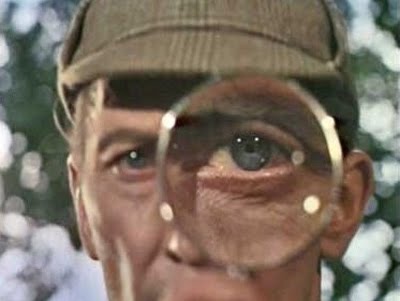
If memory serves me correctly, this is the first Sherlock Holmes film adaptation I had the fortune to see. As a young Sherlockian and rabid horror fan, it seemed perfectly natural that my beloved Hammer Horror would round up the usual suspects — director Terence Fisher and stars Peter Cushing and Christopher Lee — to adapt one of Conan Doyle's more horror-influenced tales. And though it remains the most adapted Conan Doyle story, this version is of historical interest because it was the first of any Holmes adaptation to be shot in color. Hammer’s trademark sense of Gothic style goes a long way towards bringing Conan Doyle’s suspenseful, and often richly detailed, world to life.

Unsurprisingly, The Hound of the Baskervilles has the same flavor as most of the Hammer Dracula films and is more representative of traditional Gothic horror than contemporary genre films replete with gore and brutality. This will not appeal to everyone, as it’s definitely a period piece, and though there are many scenes of suspense, nothing actually frightening occurs. The film is rich with a wonderful sense of atmosphere and is worth watching just for the typically beautiful Hammer setting with foggy moors, ancestral mansions, and the lovely if melancholic English countryside.

Though the villain is clearly not a homicidal ghost dog, I'm going to avoid spoilers, because the film's ending deviates in an interesting way from the novel. Most of the plot changes occur to spice up action and pace, giving it a more typical Hammer feel. Sir Henry is attacked by a tarantula — though this is normally one of my biggest pet peeves, the script offers a somewhat plausible explanation, as tarantulas don’t possess enough venom to do any damage to humans — and Holmes is nearly trapped in a cave-in while investigating, plus the ending is more violent than Conan Doyle’s somewhat wistful romantic conclusion.

Cushing and Lee are two of my favorite actors to see together and they are absolutely delightful here. Despite Hammer’s reliance on creating film series — as exemplified by Dracula, Frankenstein, The Mummy, the Karnstein trilogy, and so on — I’ve always been disappointed that there were no more followup films. I’m not quite sure what the explanation is, but it’s one of my biggest Hammer-related laments. Cushing's Holmes is similar to his Professor Van Helsing. He excels at playing asexual, aloof characters more interested in scientific procedure than human relationships. This was his first appearance as Holmes — he was apparently such a Holmes fanatic that his knowledge helped out on set — and he would later go on to star as the great detective in a long running TV series for the BBC. 

André Morell's Watson is calm and unaffected, generally more likable and less comic than other portrayals of Watson from the period. Though he’s warm and likable, he’s not quite able to keep up with the energy Cushing. And you might be surprised to see a young, but no less serious Christopher Lee as Sir Henry, the proud but persecuted victim. Unlike Cushing, Lee had less of an involvement with Conan Doyle’s famous character, but his turn as Mycroft Holmes in Billy Wilder’s excellent The Private Life of Sherlock Holmes is not to be missed.

There is a basic DVD available from MGM, which includes some nice, Lee-heavy special features. He gives a lengthy interview about his relationship with Peter Cushing and also reads excerpts from “The Hound of the Baskervilles" in his wonderful voice. Coming highly recommended, of course, The Hound of the Baskervilles is definitely an underrated effort, both as a Holmes adaptation and as a Hammer mystery/suspense/horror film.

Wednesday, February 10, 2016

THE DAMNED aka THESE ARE THE DAMNED


Joseph Losey, 1963
Starring: Oliver Reed, Macdonald Carey, Shirley Anne Field, Viveca Lindors

Simon, an American tourist on holiday in England, expresses interest in a young woman named Joan and gets mugged by her overprotective brother King — and his gang of motorcycle-riding miscreants — for his troubles. But Simon and Joan cross paths soon after and he convinces her to go on a date with him, a daytime boat ride. An enraged King pursues them and they flee over the sea to a strange island guarded by military personnel. They cross paths with cheerful, yet cold-skinned children who are obviously the product of some experiment. Can they escape King's jealous wrath, get away from the island, and save the children?

No, they can’t, because this is an apocalyptic sci-fi film, one of the very few produced by Hammer Studios. Known in the US as These are the Damned, this incredibly bizarre film is an inexplicable cross between apocalyptic sci-fi, romance-adventure, and the British Teddy Boy/youth gang subgenre. I still haven't really been able to wrap my brain around it, but fans of weird '60s cinema will definitely get a kick out of seeing Oliver Reed interact with radioactive children and struggle against his violently repressed sexuality. Which is not at all related to children, just to clear up confusion about what kind of movie we're dealing with.

This seemingly random sci-fi entry into the Hammer catalog bears some similarities with their horror/sci-fi mash-ups like the excellent Quatermass series. Though The Damned feels like it's made up of pages from ten different genre-themed scripts that were spliced together with someone to roughly fill in the gaps, it's actually based on H.L. Lawrence's 1960 novel The Children of Light. Despite the number of oddities and non-sequiturs going on, it's weirdly compelling and often succeeds despite itself. Of course it was (surprisingly) helmed by none other than Joseph Losey, then on exile in England after the disastrous Hollywood blacklist enforced by the House Un-American Activities Committee and Joseph McCarthy. Losey wound up making the majority of his films in England and though his name isn’t quite A-list, he’s a director you don’t want to pass up. Films like The Prowler (the film noir effort, not the slasher movie), The Servant, Mr. Klein, and others will be of interest for any genre cinema or cult movie fans.

Overall, The Damned fits loosely in the creepy children sub-genre. While a film like Village of the Damned (1960) might spring to mind as a likely influence, this has far more in common with David Cronenberg’s The Brood in the sense that it is a deeply weird film, and one that I could imagine Cronenberg himself remaking. There’s certainly something Ballardian at work and, perhaps curiously, J.G. Ballard had just began writing novels at this time: the apocalyptic disaster tale Wind From Nowhere (1961) and the post-apocalyptic sci-fi story The Drowned World (1962). The sense of inevitable, impending violence — and sexual terror — in The Damned is reminiscent of later Ballard novels like High Rise and Crash, while The Damned also captures the sense of a world being completely out of whack.

Some of The Damned’s characters could easily fit into a Ballard novel and seem unlikely protagonists (or antagonists) for an early ‘60s sci-fi film with themes of atomic terror. For starters, Oliver Reed’s character, King, would seem completely ridiculous if anyone else had been cast. Reed’s raving, violent, and incestuous gang leader becomes the film’s most interesting character, even as his actions become more and more improbable. Apparently the final version of the script toned down a lot of the more blatant incestuous references in the novel. Reed would find himself in a similar role several times in British horror, including in Hammer suspense film Paranoiac, made the same year, and the Lovecraftian The Shuttered Room (1967). Reed’s introduction — sitting in an idyllic square with his leather jacket wearing mates — is fittingly accompanied by an inane pop song with the lyrics, “Black leather, black leather, smash, smash, smash.”

To make matters even weirder, a side character — the Swedish sculptor Freya (played by Viveca Lindfors of Bell From Hell and Exorcist III), who is the mistress of an important scientist — develops a surprisingly weighty presence, as does her very weird art. The sculptures were apparently created by decorated real-life artist Elisabeth Frink, herself quite Ballardian. She belonged to the “Geometry of Fear” school and made eerie-looking sculptures of men and animals that do much to enhance The Damned’s cold, unforgiving, and loveless atmosphere. Of course this is also exemplified by the children themselves. Unlike the monsters of Village of the Damned, they are lonely and isolated. SPOILERS: They learn everything from a TV set in their classroom and are unable to receive any human affection or even contact without bestowing radiation sickness and ultimately death on their would-be guardians.

Subversive and often surreal, The Damned comes highly recommended, but will probably baffle a lot of viewers. If you enjoy unusual atomic horror or the novels of J.G. Ballard, or you’re just an Oliver Reed fanatic like me, this is definitely the film for you. The Damned is not available on a region 1 single disc as a stand alone film, though it has been fortunately restored to the original 96-minute print. It is included in the "Icons of Suspense" Collection from Hammer, along with Stop Me Before I Kill!, Cash on Demand, The Snorkel, Maniac, and Never Take Candy from a Stranger. There's also a region 2 DVD from Sony if you’re reading this from across the pond, with some utterly absurd cover art that makes it look like a low budget zombie film.