Showing posts with label Shaw Brothers. Show all posts

Wednesday, December 2, 2015

THE LEGEND OF THE 7 GOLDEN VAMPIRES

Roy Ward Baker and Chang Cheh, 1974
Starring: Peter Cushing, John Forbes-Robertson, David Chiang, Robin Stewart, Julie Ege

The Hight Priest of the Seven Golden Vampires, Kah, tracks down Dracula’s castle in Transylvania and asks the Count to go to China to help restore the glory of the once renowned Golden Vampires. Dracula agrees, but takes Kah’s form in order to travel undetected. Professor Van Helsing happens to be at Chungking University giving a lecture on Chinese vampire legends, in particular the story of the cult of the Golden Vampires. Hsi Ching, a student, tells Van Helsing the legend is true and that his grandfather is from the village terrorized by the Golden Vampires. Van Helsing agrees to accompany Hsi to his village and they are joined by Van Helsing’s son Leyland, Hsi’s seven brothers and one sister, and a young widow they rescued from the Tongs. They face off against six of the seven remaining vampires and a small army of the undead until Dracula arrives to raise the stakes. 

This is the ninth and final film in Hammer's Dracula series and, incredibly, it’s a coproduction with the Hong Kong-based studio Shaw Brothers, best known for their kung fu films. It’s amazing that this exists at all, but somehow it’s actually a delightful film and remains one of the most entertaining of the Dracula sequels. The returned of Peter Cushing’s Van Helsing — continuing from Dracula A.D. 1975 and The Satanic Rites of Dracula — is one of the film’s high points, though Christopher Lee’s absence as Dracula is conspicuous. This is the only time in Hammer history that Dracula was played by someone else (the character was absent completely from The Brides of Dracula), and in this case he’s briefly replaced by John Forbes-Robertson (The Vampire Lovers), though when Dracula takes the High Priest’s form, he’s played by the prolific Shen Chan (Five Fingers of Death, Cleopatra Jones and the Casino of Gold). Chan is obviously not Lee, but he’s captivating for his few scenes.

The film’s premise is every bit as ridiculous as it seems, but it’s also just as entertaining as you’d expect — especially if you’re a diehard fan of Shaw Brothers kung fu films. This unselfconscious blend of genres is played straight and legitimized by the always wonderful Cushing, who mostly leaves the kung fu fighting to trained professionals, but occasionally enters into the fray. I have a deep love for kung fu films, the Shaw Brothers in particular, and Legend of the 7 Golden Vampires certainly benefits from dual direction by Hammer’s Roy Ward Baker (A Night to Remember, Quatermass and the Pit) and Chang Cheh, one of Shaw’s most popular and talented directors. Chinese horror is also represented, so keep your eyes peeled for jiangshi, or hopping vampires.

Though I love it passionately, there’s no way to deny that the film has its flaws. Don Houghton returned after Dracula A.D. 1972 to pen a script that is a messy attempt to blend Hammer horror and kung fu tropes. He conveniently avoids continuity issues from The Satanic Rites of Dracula (itself a mashup of spy, sci-fi, and horror tropes) by simply setting Legend of the 7 Golden Vampires some time in the 1800s — sort of an alternate storyline adventure for Dracula and Van Helsing. Though there are some nice special effects from Les Bowie, a lot of the vampire make-up is dreadful, particularly Dracula’s at the start of the film. Dracula is barely present in this film, but it’s unclear if that’s a good or bad thing. Forbes-Robertson had some impossibly large shoes to fill, so perhaps it’s for the best that he was given little screen time. His few lines of dialogue are frankly appalling.

But there are plenty of things about that film that make it a worthy final entry in the series. There’s some great cinematography from Roy Fords and John Wilcox, particularly in the Chinese countryside. There are some very entertaining fight scenes between the Hsi family and the undead and anyone on the lookout for some martial arts won’t be disappointed. Probably the best thing about Legend of the 7 Golden Vampires is that it is wholly energetic and unafraid to simply be a campy, almost cartoonish kung fu-vampire-action-horor film. 

It comes pretty highly recommended, though my review should give you an idea of whether or not you’re the target audience. Anchor Bay released a nice DVD as part of their Hammer Horror collection. It includes The Legend of the 7 Golden Vampires and The Seven Brothers Meet Dracula, the sadly truncated U.S. version that no one needs to watch. There are a few special features, including a somewhat bizarre recording of Peter Cushing telling the film’s story with musical accompaniment and sound effects. Must be seen to be believed.

Thursday, April 5, 2012

THE 36TH CHAMBER OF SHAOLIN


Lau Kar Leung, 1978
Starring: Gordon Liu, Lo Lieh, Yung Liu Chia, Norman Chu

Shao lin san shi Liu Fang aka Shaolin Master Killer is one of the most beloved martial arts films of all time and helped launch the careers of star Gordon Liu and director Lau Kar Leung. San Te, a student, is swept up in the rebellion against the evil Manchus. When his friends and family are killed during an uprising, San Te heads for the closest Shaolin temple, determined to learn kung fu and avenge his father. Though the monks forbid revenge, he is accepted into the temple only because he almost died getting there and one of the elders takes pity. Eventually he begins his training through the thirty five chambers of the Shaolin temple, each teaching and honing a different skill. After five years, when he graduates, he is expelled for wanting to create a 36th chamber where he will teach common people to defend themselves. After accidentally defeating the evil Manchu leader, he begins his school and is accepted back into the temple.

With excellent direction by Lau Kar-Leung and lovely if functional cinematography by Huang Yeh-tai, this helped kick off Lau's long career for Shaw Brothers. Though initially fight choreographer for the great Chang Cheh and other non-Shaw works like Master of the Flying Guillotine, this is where Lau really came into his own. The film became so popular that it resulted in a trilogy and was followed by Return to the 36th Chamber, where Liu appears again in a new role. This was followed by Disciples of the 36th Chamber. All these films deal with the fictionalized character of real historical monk San Te, who was supposedly the first to teach kung fu outside the temple. Though the synopsis is not new and borrows from some of Chang Cheh films such as Shaolin Temple, this is likely due to Lau's long involvement as Chang's choreographer until he was promoted to director by Run Run Shaw. 36th Chamber includes themes that Lau would pursue throughout his career, namely the history of kung fu, the intellectualism and spirituality of fighting, and redemption rather than revenge.

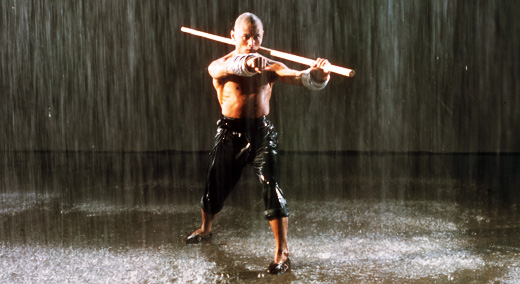
There is one reason and one reason only to watch the film and that is Gordon Liu. Also known as Lau Kar-Fai or Liu Chia-Hui (though born Xian Jinxi), he trained at Lau Cham's Hung Ga school until he rose to fame. Lau Cham was a student of the famous Wong Fei-hung and is also father to Lau Kar-Leung, making Lau and Liu adopted brothers in a loose sense. In one of Liu's earliest films, he actually starred as Wong Fei-hung in Challenge of the Masters. Liu's lean, bare-chested form complete with a monk's mandatory shaven head became a Shaw Brother's trademark image and guaranteed his future fame. Though his acting isn't the most mind blowing I've ever seen in a kung fu film, his naive, yet stubborn charm and ability to kick ass without actually kicking anyone's ass is one of a kind.

The film is innovative because it departs from the standard revenge plot in that it loosely follows this formula for the first third of the film, but completely discards this halfway through in favor of a more philosophical approach. San Te makes good on becoming a monk and though he does create the 36th chamber, he never becomes a killer. Because of this lofty intellectualism, at times this feels like a serious, humorless training film with little actual fighting and nary a drop of blood, but don't be misled. There is some excellent kung fu, particularly where weapons are concerned. Though Liu is the shining star, there are also some nice cameos. Lee Hoi San appears as a Shaolin Officer who effortlessly wields double blades and Wilson Tong is barely given a chance to show his skills as the ruthless leader of the Manchus. Lo Lieh is aged, but excellent as the evil General and manages to hold his own for most of the fighting scenes.

Be wary of which version you purchase or view on DVD. There's an earlier Crash Cinema DVD titled Shaolin Master Killer that is absolutely horrible. It has a terribly aged print and some of the worst English dubbing I have ever heard. It's the version I grew up watching, but please avoid it at all costs. The excellent Dragon Dynasty DVD is far superior with a beautifully restored transfer and Mandarin and Cantonese language tracks in addition to the English dub. There are some nice special features, namely an interesting -- if rambling and not particularly well-researched -- commentary by RZA and Andy Klein, a film critic. There's also a Dragon Dynasty Blu-ray disc that is similar to the DVD release, but allegedly this Blu-ray transfer does ShawScope little favors. Either way, the film is mandatory viewing for all fans of martial arts cinema.

Wednesday, April 4, 2012

THE MAGIC BLADE


Chor Yuen, 1976
Cast: Ti Lung, Lo Lieh, Tim Lei, Cheng Lee, Ha Ping, Guk Fung

Swordsmen Fu Hung Hsueh (Ti Lung) and Yen Nan-Fei (Lo Lieh) meet a year after their first fight for a final duel to the death. The stoic, lone wolf Fu and the showier, more boastful Yen put aside their differences mid-fight when Yen is attacked by a group of warriors. Fu is determined that he is the only one who will kill Yen, so they band together to hunt down and destroy the mysterious Yu, who is behind the attack. It seems Yu is an evil sorcerer in search of the legendary peacock dart, which will give him power over the underworld.

Fu and Yen race to find the peacock dart, which Fu takes in order to protect. Yu has the Peacock Mansion destroyed and one of the dart's young, beautiful protectors, Chiu Yu-Cheng (Cheng Lee) is forced to accompany the two swordsmen. Soon they are separated in order to protect the dart, Chiu gets kidnapped and Yen goes missing and is presumed dead. Fu fights Yu's bizarre and dangerous warriors to reclaim the dart and rescue Chiu, whom he has fallen in love with.

Though The Magic Blade is not in the upper tier of my favorite Shaw Brothers films, it is still well worth watching because of the odd, imaginative characters and twist-filled plot, which is based on a book by popular novelist Gu Long. I am at least partially biased against it because I prefer kung fu based Shaw Brothers films. My favorite swordplay epics are all Japanese chanbara, though Chang Cheh's One-Armed Swordsman, Tsui Hark's Zu: Warriors from the Magic Mountain, and Wong Kar-Wai's later Ashes of Time. Originally known as Tien ya ming yue dao, The Magic Blade is part swordplay film and part standard wuxia revenge plot, though it oddly has elements of Sergio Leone's spaghetti western films. There is a ghost town, a sandstorm, a stoic, lone hero wearing a poncho and a sympathetic prostitute, among other things. What's so odd about this influence is that Leone was directly inspired by Akira Kurosawa, master of the chanbara.

Though is a sword fighting epic, there is nothing typical about the excellent choreography from Tang Chia. Though Fu is a swordsmen, he carries an interesting weapon that appears to be a machete-like sword that unlocks and spins with devastating affect. The fight scenes usually result from bizarre situations or involve Fu and Yen interacting with the oddest of villains. While all of Yu's top five killers have a specific theme and matching weapon, the best and most horrifying is an old woman known as Devil's Grandma (Ha Ping). She is witch-like, drinks blood, eats human flesh, hopes to bake our heroes into a pie and her food cart is stocked with exploding Thunder Bullets and hidden warriors. There is a surprisingly high number of female fighters in The Magic Blade, all of them evil. We even get a nice appearance from Lily Li, who has the best death scene in the film. There is also a backstabbing, transgendered assassin and the remaining villains are all outrageously costumed and brightly colored. The level of violence is surprisingly high as is the completely unexpected nudity.

Another strong point for The Magic Blade is that it is colorful and lovely to look. The cinematography is imaginative and there are a number of beautiful set pieces including a ghost town, a human-sized chess board, a tea-house full of dead patrons, the lovely Peacock Mansion and many other fantastical locales.

My least favorite part of the film were the two leads, Ti Lung as Fu and Lo Lieh as Yen. Though both actors appeared in a number of well-acclaimed Shaw films, I found Ti Lung flat and Lo Lieh unlikable. Part of the fault undoubtedly lies with the writing, which also makes Fu and Yen near invincible during the increasingly ridiculous fight scenes. The love story between Chiu and Fu is a also trite and annoying, but serves the plot. The odd erotic flavor to the film is jarring, probably because it is infrequently used. Fu's evil ex-girlfriend tries to seduce him to the dark side, there is a poor, sick girl willing to prostitute herself and a nonsensical lesbian shot that is completely disjointed from the rest of the film. Aside from this, the other plot-related non-sequitors and absurd twists felt surprisingly natural, due to the fantastic and eccentric elements that kick off the film.

Overall I recommend The Magic Blade as a worthy, entertaining installment in their long line of successful wuxia films. Image released it on region 1 DVD and did a wonderful job with the transfer, which looks too perfect to be from the '70s. There is fortunately a Mandarin language track and English subtitles, as well as a good number of trailers.

See this for Devil Grandma alone.

CRIPPLED AVENGERS


Chang Cheh, 1978
Starring: Kuo Chui, Lu Feng, Lo Meng, Chiang Sheng, Sun Chien, Wang Lung Wei

I've been on a huge Shaw Brothers kick lately and despite some of the truly great films I've seen, Crippled Avengers might just be my favorite. Released in the U.S. as Return of the 5 Deadly Venoms, this is not a sequel to Five Deadly Venoms; rather it is the return of the Venom Mob actors, comprised of hero Kuo Chui, acrobat Chiang Sheng, Tae Kawn Do expert Sun Chien, strongman Lo Meng, and weapons expert/villain Lu Feng. There are over 20 Venom Mob films produced by the Shaw Brothers including Invincible Shaolin and The Kid with the Golden Arm. This group of actors trained together at the Peking Opera School as children and were eventually discovered by Chang Cheh and hired by the Shaw Brothers. They represent some of the best choreography, acrobatics, and acting in the Shaw Brothers martial arts films.


When the Tinan Tigers kill kung fu master Dao Tian-du's wife and maim his son (Lu Feng), he becomes bitter and vengeful. He trains his son in martial arts and has a pair of iron hands made for him that can extend and shoot knives. After the two complete their vengeance on the Tigers, killing them and their children, Dao and his son rule the local town with cruelty and violence. A traveler (Kuo Chui) speaks out against them and is blinded for his efforts. A blacksmith (Lo Meng) also curses Dao and is forced to drink a potion that makes him mute, then has his ear drums ruptured when he continues to rebel. Another man (Sun Chien) has his legs cut off when he bumps into Dao's son accidentally. The three crippled men join together in an attempt to survive. Dao foils this plan when he declares that the townspeople cannot go to the blacksmith and all three men are pariahs.

A passing kung fu student, Wang (Chiang Sheng), attempts to get vengeance for the three men, but is tortured to idiocy by Dao. He still knows kung fu, but is incapable of thinking or caring for himself. The three crippled men learn that he is the student of a local kung fu master. The four travel to the school and Wang's master takes pity on them and promises to teach them enough kung fu to avenge themselves against Dao. After three years of difficult training, the four men return to town, determined to defeat Dao and his son once and for all. The blind traveler and deaf blacksmith have fine-tuned their other senses and the blacksmith has made iron legs for the third man. They best Dao's second-in-command, Wei, and his nearly invincible brother Chu, then prepare for the final showdown at Dao's obstacle course-like mansion.

Also known as Mortal Combat, the real reason to watch this film is because of the excellent choreography by Robert Tai, Lu Feng, and Chiang Sheng. Though Lu Feng isn't used very much as Dao's handicapped, vicious son with iron hands, Chiang Sheng steals the film as both the comic relief and the most graceful and acrobatic of all the actors. He is also surprisingly good as the idiot Wang, adding an element of chaos into an otherwise traditional revenge narrative. The final battle with Chiang Sheng, Kuo Chui, a handful of metal rings, and Lu Feng is truly a sight to behold.

The other Venoms are also worth watching, particularly the pair of Kuo Chui and Lo Meng, blind and deaf fighters who team up to support one another in a hostile world and to kick some serious ass. The usually deadpan Lo Meng has an almost comic role, as he is forced to pantomime or write out all his dialogue, and continues to curse Dao even when he can no longer speak. "Everyone is cursing you!" The relationship between Lo Meng's deaf blacksmith and Kuo Chui's blind traveler is also an interesting example of male bonding in action cinema, as the two hold hands to communicate or guide one another throughout most of the film. Sun Chien is unfortunately left out in the cold and only appears a handful of times to deliver some truly brutal kicks with his iron legs. The villains are utterly ridiculous, but there are a few nice fight sequences with Wang Lung-Wei, who appears as Dao's second-in-command and fights with one of my favorite weapons, the meteor hammer.

The idea of disabled fighters began with Japanese chanbara films, which are samurai-themed period pieces usually set during the Tokugawa period. They deal with violent action and frequently troubled heroes. The Zatoichi films and their titular blind samurai were an obvious influence on Chang Cheh, who has several films with disabled martial artists, such as The One-Armed Swordsman series. The inclusion of four disabled heroes gives Crippled Avengers a blackly comic, bizarre, and almost exploitative feel. Though there is a clever script by Chang Cheh, a lot of the dialogue comes across as outrageous, but somehow works for the film and not against it. Partly this is bolstered by the non-stop action and pacing that increasingly speeds up towards the film's inevitable conclusion.

Though there are constant fisticuffs, a lot of mutilation, and much maiming, there is little bloodshed in the film. The kung fu feels more balletic that in slower, more inferior films and carries Crippled Avengers past occasionally funny dialogue and questionable special effects. I highly recommend Can Que (Incomplete), which is its original title. The Weinstein Brothers/Celestial Pictures DVD released for region 1 as Return of the 5 Deadly Venoms is excellent. There is finally a Mandarin audio track with English subtitles, though the English dubbed track is also available. The picture has been beautifully restored and given a true NTSC transfer.

A note: Please don't mistake this for Crippled Masters, which is a 1979 Joe Law film that includes two actually disabled kung fu warriors fighting against their evil teacher.

Sunday, June 12, 2011

MIGHTY PEKING MAN


Meng Hua Ho, 1978
Starring: Evelyne Kraft, Danny Lee, Feng Ku, Wei Tu Lin

Though Mighty Peking Man aka Xing Xing Wang aka Goliathon aka Colossus of the Congo is absurd and flawed, I absolutely loved it. I'm sure the Shaw Brothers have made a film I dislike, but this attempt to cash in on the '70s King Kong remake isn't it.

A heartbroken adventurer, Johnny (Danny Lee), is enticed to track a giant ape through the jungles of India. He discovers that it has been raising and protecting a human woman, Samantha (Evelyne Kraft), who survived a plane crash as a child. Johnny and Samantha fall in love and he convinces her to bring Utan, the giant ape, to Hong Kong. Of course everything that could go wrong does. A sleazy promoter displays Utan in chains and attempts to forcibly put the moves on Samantha. Johnny goes back to his ridiculous ex-girlfriend and Samantha and Utan are left to fend for themselves. Predictably, Utan goes on a mad rampage in his attempts to free Samantha and keep her from harm. Watch out, Hong Kong.

Mighty Peking Man is trashy, funny, full of sexual innuendo and even has a few tearjerker moments. Plus, LOTS of stuff gets smashed. There's a monster, a babe, and an action hero. What more could you want? Be forewarned that, like much of its cinematic brethren, this movie is about as un-PC as it gets. I found the numerous visual references to a sexual relationship between Samantha and Utan hilarious, but I'm sure it will offend someone. Plus, there are obvious connections between Samantha and Utan as equally exploited objects of otherness. It's kind of amazing to see the rampant pro-Asian racism at the heart of the film -- namely that Samantha is constantly reduced to a sexual object, as she can't really speak for most of the film and refuses to wear clothes -- and to add insult to injury, is eventually abandoned for a well-dressed, well-spoken, and otherwise more civilized Chinese woman who wants a wedding and not just a roll in the hay.

Thanks to Quentin Tarantino, it got released on region 1 DVD through his Rolling Thunder label. For fans of exploitation, King Kong, kaiju and, honestly, for anyone with a good sense of humor.