Showing posts with label Peter Greenaway. Show all posts

Thursday, April 26, 2012

DROWNING BY NUMBERS


Peter Greenaway, 1988
Starring: Joan Plowright, Juliet Stevenson, Joely Richardson, Bernard Hill, Jason Edwards

Though this begins as one of Greenaway's most whimsical films, it surprisingly ends as one of his most misanthropic. Drowning by Numbers opens with a girl jumping rope and counting the names of stars up to number 100. It quickly moves to the elder Cissie Colpitts (Plowright), who drowns her drunk, adulterous husband in the bath while he is having a tryst with a younger woman in their home. She informs her daughter, also named Cissie Colpitts (Stevenson), and another younger Cissie Colpitts (Richardson), who may be her granddaughter or niece. They enlist the aid of Madgett (Hill), the love-starved coroner, to help them cover up the murder and ensure an accidental death certificate.

Things begin to spiral out of hand when Cissie #2 drowns her distracted, sexually-unfulfilling husband in the ocean when she realizes he has gotten too fat to swim properly. Madgett is forced to help them again, but makes it clear he expects a sexual exchange as part of the bargain. After the youngest Cissie marries her boyfriend and he threatens to reveal their crimes, she drowns him in the local pool while giving him swimming lessons. Madgett helps them again, but grows more demanding. Meanwhile, his eccentric son Smut, who alternates between making up elaborate games and obsessively counting everything, is growing more out of touch with reality.

Drowning by Numbers is a blackly comic, surreal blend of Greenaway's other films The Draughtsman's Contract and A Zed and Two Noughts. Like Draughtsman, this film returns to the quaint, countryside murder mystery and is populated by some thoroughly British characters. Like Zed, it is bursting with a barrage of lush, colorful visuals and a haunting, if repetitive score by Michael Nyman, which is based on Mozart's Sinfonia Concertante in E flat, earlier used in Greenaway's The Falls. This enjoyable and endearing film is also Greenaway's most direct confrontation between the sexes, though many of his works visit the concept of women rising up against their oppressive male counterparts. Part fairy tale, part encyclopedia, and part game, Drowning by Numbers is a good place to start for anyone interested in Greenaway's works but unfamiliar with his overall experimental style.

This is also the most pastoral of Greenaway's films. Though several of his other movies concern gardens, the Suffolk countryside is shot with dizzying beauty by the great Sacha Vierny. Though it lacks the grandiose set pieces and elaborate costumes of earlier films, the lush countryside and elaborate games more than make up for this. The opening scene is shot at a house that borders an apple orchard and the detail is overwhelming. Like A Zed and Two Noughts, the rich color and obsessive detail is enhanced by careful lighting techniques. Greenaway states that he and Vierny used multiple sources of artificial light, so that very few shadows appear in the film and that "this often produced a surreal effect of trying to compete with God on his own lighting scheme." The usual careful framing is also present, borrowing visuals from Fellini's group shots, Lewis Carroll's game sequences, and Greenaway's usual nods to Dutch masters. Keep an eye out for Bruegel's "Children's Games," which makes an appearance.

Like Greenaway's other works, this is a film rife with themes. Numbers are of primary importance. This is introduced in the bizarre, anxious opening scene with the girl in the starred dressed counting to one hundred while she jumps rope. Smut counts and numbers everything with obsessive detail. This seems to stem from his father Madgett, who puts particular importance on the rules and numbering systems of his made up games and keeps a herd of sheep around because counting them brings him pleasure. If you pay close attention, numbers 1 to 100 are included on props throughout the film, though some are easier to spot than others. Three is of primary importance to both myth and fairytale and the three Colpitt women easily correspond to the three fates. The larger framework with its imaginative childhood games is also reminiscent of the "Three Billy Goats Gruff" story told in reverse. The three goats taunting the bridge troll are the three Colpitt women distracting the hairy, satyr-like Madgett from sexual conquest until they trick him to get what they want.

Sex is a major component of the film. In this film it is mercenary, manipulative, and un-erotic, but can also be an act of love and intimacy. In either case the frequent nudity feels normal and not exploitative, though it is usually quite graphic. As in The Draughtsman's Contract, there are references to fruit and gardens, but instead of Greenaway's frequent references to pregnancy and inheritance in some of his other works, there is the frequent mention of necrophilia. Water is almost constantly present and is symbolic of women, namely the three Colpitts, and constantly separates them from the men in the film. 

Though there is almost nothing about Drowning by Numbers that I personally dislike, several things might be jarring for unseasoned Greenaway viewers. For instance, there are many moments that seem to be absurd for the sake of it and make no connection to the larger narrative or symbolism of the film. There is also rampant misanthropy at work, which is unsettling in a film that begins full of childhood imagination, whimsy, and fairy tale leanings. It is clear that there is a distinctly derogatory view of men, who are all either fat, lazy, selfish, aimless dreamers, sex-crazed, or outright cruel. As a whole their stupidity saves none of them from the Colpitt women who first seemed pleasant but eventually allow their manipulative, sociopathic, and casually murderous intentions to be revealed. Regardless of this, like so many of Greenaway's other films, multiple viewings are both necessary and pleasurable.

This film comes recommended, though it is an acquired taste. It won an award for Best Artistic Contribution at Cannes in 1988. Drowning by Numbers is unfortunately unavailable on DVD. As far as I can tell, there has never been a region 1 DVD, only a VHS tape. There is a very out of print FilmFour region 0 DVD, which I am reviewing. It has a dark, somewhat muddy print and no extras other than a trailer. I believe this print is from an Australian source, like several other unavailable Greenaway films. There's an available region 2 Danish DVD, but it has the same dark print as the FilmFour release. For the desperate, there's also an 8-disc Australian region 0 boxset from Umbrella than contains 7 of Greenaway's early films, including this one, and a special features disc.

Sunday, April 8, 2012

THE BELLY OF AN ARCHITECT


Peter Greenaway, 1987
Starring: Brian Dennehy, Chloe Webb, Lambert Wilson, Sergio Fantoni, Stefania Casini

Though this is one of Greenaway's most acclaimed films, it is not one of my favorites. Ironically, the first time I saw it I suffered from a nasty bout of food poisoning and watched it three times in a row, because I simply could not do anything else. Chicago-based Architect Stourley Kracklite travels to Rome to build an exhibition for forgotten French architect Etienne-Louis Boullée. He brings his wife Louisa, whom he neglects due to his obsession with the project and his increasing stomach troubles. He suspects she is poisoning him with figs, like Augustus's wife Livia was believed to have done so many centuries before. In reality, he has a terminal case of stomach cancer that comes to ruin his professional and domestic life. Louisa, who is newly pregnant, leaves him for his Italian exhibit partner, Caspasian Speckler. Speckler's charm and financial success allows him to eventually gain control of the exhibit, though he is stealing funds to rebuild a monument to Mussolini. As Kracklite's health deteriorates, he begins to write postcards to Boullée and sinks further into madness.

This wildly alienating film is worth watching for two reasons. First, there is an unexpectedly powerful, sympathetic performance from Brian Dennehy, whose character has a touch of Lear about him and struggles futilely against age, illness, and a sort of symbolic impotence. He fails at reproduction, creatively, professionally, domestically, and biologically. His wife's previous pregnancies have resulted in miscarriage and the current, healthy child will be raised by another man. He is left alone to constantly reproduce images of stomachs and statues on a photocopier.

The second reason to see this is for the always stunningly lovely cinematography by Sacha Vierny. The film is full of the traditional painterly tableau-inspired long shots Greenaway favors, as well as many scenes carefully framed by windows, doorways and impressive architecture. The rich colors and textures are balanced by constant images of photocopies, architectural plans and drawings. In much of the film the actors are crushed by claustrophobic shots of massive Roman buildings made of sepulchral white marble. As always, the colors and schematics recall Renaissance painters, but instead of being distractingly beautiful, the landscape feels cold and oppressive. There is also an odd biological symbolism with constant shots of stomachs, antiquated statues and smooth domed buildings that juxtapose Kracklite's sick stomach and his wife's pregnant one.

The Belly of an Architect shares some similar themes with earlier Greenaway films. There is a focus on food and the stomach, though this time the latter is in the forefront. There are many scenes framed around important meals and some are organized to resemble Da Vinci's Last Supper. There is the continuing importance of sex, death, pregnancy, legacy, art, ownership, and obsession. As in all of his films thus far, permanence and mortality play an important role in the plot. Visually, there is a barrage of still shots of photographs, letters, drawings, and architectural plans, representing the need to control and organize. Regardless of the setting, Greenaway's films are obsessed with order and symmetry and there is no exception here despite the beautiful Roman statuary and architecture. And as in all Greenaway's films, the soundtrack is lovely and fitting. Glenn Branca and Wim Mertens provide minimal, repetitive themes that cut back and forth between rich piano compositions and anxiety-inducing string pieces.

My biggest complaint are the performances. Aside from Dennehy, the other actors pale in comparison, particularly the insufferable Chloë Webb (Sid and Nancy). Between her awful accent, monotone style of speaking and limited dialogue, she simply cannot carry the role of Louisa. She has barely any scenes in the second half of the film, which is a relief. The other actors are given little screen time and few individualizing qualities. All of them are filmed in long shots, so it is occasionally hard to discern one black-suited, aged Italian from another. The pace can be plodding, with frequent repetitive blocks of xeroxed stomachs and Roman architecture. This is also one occasion in Greenaway's work where the long shots do not do him any favors dramatically.

Regardless of its flaws, The Belly of an Architect is still worth seeing, if only for Dennehy's surprising performance and, after all, was nominated for the Palme d'Or at Cannes that year. There is a serviceable MGM DVD that sadly doesn't hold a candle to the recent Zeitgeist releases. Shame they couldn't get the rights. The transfer does not seem cleaned up at all, which makes it difficult to get a close look at actors other than Dennehy and in darker scenes there is an unfortunate lack of detail. The sound is poorly mixed with the score drowning everything out on occasion. Luckily there is a BFI region 2 Blu-ray/DVD on the horizon and I would recommend waiting until this print is released in June, especially if you have a region free Blu-ray player.

Saturday, April 7, 2012

THE FALLS


Peter Greenaway, 1980
Starring: Peter Westley, Aad Wirtz, Michael Murray

“I’d rather be pecked to death by penguins.”

Greenaway's first feature film lacks a typical narrative structure and is instead a three and a half hour satirical documentary made up of 92 parts of varying length. After suffering the worldwide VUE, "Violent Unknown Event," many survivors developed common symptoms resulting in internal and external ailments, mutations, obsessions with birds and flight, persistent dreams of water, knowledge of new languages, agelessness and immortality, though they are still susceptible to injury and certain diseases.The Falls is a small section of a fictional directory compiled of biographical information from all the survivors of the VUE and the 92 entries correspond to persons with last names beginning with "F-A-L-L." Some of the entries are cross references, refer to organizations like the VUE Commission, discuss the role of birds or flight in the VUE, or relate fictional stories by the author Tulse Luper, a character who would show up again later in Greenaway's multimedia multi-film series The Tulse Luper Suitcases.

The Falls is truly a breathtaking, inspired experiment and I'm surprised to find that it is quickly becoming one of my favorite Greenaway films. You don't have to watch it in any particular order, nor do you have to endure all three and a half hours in one sitting, an endeavor that is painful and rewarding in equal parts. Fans of Pynchon, Nabokov, Vonnegut, Borges, Marquez, Kafka, and Lewis Carroll will no doubt enjoy it, though The Falls bears a particular resemblance to some of the more absurd humor found in Monty Python. There are large doses of surrealism, social satire, and magic realism. Those who love experimental cinema should keep an eye out for an appearance from the Brothers Quay, who star as twins Ipson and Pulat Fallari in one of my favorite reoccurring story lines.

Thematically, The Falls is most concerned with birds and flight. There are multiple layers of references to Hitchcock's The Birds, ornithology, and bird mythology from around the word, namely the story of Icarus and Daedalus. Communication and language also has primary importance and the film is full of made up languages that resulted from the VUE. As in Greenaway's later works, he is concerned with list making, collecting, organizing, anecdotes and story telling and the blurring of fact and fiction. The incredibly inventive, well written vignettes help the lengthy running time speed by and allow viewers to remember characters and plot details and develop a connection to a story that only emerges through the brie, scattered fragments. The film is put together with still photographs, stock footage, documents, drawings and graphs. Like the later Tulse Luper Suitcases, it feels more like a multimedia adventure than a feature length film.

Though it is humorous and satirical, the film is also concerned with a cosmic, chaotic kind of terror that waits around the corner in the guise of war, disease and unexpected violent events. Communication breaks down on every level, leading to both the tragic and the comic. In a thoroughly British way, it mocks bureaucracies and the futile attempt to organize information and reality.

There is an excellent score comprised of music by Michael Nyman, Greenaway's regular collaborator, as well as songs from Brian Eno, John Hyde, and jazz musician Keith Pendlebury, who appears in the film. "Golden Hours" from Eno's excellent album Another Green World is featured repeatedly, as is "Jugband Blues" from Pink Floyd's final Syd Barrett album, Saucerful of Secrets. There is also a reoccurring adaptation of the second movement of Mozart’s Sinfonia Concertante for Violin, Viola and Orchestra in E Flat Major, which is used again in the later Drowning by Numbers.

The Falls received a British Film Institute Award and is a dazzlingly creative, rewarding work that will be particularly beloved by those who enjoy lists, word games, puns, literary jokes, and absurd humor with deadpan delivery. The Falls is available on DVD from Zeitgeist as part of their Early Greenaway collection. There is a single disc DVD that contains The Falls and Vertical Features Remake, as well as the two disc set with a second disc featuring several of Greenaway's experimental shorts and a number of special features. Though The Falls is surely an acquired taste it comes with the highest recommendation.

Tuesday, June 14, 2011

THE PILLOW BOOK

Peter Greenaway, 1996
Starring: Vivian Wu, Ewan McGregor, Yoshi Oida, Ken Ogata

I passionately love Peter Greenaway. A lot of his earlier films are on my list of favorites, particularly
The Draughtsman's Contract, A Zed and Two Nought, and The Cook, the Thief, His Wife & Her Lover. While The Pillow Book doesn't quite fit into this category, it's still a solid entry in Greenaway's canon.

The half-Chinese, half-Japanese Nagiko (Wu) was raised in a traditional Japanese family, where she was expected to be a submissive young woman, marry, and effectively transfer ownership of herself from her father to her husband. Early on, her artist father instilled a deep love of calligraphy in her, so deep a love that it has become more of a sexual fetish than an artistic appreciation. Under her aunt's influence, she also develops a love of pleasure and begins keeping a diary of her lovers, known as a pillow book, which is based on
Makura no Soshi (translated as Pillow Book), the famous diary kept by eleventh century Japanese court lady Sei Shonagon. Basically a pillow book is a poetic collection of notebooks that details a person's private life and, in the case of Shonagon, develops into an interesting and pertinent historical document.

When Nagiko openly fights with her husband, he discovers, reads and destroys her pillow book, prompting her to leave him and her traditional life forever. She moves to Hong Kong and supports herself by becoming a secretary, then a model, known for her beauty, free spirit, bad temper, and love of calligraphy. Soon Nagiko meets Jerome (McGregor), a beautiful, multi-lingual British translator. She dares him to write on her body, but he does a poor job. Nonplussed, Jerome challenges her to write on his body, but she balks and walks out. She is intrigued despite herself and begins to incorporate this into her sexual affairs. A Japanese photographer, Hoki, becomes infatuated with her. Though she refuses to take him as a lover, he convinces her to explore the possibility that she should compose a novel, though it later gets rejected by a publisher. Angrily determined, Nagiko discovers that Jerome is the publisher's lover and assistant. She seduces him, but quickly develops feelings for him. Jerome's calligraphy and language skills have improved and Nagiko realizes she has found a perfect match. She tells Jerome the truth and he is delighted to help her get published.

At this point the film splits into a series of chapters, one for every chapter of her book, which Jerome decides will be written out on his skin and then sent to the callous publisher. He is delighted and has her unique, beautiful book copied out and published. He demands a few nights of pleasure from Jerome as part of the deal, but when Jerome loses track of time and doesn't return to Nagiko when promised, she takes it as an extreme betrayal. She begins to write the next few books on other men, which makes Jerome insanely jealous. She refuses to see him or speak to him. Hoki suggests that he fake his own death, a la Romeo and Juliet, to spark Nagiko's interest and frighten her. Hoki gives him some pills and he stages a dramatic scene at her home. He begins to write a long letter to her and loses track of the pills he has taken: one for every page.

When she returns home, ready to forgive him, it is too late. Jerome has overdosed and Nagiko is devastated. She writes the sixth book, The Book of the Lovers, on his dead body. After his funeral, the publisher has him secretly exhumed and flayed, so he can create a pillow book from Jerome's skin.* She is horrified and becomes determined to possess the book. Still an anonymous author, she offers to trade the publisher the missing books for Jerome's skin. He agrees and a series of messengers, all bearing more artistically dramatic versions of the books, appear to him. Meanwhile, Nagiko realizes she is pregnant with Jerome's child. In the thirteenth and final book, she reveals her identity and accuses the publisher of his many crimes, including those against her father, her Japanese husband who he influenced and corrupted, and Jerome. Deeply shamed, he gives her the pillow book and kills himself. Nagiko buries Jerome under a bonsai tree and gives birth to their child.

There are a lot of beautiful things about The Pillow Book. The obsession with writing, beauty, books, and pleasure all struck a chord with me. The love for and expression of eroticism trails throughout Greenaway's films and is the main focus of many of them. I also enjoyed the artful, diverse use of language. Most of the characters are multi-lingual and explore their identities by using different written and spoken languages. It is appropriate that the film is set in Hong Kong, as it geographically unites the merging of Nagiko's Chinese and Japanese body with Jerome's British one, as well as the love both have for the exploration of multiple cultures and languages.

I really did enjoy this film, but it is deeply flawed. Greenaway simply tries to do too many things at once and the story would be better serviced in a mixed media style novel rather than a film. He tries to incorporate the art of Japanese calligraphy, which takes enough time to explain, as well as the history of Sei Shonagon and Makura no Soshi, which provides a critical current for the film and Nagiko's personal development and goals. The Hong Kong photography and modeling world is another backdrop, as well as books, writing, and the publishing world. All of these are critical to the film, but the plot is slowed to a crawl by constant exposition.

Greenaway also treads some dangerous ground with his wanton mixing of Asian culture and iconography, leaping back and forth between Japanese and Chinese imagery. Though I haven't read a lot of academic criticism of this film, I can see the giant, red danger light it will likely set off for many film scholars. A white, British director writing a film about a Chinese-Japanese woman is a little risky and he doesn't handle it as well as he could. Casual audiences will likely not care about this, but the level of exoticism is distracting, particularly when he uses long segments early in the film to do strange montages of Asian cultural imagery.

The plot is also needlessly complicated and meandering. I enjoy his frequent rejection of strict narrative structure, but I think it would be better served with a much shorter introduction. The core of the film is Nagiko's relationship with Jerome, the sexualized calligraphy, and the series of dramatic events that occur around the books she is writing. How she gets to this point is important, but doesn't need the drawn out opening sequence it is given. The narration is also tedious. It gives the film a diary-like quality that I love and appreciate, but there is rather a lot of narration and a lot of exposition. Character is another issue. What I can't stand about Shakespeare's Romeo and Juliet is the same thing I hate about The Pillow Book. Selfish characters make stupid mistakes, turning a simple situation into a ridiculously dramatic one, which makes the potential tragedy seem more like a farce. In some ways Nagiko and Jerome are able to transcend the spoiled, selfish teenage tropes that Romeo and Juliet embody and these are the best parts of the film.

Greenaway, even at his most masturbatory and pretentious, always makes me think critically about the use of certain themes in film and in my own life. I think he beautifully captures the selfish impulse of artistic and intelligent people that, though dramatized in a work of fiction, also exists in real life. Because Nagiko initially is different and doesn't adapt to socially prescribed roles, she gains a level of self-preservation that evolves into utter selfishness and keeps her disconnected from real emotional relationships, at least until she meets Jerome. Jerome, unfortunately, is mostly a cipher for Nagiko's character development. His own selfishness, drama, and need for attention is his downfall and gives him an element of complexity. Nagiko is able to spin his needless destruction and her deep grief to a positive conclusion that constructively changes her life and the lives of people around her. Though there is no way I find the publisher's suicide believable.

The film is visually beautiful and worth watching because of the lovely imagery and direction. Though the soundtrack has a very '90s feel, I also enjoyed it and thought it was perfect for the film. I generally like Vivian Wu, but she was flat in this role, though that is probably the fault of the writing. Ewan McGregor, young, beautiful, and fearless, was a joy to watch, as always. I'm reviewing the Sony single-disc DVD, which, as far as I know, is the only one available in region 1. Greenaway's work is difficult to find for American audiences, though Zeitgeist has happily been changing that in the last two years. Film connoisseurs and collectors will likely be annoyed by the changing image size, which is due to the fact that the film was shot in different aspect ratios. Regular genre fans and more conventional film viewers will also probably be thrown by the constantly changing languages - English, Japanese, Chinese, French, etc. But if you can't keep up with the language changes, this is probably not a film for you in the first place.

*A note on skin flaying. This needs a certain amount of explanation for Western audiences. Skin flaying, particularly anthropodermic bibliopegy, the practice of making books from human skin, has long been associated with the worst kind of punishment in the West. Flaying was a way of taking war trophies from defeated foes and was a common punishment for traitors in medieval and early modern France. Foucault's wonderful Discipline and Punish talks about this happening up to the eighteenth century. Everyone has heard of the rumored lampshades and books the Nazis made from some of their Jewish victims. This has a different connotation in Japanese history. Flaying has never been a popular means of capital punishment. Irezumi, a specific type of Japanese tattooing, usually done by hand instead of machine, is paradoxically considered a serious art form that has well-established masters, but is currently associated with the yakuza. It has had different fads in Japanese society, starting out as a means of punishment, but was briefly popular in the Imperial court for decoration or between lovers. Irezumi, in the elaborate form we now know it, developed in the Edo period and gradually became a traditional art form. It isn't a terribly common practice, but throughout the last few centuries a number of these tattoos have been preserved, collected and displayed by irezumi masters and members of the Japanese aristocracy. It's exactly how it sounds. Dead men are flayed, which is apparently another old Japanese art that has been passed down to doctors by word of mouth, and their beautifully tattooed skin is preserved and framed for private collections. Currently Tokyo University's medical museum has the largest collection of these, though I'm pretty sure it is not open to the public. On the other hand, if you want to see some books bound in human skin, you can visit University of Pennsylvania's rare books library, though I believe you need an appointment. If you're travelling in New England, they have a sizable collection at Brown and a few at Harvard.

THE DRAUGHTSMAN'S CONTRACT


1982, Peter Greenaway
Starring: Anthony Higgins, Janet Suzman, Anne-Louise Lambert, Hugh Fraser, Neil Cunningham

The Draughtsman's Contract is director Peter Greenaway's second feature-length film and his first straightforward narrative work after many years of doing only experimental shorts or documentaries. The film is loosely a country house murder mystery set in 17th century England. A draughtsman, Mr. Neville (Higgins), is hired by Mrs. Herbert (Suzman) to do 12 landscape drawings of her husband's estate in the 12 days that the estranged Mr. Herbert will be out of town. Initially not wanting to take the commission, the arrogant Neville charges an exorbitant price and demands 12 sexual encounters with Mrs. Herbert. To his surprise, she agrees, though it is clear throughout the encounters that Mrs. Herbert is either uncomfortable or directly unwilling, a fact Mr. Neville ignores.

Despite his distaste for the other members of her family, Mrs. Herbert's daughter, Mrs. Talmann, strikes up the same sexual arrangement with Neville that he has with her mother. She blackmails him because curious things turn up in his drawings and she suggests these are clues to the murder of her father, though Neville insists that Mr. Herbert is only out of town. Soon his body is discovered in the moat, Neville's contract is up, and he leaves the house. Unfortunately for him, his passion for Mrs. Herbert causes him to return and make a thirteenth drawing of the site where Mr. Herbert's body was found. While drawing, Mr. Talmann and the other men of the neighborhood appear in disguise and accuse him of Mr. Herbert's murder. He denies it, but they burn his eyes out and beat him to death, throwing him in the moat where the first body was discovered.

Notably the film lacks a denouement and refuses to provide the resolution characteristic of mysteries. It is clear that Mrs. Herbert and her daughter planned the murder, possibly with the help of the gardener. The estate initially belonged to Mrs. Herbert, whose only heir, Mrs. Talmann, was childless probably due to the impotency of her husband. Both women agreed to a sexual relationship with Neville in order to produce an heir and, presumably, to have a lower class scapegoat for the murder of Mr. Herbert. The 1694 setting is particularly important to this element of the story, as it was the year of the Married Women's Property Act during the reign of William and Mary. Though Mrs. Herbert and her daughter feel like decorative pawns for most of the film, they have been manipulating and maneuvering the male characters all along.

The period setting intensifies the carefully measured formalism of the film. Though this is well illustrated by Michael Nyman's excellent Henry Purcell-influenced score, cinematography by Curtis Clark is the heart of the film. There is a stark contrast between the lush, bright gardens and the dark, candlelit interiors. The film is basically color coded in black and white, plus the bright green of the exterior landscape. The characters all dress in exaggerated black or white costumes. For most of the film the aristocracy is in white and Neville is in black, though this is reversed for the final scene, symbolically positioning him as an eternal outsider. The visuals assure us that this is definitely a Greenaway work. Artistic references abound, particularly to paintings by Rembrant, Vermeer and Caravaggio, something Greenaway returns to in later work. The mostly static cinematography and constant framing, both with and without Neville's drawing grid, make the film seem like a series of painted tableaux. Several of the shots are devoted to studying drawings or paintings with a running commentary on art history and analysis from various characters.

This is the first time we see many of Greenaway's major themes that will return again and again throughout his career. The film is primarily concerned with the relationship between sex, power and wealth. The main struggle is that Mrs. Herbert and her daughter want control of their own property. The only way to do this is to dispatch the controlling, disinterested Mr. Herbert and sire an heir. Like many of Greenaway's later films, there is infidelity, odd sexual relationships, the sexual contract and an ongoing discussion about the role of women in the world. Conception and pregnancy play an important role and are intertwined with constant visual and spoken references to fruit, fruit trees, fertility, succession and gardens, as well as repeated references to the myth of Persephone and her kidnapping to the underworld. There is the usual Greenaway concern with art, coded images, symbols, signs, visual representation and issues of perception. As in later works there is a feel for cataloguing, listing obsessions and keeping rigorous schedules. There is the appearance of symmetry, twins and doubling. There is also an odd nonsequitor character, a mute man covered in make up who appears to be a living statue, which gives the film a touch of the absurd and of magic realism.

It might be a little jarring for new viewers, but the characters speak in measured, literary dialogue and are positioned in deliberate poses and at specific angles to the camera. Though this is essentially an English period drama, it is also a satire and borrows liberally from Restoration comedies like Etherige's The Man of Mode, Wycherly's The Country Wife, Behn's The Rover and even Vanbrugh's The Provoked Wife. The acting is excellent, particularly from the wonderfully restrained Janet Suzman and Anthony Higgins, whose character Neville is the central figure of the film. Though Neville is a Byronic figure, he never emerges as a true hero due to the pawn-like role he is forced into by Mrs. Herbert. He is ultimately naive, ignorant and a touch tragic.
The Draughtsman's Contract was restored by the BFI in 2003 and given a wonderful DVD release by Zeitgeist. This includes the restored, anamorphic transfer, an introduction and informative commentary track by Greenaway, deleted scenes, behind the scenes footage, interviews, etc. This is an excellent treatment for a long neglected masterpiece. The lovely packing also includes two essays by Greenaway and Curtis Clark. This film comes highly recommended and is an excellent starting point for those new to the director's work. Multiple viewings are essential and reveal the many layers of plot intrigue, rich detail and complicated visual symbolism.

THE COOK, THE THIEF, HIS WIFE, AND HER LOVER

Peter Greenaway, 1989
Starring: Michael Gambon, Helen Mirren, Richard Bohringer, Alan Howard, Tim Roth

My love for Peter Greenaway knows few bounds.
The Cook, The Thief, His Wife, and Her Lover, though quite a mouthful (pun intended), is his most popular film and comes highly recommended. Film fans tend to either love or hate Greenaway, as he can be a bit pretentious and nonsensical, but that doesn't bother me. This film is sad, violent, disgusting, funny, sexy, and visually beautiful. I'm not really sure why this is his most popular, but it is definitely among his best work, next to Draughtsman's Contract and Zed and Two Noughts. Some reviewers discuss that it is his most approachable film, but I'm not entirely sure about that.

Helen Mirren, surely one of the hottest women on the planet, is wonderful as Georgina (the wife), a classy lady who prefers to spend her time reading and dining in upscale restaurants. Unfortunately she has to put up with her husband, Michael Gambon's Albert (the thief). He is perverse, violent, controlling, insanely jealous and has delusions of sophistication. When he isn't abusing Georgina or terrorizing innocent people, he gathers his gang together to dine in Le Hollandais, the fancy restaurant owned by the french cook, Richard. At Le Hollandais, Georgina locks eyes with Michael, a lone diner who always has a stack of books with him while he eats. Soon they begin an affair under the protective eye of Richard, who feels sorry for Georgina and is tired of Albert's disruptive shenanigans. Unfortunately Albert discovers the affair and beats her. She leaves him, setting in motion a chain of revenge and violence.

Like all of Greenaway's works, The Cook, The Thief, His Wife, and Her Lover is challenging and will not be appreciated by most viewers. The X-rating it received upon release has made it criminally unavailable to U.S. viewers and it is currently not on region 1 DVD. Many of Greenaway's films are hard to find; I hope Zeitgeist manages to get the rites and release them all. It is available from Anchor Bay used on Amazon for an unreasonable price, but there is also a good torrent. It is really meant to be seen in a theatre or, at best, a large home screen, but take whatever you can get.

This transgressive, multi-layered film is Greenaway's treatise on digestion, indigestion and the pleasure of food and sex. It presents a carnivalesque parade of disgust, cruelty and the grotesque and is inspired by Jacobean revenge tragedies, namely Ford's
'Tis Pity She's a Whore. I realize that a lot of modern audiences aren't into reading drama, but I love revenge tragedy and highly recommend the play. It has little to do with the actual plot of The Cook, The Thief, His Wife, and Her Lover, but was obviously a major inspiration.

Some viewers might be bothered by the film's self-consciousness and meta-theatricality, but I think it is part of the charm. The visuals are astounding. It has Greenaway's normal use of montage, organization (days of the week by menu in this case) and obsession. There is incredible use of set and color, Gaultier designed costumes and cinematography by the talented Sacha Vierny. The rich visual symbolism makes Greenaway a master of arthouse cinema. The Cook, The Thief, His Wife, and Her Lover celebrates sexuality and sensuality, while also creating a dialogue about the vulgar baseness of flesh and excess. There is a brave use of sex and nudity that is at once erotic and then revealed to be repulsive and un-erotic. Greenaway bombards us with images of food preparation, cooking, eating, overeating, stuffing and gorging. The importance of the mouth - speaking, eating, kissing, love-making - is constant. Even smoking, Georgina's main vice, is something that Albert hates and seeks to control. One gets the feeling that she smokes out of a last, feeble attempt to retain individuality or any emotional autonomy.

This is the most obviously narrative of all of Greenaway's films, character carries plot forward more than anything else. Though we hate Albert, he is sympathetic because of his absolute obsession with his wife, even while he abuses and berates her. His foul, disgusting use of language and his need to eat at Le Hollandais to prove his social class are fascinating, particularly because they are at such odds with Georgina, Michael and Richard. Georgina is an incredibly complex character and Mirren's performance makes the film worth watching. The love story, which we know has to be tragic, strikes a deep tone in the film. The chef is the weakest link and he exists mainly to support the other characters and round out the food theme.

For fear that I will babble on incessantly, I will say no more about this wonderful, difficult film that I love very much. Good luck finding it and drop me an email if you're desperate. Edit: Now you can find it streaming on Netflix!

Tuesday, June 7, 2011

A ZED AND TWO NOUGHTS

Peter Greenaway, 1985
Starring: Andrea Ferreol, Brian Deacon, Eric Deacon, Frances Barber, Joss Ackland

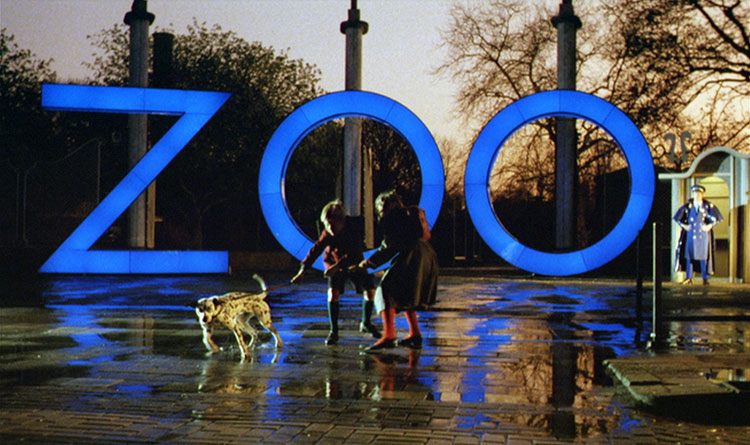
Peter Greenaway's third feature length film and second to follow a traditional narrative structure is one of his absolute best. There is a major accident in front of the zoo involving a collision between three women in a car and a low-flying female swan. The two women in the backseat die instantly, and the third, Alba Bewick, has a leg amputated. The husbands of the two dead women are brothers Oswald and Oliver Deuce, who work at the zoo studying animal behavior. They suffer extreme depression and become obsessed with learning about the biological process of death. Using the zoo equipment, they study and film the decay rate of a variety of animals. Venus de Milo, the zoo's local prostitute and writer of erotic fiction, attempts to console them and they both begin sexual relationships with her. She also convinces them to meet and reconnect.

They regularly visit Alba and begin a threesome with her. Soon they are fired from the zoo for using the equipment and begin setting the animals free. It is revealed that Alba was pregnant and miscarried during the crash. She becomes pregnant again through her relationship with Oliver and Oswald, who are revealed to be twins, ultimately Siamese twins that were separated at birth. They become intrigued by an image of a picturesque country garden Alba grew up in, L'Escargot, and visit it. Meanwhile Alba's doctor, who is obsessed with Vermeer, amputates her other leg and uses her to recreate a Vermeer painting, "Lady at the Virginals." She gives birth to twins, who are adopted by a legless man she met at the zoo. Her body is tired and broken, so she dies, promising the twins can film her decay. When her family predictably refuse, Oliver and Oswald travel to L'Escargot and film themselves dying. Though they appeared physically different at the beginning of the film, by this point they are identical and wish to revert to their original Siamese form.

The film is inter-spliced with videos of time-lapse animal decay and wildlife documentaries about the origins of life and evolution. The voice overs are taken from Life on Earth, the famed nature documentary series narrated by Sir David Attenborough. Many of the ideas here come from Desmond Morris's The Naked Ape: A Zoologist's Study of the Human Animal and The Human Zoo. At least a part of the film is thematically concerned with life as a zoo, as well as the animalistic urges felt by humans. The zoo setting fits particularly well into Greenaway's need to count and catalog, which is replicated in Oliver and Oswald's need to document death within the film. Greenaway gives free reign to his organizing principle with Zed, arranging things by the 26 letters of the alphabet, the 26 paintings of Vermeer, and the 26 different ways he lit various scenes.


As with The Draughtsman's Contract, Zed lacks any real explanation of the events and carefully underplays comic elements in the script. There is explicit nudity and several thoroughly un-erotic scenes where sex is implied but not shown. As with most of Greenaway's films, sex is a power play and a way to realize one's obsessions. Like The Cook, The Thief, His Wife, and Her Lover and 8 1/2 Women, it's also a way to process grief. 

There are a wide variety of interconnected themes within the film. Zoos, collections, animals, particularly black and white species, and an overall black and white schematic as in The Draughtsman's Contract. There is a particular fascination with swans and many references to Leda, who was seduced by Zeus while he was disguised as a swan. The same night, she had sex with her husband, resulting in two eggs, one which hatched the twins Castor and Pollux and the other with the beautiful Helen and the treacherous Clytemnestra. These children are fathered by both Zeus and Leda's husband Tyndareus, as Alba claims her twins are fathered by both Oliver and Oswald. As with The Draughtsman's Contract, the themes of fertility, pregnancy, legacy, gardens, and the garden of Eden are of major importance. This is juxtaposed with a clinical, scientific study of death and decomposition. The larger framework of the narrative is organized by measuring, collecting, cataloging, classifying and story telling. Zed is also obsessed with twin-ship, doubling, symmetry, and repetition. It may take several repeat viewings to catch these clever, subtle layers. Weaving all these elements together narratively and visually is where Greenaway's real genius lies.

Zed is visually reliant on Vermeer and it helps to be familiar with the great Dutch painter and his work before you see the film. Several images are recreated on screen, namely "The Lady in the Red Hat" and "Lady at the Virginals." As in The Draughtsman's Contract, the characters are placed in still life-like tableaux with an emphasis on symmetry. The work by cinematographer Sacha Vierny makes this film a near masterpiece. Though Vierny would work with Greenaway for the rest of his life, this was their first collaboration together. Vierny was primarily known for his work with Resnais and on art-house films like Belle de Jour. An interesting experiment carried out by Greenaway and Vierny was to have 26 different lighting sources throughout the scenes. They use flashlights, car headlights, TV monitors, fluorescents, and, apparently, an artificial rainbow. The use of color and texture is breathtaking, particularly during the sequences with time-lapse photography of decaying animals. Speaking of collaborations, there is yet another excellent, minimalist score from Greenaway's regular composer Michael Nyman, who makes used of a repetitive, melancholic theme mixed with recordings of children's songs like “Teddy Bear Picnic” and “Elephants Never Forget.”

The film benefits from the two eccentric female lead performances from well-known French actress Andréa Ferréol (La grande bouffe) and Frances Barber, a British stage actress who also made regular appearances on British TV shows like Red Dwarf and Doctor Who. Her character, the prostitute Venus de Milo, is named after one of the world's most famous statues, which notably lacks arms and was allegedly holding an apple in her missing left hand. There is also an oddly angry performance from the extremely prolific Joss Ackland. The twins, played by Brian and Eric Deacon, are brothers, not actually twins, and both appear in British film and television, though this is their biggest role. 

The Zeitgeist DVD, whose late 2007 release coincided with The Draughtsman's Contract, was lovingly restored by BFI and comes highly recommended. The vivid colors pop out of the screen and you can see every detail of the twitching decay that is present throughout so much of the film. Included is an introduction and detailed commentary from Greenaway, behind the scenes shots, the complete animal decay footage, and a few other goodies. Allegedly the region-free BFI Blu-ray is the best bang for your buck with a glowing print and the same extras as the Zeitgeist DVD, plus Sea in Their Blood, an early short film about the British coast.