Showing posts with label sci-fi. Show all posts

Tuesday, November 29, 2016

CHILDREN OF THE DAMNED

Anton M. Leader, 1964
Starring: Ian Hendry, Alan Badel, Barbara Ferris

A psychologist, Tom (Ian Hendry), and a scientist, David (Alan Badel), are working together on a study examining childhood development. They are fascinated when they come across the case of a young boy, Paul (Clive Powell), with remarkable mental powers and a very strange personality. They track down his mother (Sheila Allen), who ultimately reveals that the child forces her to do things, perhaps telepathically, and that she can’t stand to be around him because she was a virgin when he was conceived. Though they are reluctant to believe her story, they soon realize there are five other children from across the globe — countries like China, India, and the Soviet Union — who exhibit similar powers and soon run away from their respective embassies and gather together in an abandoned church in London. As government officials and British Intelligence close in, Tom and David attempt to prevent ultimate destruction.

This sequel to Village of the Damned is less of a direct follow up and more a film that happens to be set in the same universe. There are the requisite parallels, namely the fact that the children were all the result of virgin births from human mothers, they have a superior intellect, share knowledge, and are apparently telepathic. Where they different from the children in the first film is that, for starters, they don’t look alike: instead they represent a range of nationalities. They also seem to be more human than alien — some cockamamie explanation about blended DNA is given — and here they are clearly meant to be sympathetic. It’s actually the film’s saving grace; they recognize that they have no place on the earth and, once their true natures are revealed, will drive humans to desperate acts of fear-based violence despite their efforts to remain in obscurity.

This is also more overtly a Cold War-themed film, though its League of Nations approach to the second half of the plot hasn’t aged particularly well. It’s amusing to think of this set up in comparison to the last fifty years of cinema and television; somehow the British military (and intelligence service) have spearheaded a mission to kidnap or destroy the children that involves a number of embassies and diplomats, but is basically run by two scientists who just barge on the scene and do whatever they want (especially Ian Hendry’s Tom, though he’s known for this sort of arrogant kind of character, so either I’m just used to seeing him in a role like this or it really is plausible). There is an effectively moment when orders become confused and the different British regiments are basically firing on themselves, but overall it feels a bit ridiculous.

There are some eerie Quatermass and the Pit-like moments — particularly a scene where a child is killed and later raised from the dead — but overall the film beats you over the head with its anti-war/anti-nuclear terror message. The instances of the children forcing adults to become violent are a bit more ridiculous in this second film and I think someone was asleep at the wheel with those sequences, though part of the problem is that they don’t really seem to fit in with the film’s underlying thesis that the children aren’t inherently violent or dangerous, but will protect themselves when necessary. There is, however, a grisly sequence when British officials (it seems like a mix of military and intelligence) arrive to kidnap the children — who are newly arrived at the abandoned church — and they force the men to brutally murder each other.

Despite effective sequences like that one, there is a lot that patently doesn’t make any sense. Where Village of the Damned introduced some interesting religious themes, only to throw them away by the second half, Children of the Damned does something similar with its central location of the abandoned church; the children use parts of the structure to build an insane mega-weapon to defend themselves. If they’re so smart, surely they could have constructed something a little simpler and more innocuous? When the government officials realize they could use the children’s device — and the children themselves — as powerful weapons, they change their tune and immediately roll out every excuse from patriotism to common sense to try to get the scientists to convince the children to come on board. And while the first film has an admittedly downbeat ending, this one attempts to be more tragic in tone and winds up being a bit too sentimental and moralistic for my taste. Mild spoilers: the film more or less ends with someone postulating that the children are not alien at all, but advanced humans who have arrived before their time.


I don’t know that I can really recommend Children of the Damned, though it is an interesting film and it’s worth tracking down if you like atomic horror, British sci-fi, or weird children’s movies. It’s available on DVD as a double feature with Village of the Damned. Though I do have to admit that Losey’s These are the Damned is still my favorite “evil alien/atomic children” film — and perhaps you should make a triple feature out of these three — but hey, it’s Joseph Losey. Nothing against Village of the Damned’s director, Wolf Rilla, or Anton M. Leader, but come on now. Joseph Losey.

Saturday, July 23, 2016

DOOMWATCH

Peter Sasdy, 1972
Starring: Ian Bannen, Judy Geeson, John Paul, George Sanders

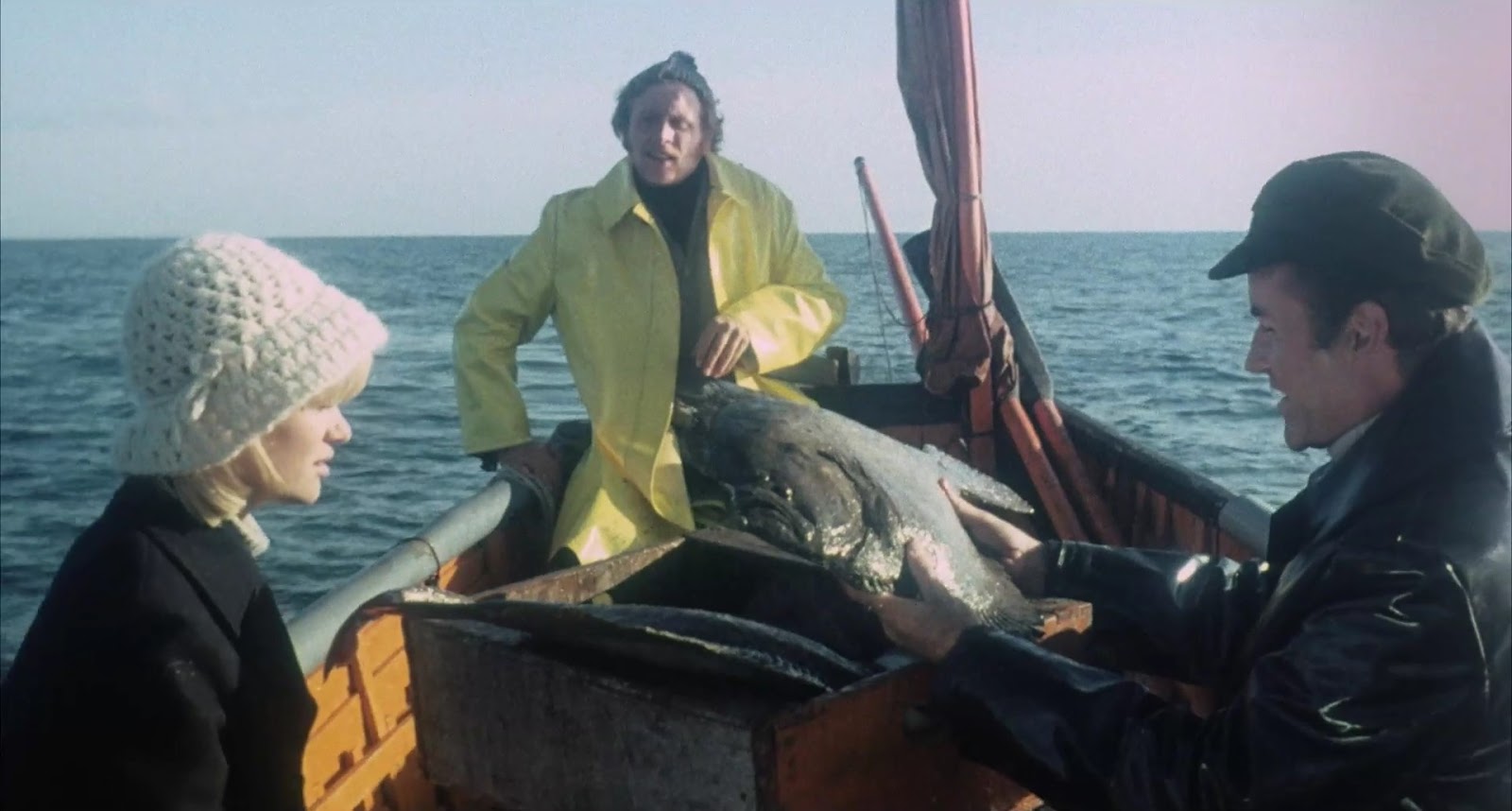
Dr. Dell Shaw, a member of the environmental agency Doomwatch, travels to a remote Cornish Island known as Balfe to take some wildlife samples in the wake of an oil spill. But the secretive, sometimes violently unwelcoming locals accidentally reveal to Shaw that something is going on with their community and he soon recognizes signs of a hormonal disease, acromegaly, which causes pronounced deformities (and here, violent behavior). Despite their resistance — and with the reluctant assistance of a young schoolteacher who is also a newcomer to the island — he begins collecting research. He sends this back to Doomwatch and the teams learns that there may be a connection between the islanders’ deformities and an unauthorized chemical dump that may have spread to the local fish population…

One of the last films made by Tigon Pictures, Doomwatch was based on, and is sort of a spinoff of, a British TV show with the same name. I’ve never seen the show, which is perhaps why I was able to enjoy this strange and unfairly maligned little film that is compellingly made but straddles a number of genres, which made it difficult to market upon its release (and makes it somewhat difficult to recommend now). Much like the two Doctor Who films produced by Amicus, this is a baffling departure from the show and probably frustrated loyal fans. Not only are the show’s main characters relegated to supporting roles, but Doomwatch was misguidedly marketed as a horror film, whereas it’s better described as sci fi-tinged, ecological suspense.

Doomwatch is a bit of a mixed bag, because it’s roughly split into two parts. The first half is a bit reminiscent of The Wicker Man, in the sense that an investigator (in this case a doctor and not a police inspector) arrives on a strange, insular island and is instantly struck by a sense of claustrophobia, even paranoia, as the islanders manipulate him into ignoring their true purpose. And like The Wicker Man, events revolve around a dead or missing body; in this case, Shaw finds the body of a young girl or a child in the woods, but as soon as he draws the island’s lone police officer back to investigate, it is gone and has been reburied elsewhere.

The second half is a completely different beast. Shaw returns to the mainland to brainstorm with the rest of Doomwatch and they confront a naval commander, played by the always magical George Sanders, here in one of his last roles. This wasn’t the first time he appeared in a Tigon film, though I have to say that Doomwatch is a marked improvement over The Body Stealers (1969). But not even Sanders is given the screen time to do much to spice up the conclusion, most of which is largely concerned with three different kinds of conversations: either Doomwatch is wrapped up in scientific investigation (they’re trying to find who dumped some experimental growth hormones into the sea); Shaw is trying to convince the islanders that their problem is medical and not divine retribution/inbreeding; and there are many shots of British people shouting at each other over the telephone, as should be expected.

And yet, despite its sort of glum reputation, I really have a soft spot for Doomwatch. No, it’s not a horror film, though it does have some delightfully Lovecraftian touches and plenty of atmosphere. It’s not even really a sci-fi film, but straddles a pleasant line between the two genres, adding in a hefty dose of what I would describe as moral responsibility drama. And the cinematography from Ken Talbot — shot on actual Cornish locations and not on a soundstage — goes quite a long way, as does the moody score from John Scott. 

Finally, I have to admit my real, abiding love for director Peter Sasdy, who was an undeniably bright note in British horror with enjoyable titles like Taste the Blood of Dracula (1970), the mediocre but lovely Countess Dracula (1970), sleazy cheese-fest The Devil Within Her (1971) — about a bitchy exotic dancer who is being stalked by a Satanic dwarf, who may have possessed her unborn child (I could not make this shit up) — and classics like his masterpiece, Hands of the Ripper (1971), The Stone Tape (1972), and so on. I’m a little reluctant to recommend this, based on the rather intense hatred it seems to have experienced critically, but I really think you’ll be pleasantly surprised if you give it a shot and don’t expect The Wicker Man, Dunwich-style. Pick it up on DVD here.

Monday, July 4, 2016

THE BODY STEALERS

Gerry Levy, 1969
Starring: George Sanders, Maurice Evans, Patrick Allen

During a series of jump trainings, paratroopers in the British army mysteriously begin to disappear. The concerned General Armstrong (George Sanders) brings in specialist and NATO agent Bob Megan (Patrick Allen) to investigate — along with a panel of scientists — in the few spare minutes he’s not busy trying to have sex with every woman on the planet. Megan meets a strange woman named Lorna (Lorna Wilde) on the beach and learns that she’s connected to a race of aliens who are behind the disappearances. Meanwhile, Armstrong and Megan meet resistance in their investigation in the form of some government ministers. 

Tigon’s The Body Stealers aka Thin Air aka Out of Thin Air aka Invasion of the Body Stealers is nearly on the same level as the studio’s disappointing Haunted House of Horror in the sense that it’s maybe founded on some interesting ideas, but is an absolute mess. Essentially a weird throwback to cheap sci-fi films like The Trollenberg Terror (1958) and Fiend without a Face (1958), the film is almost a direct rip off of Robert Day’s First Man into Space (1959), another title about disappearing pilots. But I’m genuinely sad to say that while The Body Stealers has the flimsy plot and threadbare production values of those British sci-fi/horror mashups from a decade earlier, it utterly lacks their improbable charm.

In a weird way, it’s basically like ‘50s British sci-fi meets James Bond, thanks to the presence of Patrick Allen (who I can’t even look at without thanking of Captain Crunch thanks to his absurd costume in Hammer pirate/smuggler film Captain Clegg aka Night Creatures), who is on top of his philandering game in this film. The Body Stealers suffers from lots of scenes of stuffy dialogue — though there are some hilarious lines like “Perhaps it’s the work of some Scottish nationalists’ devious plans to repopulate the Highlands?” as an explanation for the disappearances — and little action, but Allen gets plenty of a different kind of action. 

He has some outrageous scenes that make the Bond films look like an exercise in gender equality and the female alien, Lorna, presumably exists just so Megan can have yet another love interest. Not only does he bag her with zero effort — she leaves, but assures him she will come back one day — but he also seduces the film’s only female scientist (Hilary Dwyer of Witchfinder General, Cry of the Banshee, The Oblong Box). Still, amazing as some of the misogyny is (like the scene where he leaves a woman stranded in the middle of nowhere), Hammer would never cast a woman as a scientist and Julie is the one who actually makes the major discovery of the film: the recovered parachutes are irradiated and have begun to somehow change their molecular structure.

The espionage angle trickles out fairly quickly, to the film’s detriment, and it doesn’t do a lot of leg work in terms of making the alien invasion plot particularly plausible. There are basically no special effects outside of the aerial shots and, hilariously, the space ship is actually the same one used in Doctor Who spin-off film, Daleks – Invasion Earth: 2150 A.D., which Amicus bafflingly produced (as the sequel to their Dr. Who and the Daleks). There are some decent parachuting and flying sequences — this seems to be where the whole of the budget went — but the real reason I was so excited to watch The Body Stealers was because of the costarring role for the the great George Sanders, king among men. He is one of the finest human beings to have ever walked this earth, but just looks sort of amazed at what’s going on around him (or perhaps at the complete lack of what’s going on around him). 

You really have to feel sorry for director Gerry Levy, for whom this was his second and final film. He did some uncredited script work on Curse of the Crimson Altar and Haunted House of Horror, and The Body Stealers affectively ended his career in that arena; though he did spend a number of years working as production manager on everything from The Benny Hill Show and Octopussy, to Gorillas in the Mist and The Hunger, as well as genre sequels Howling V and Lawnmower Man 2. I am dying to see his first and only other film, Where Has Poor Mickey Gone? (1964), about boys who terrorize the owner of a magic shop, only to learn that he’s more than meets the eye.

You can find The Body Stealers on DVD in the UK, but I certainly can’t recommend it and you should watch it at your own peril. The film has a certain lazy attitude to its own plot that can’t be saved by wonderfully smarmy performance from Patrick Allen or even from the great George Sanders, who looks both amused and unconcerned for most of the film. The conclusion resolves precious little and I really don’t understand exactly why the aliens are kidnapping paratroopers, of all things, and sending them back to their home planet. 

Friday, April 1, 2016

ON THE SILVER (1988)

This is the third entry in a four part series on director Andrzej Ĺ»uĹ‚awski’s recently restored early Polish films — Trzecia częśc nocy (1971) aka The Third Part of the Night, Diabel (1972) aka The Devil, and Na srebrnym globie (1988) aka On the Silver Globe — which I recently had the pleasure to see at the Lincoln Center in New York. The series will conclude with an interview with the retrospective’s co-curator, writer and Ĺ»uĹ‚awski collaborator Daniel Bird.

Arguably Ĺ»uĹ‚awski’s most challenging film, this sci-fi epic was unfinished, thanks to the interference of the Polish government, and Ĺ»uĹ‚awski was forced to abandon it in the late ‘70s. Though he was able to partially complete the film in 1988, it is still missing significant portions of the narrative. I first encountered On the Silver Globe as a bootleg copy missing obvious chunks of its running time and lacking English subtitles. The recent restoration, therefore, should be considered one of the major film events of 2016 and if you did not get a chance to attend the Lincoln Center screening, hopefully it will find its way to a home video release soon.

An adaptation of the first two books of his great uncle Jerzy Ĺ»uĹ‚awski’s sci-fi trilogy, Trylogia Księżycowa aka The Lunar Trilogy, the film can be loosely split into three acts. In the first, a group of scientists travel from Earth to the moon, where their ship crashes, leaving them stranded. One of the scientists (Jerzy Trela) records their difficulties with their semi-inhabitable new home on a video diary. They learn that near the water, the atmosphere is breathable, so they settle near the sea. They begin to have children, who mature much faster than the normal human rate. Their children’s culture becomes primitive and, led by a strange priestess, they regard the only surviving scientist as a holy man, building myths around him. Before his death, he sends his video diary back to Earth.

In the second act, the descendants' primitive society has become sharply divided by class and they are subjugated by the planet’s native species called the Szerns, monstrous telepathic creatures with wings. A new scientist, Marek (Andrzej Seweryn), arrives and learns that they are waiting for a messiah, whose coming has been foretold in a prophecy. In the final act, Marek assumes the role of this religious figure and leads the people against the Szerns, but the priests doubt that he really is the messiah and crucify him.

On a Silver Globe’s disjointed and frequently nonsensical narrative can only really be compared to the mystical epics of Alejandro Jodorowsky from the same period, such as Fando and Lis (1970) and The Holy Mountain (1973). The plot is not always easy to follow, thanks to very little exposition and numerous characters, many of whom aren’t given names. Because he couldn’t film all the missing scenes, Ĺ»uĹ‚awski’s way of dealing with this lost material was to insert mundane sequences of life in a modern city with his own voice narrating what was to occur in the intended scene. Though confusing at first, this comes to feel like a response to the early video diaries and comes to provide an interesting juxtaposition with the cave-dwelling society depicted in the second and third acts.

Ĺ»uĹ‚awski’s reputation for hysteria and emotional excess takes on a new meaning here with rituals that devolve into orgies, bizarre ceremonies that could be described as pagan Gothic, and characters falling into trances and going mad. The film is also fairly gory, for example there are graphic scenes of victims impaled over the beach on wooden spikes that stretch impossibly high into the air. The film’s singular visual world includes an eerie blue color palette, costumes and set design that seem to actually come from another planet, and threatening lunar landscapes shot everywhere from the Baltic Coast and the Gobi Desert to the shores of the Black Sea. While contemporary science fiction films are often little more than a blend of mythic tropes and soap opera trapping set in space or in futuristic societies, On the Silver Globe is a true cinematic work of science fiction, if a deeply nihilistic, dystopian one. 

It helps that the source material is one of the finest science fiction literary works of the early 20th century, on par with Frank Herbert’s later Dune series. Popular Polish science fiction writer StanisĹ‚aw Lem has cited Jerzy Ĺ»uĹ‚awski as an important influence and it’s something of a mystery that he hasn’t been translated into English yet. (I was forced to read On the Silver Globe in German, for instance.) Far more than a writer of pulp novels, Ĺ»uĹ‚awski was a well-rounded and influential literary figure, once a prolific poet, philosopher, translator, dramatist, essayist, and literary critic. 

He was associated with an intellectual movement known as MĹ‚oda Polska or Young Poland, sort of a descendent of Polish romanticism. In The Polish Review, Bogdan Czaykowski describes the movement as concerned with “decadence, neo-romanticism, modernism, parnassism, symbolism.” While many of their aims were wrapped up in producing theories about art, aesthetics, and poetics, this was also a period where many young intellectuals struggled with concepts of identity and freedom on both personal and national levels. Since the country was partitioned in the 1790s, Poland had been a land subjugated by Russia, Prussia, and the Austro-Hungarian Empire. Despite a comfortable life as a writer and magazine editor, Ĺ»uĹ‚awski himself joined the cause to fight for Polish independence in WWI, where he died of typhus at just 41 years of age.

At least in part, it’s easy to interpret this trilogy as a response to political tensions and anxiety about an unstable, rapidly changing world. Written between 1901 and 1911 — first published in installments in various Polish literary journals — the trilogy is pessimistic, poetic, and increasingly dark. Ĺ»uĹ‚awski was deeply influenced by 17th century Dutch philosopher Baruch Spinoza, on whom he wrote a dissertation. One of the forefathers of modern metaphysics, Spinoza was also a harsh critic of organized religion. In a controversial early work, the Tractatus Theologico-Politicus, he wrote, “The supreme mystery of despotism, its prop and stay, is to keep men in a state of deception, and with the specious title of religion to cloak the fear by which they must be held in check, so that they will fight for their servitude as if for salvation” (3).

The Lunar Trilogy certainly shares this bitter criticism of religion and it stands as a polemic to man’s gullibility and obsession with utopia and salvation. The first book, Na srebrnym globie (1903) aka On the Silver Globe, follows a man’s bleak account of homesickness and unrequited love. The absolutely beautiful prose is full of lines like, “It is a terrible thing to love the stars! For the earth is only a star, which I love above all else.” The narrator and his fellow survivors did not mean to relocate to the moon, but merely to undertake an expedition there. When their ship crashes, they are permanently stranded and struggle to survive in a hostile environment.

While Andrzej Ĺ»uĹ‚awski’s adaptation is quite faithful to the novel, it abandons the strong, sentimental themes of existential isolation and disappointed love. The novel’s female character, Marta, journeys to the moon solely because she is determined to follow her lover. She tells him, “I followed you and will follow you everywhere, even on the moon!” While she must wrestle with depression and grief when he dies, the narrator also suffers from his unrequited feelings for Marta. A two dimensional character who largely becomes a breeding vessel by the second half of the novel, her obsessive love is shown to be a corrosive influence on the new generation of moon dwellers.

The second volume, ZwyciÄ™zca (1910) aka The Conqueror, follows another lovelorn character — Marek, also the name of Ĺ»uĹ‚awski’s son who was born during this period — who is going to the moon to run away from heartbreak on Earth. It presents a radical, nihilistic interpretation of the savior myth, which also makes up the second half of Andrzej Ĺ»uĹ‚awski’s film adaptation. The final, apocalyptic volume, Stara ziemia (1911) aka The Old Earth, is missing completely from the film. It takes place further in the future, where new characters escape a complete societal breakdown — including elements that loosely anticipate atomic warfare — by returning to the now abandoned Earth. I can’t help but wonder if Ĺ»uĹ‚awski would have attempted filming The Old Earth if On the Silver Globe’s production hadn’t been interrupted by the Polish authorities.

Parallels can be made between the environment in which Jerzy Ĺ»uĹ‚awski wrote the trilogy and the political climate in which Andrzej Ĺ»uĹ‚awski filmed his adaptation. After being forced to leave Poland because of The Devil, Ĺ»uĹ‚awski was invited back after the success of his next film, L’important c’est d’aimer (1972), in France. But On the Silver Globe’s subversive anti-totalitarian themes were obviously too much for communist Poland and the film was cancelled after production was nearly complete. WĹ‚adysĹ‚aw GomuĹ‚ka’s communist Polish People’s Republic at first took a more open-minded attitude towards censorship — at least compared to their Russian neighbors — but the yoke had tightened by the late ‘60s and art of nearly any kind was targeted.

While On the Silver Globe can hardly be reduced to a simple political treatise, it is easy to see the film as an attack against the Marxist utopian vision. Another intellectual kicked out of communist Poland, philosopher Leszek KoĹ‚akowski, explored this theme in his lecture, The Death of Utopia Reconsidered (1982). He wrote, “A utopian vision, once it is translated into political idiom, becomes mendacious or self-contradictory; it provides new names for old injustice or hides the contradictions under ad hoc invented labels. This is especially true of revolutionary utopias, whether elaborated in the actual revolutionary process or simply applied in its course. The Orwellian language had been known, though not codified, long before modern totalitarian despotism. Rousseau’s famous slogan, ‘One has to compel people to freedom,’ is a good example.”

Both Ĺ»uĹ‚awskis seem to imply that — as with revolution — starting from scratch is not a viable option either. KoĹ‚akowski explained that, “The victory of utopian dreams would lead us to a totalitarian nightmare and the utter downfall of civilization.” On the Silver Globe, then, is an exploration of this nightmare from beginning to end: the hope of a new beginning perverted merely by human nature, by the aggressive longing to be led to salvation. It is somewhat ironic, then, that this anti-utopian epic was nearly destroyed by the Polish government. After the film was close to complete, Minster of Culture Janusz Wilhelmi cancelled the production and ordered that the unique — and thus nearly irreplaceable — props and costumes be destroyed.

KoĹ‚akowski wrote, “The great works of our century are anti-utopias or kakotopias, visions of a world in which all the values the authors identified themselves with have been mercilessly crushed.” Though a defeated Ĺ»uĹ‚awski had to return to France in the late ‘70s, his epic was eventually able to see the light of day. Thanks to the efforts of the cast and crew, who stored or sometimes outright hid the film reels, props, and costumes, Ĺ»uĹ‚awski was able to complete the film in the late ‘80s, after the fall of communism in Poland. 

He was finally able to present the film at the Cannes Film Festival in 1988, narrating over the missing footage himself. The triumphant, though bittersweet last shot of the film — a distorted image of Ĺ»uĹ‚awski, reflected in glass while he briefly explains the film’s complicated history — remains a fitting tribute, not only to the tenacious vision one of Europe’s greatest and most unconventional directors, but to a challenging sci-fi epic with no real equal. Hopefully its restoration will allow for a much deserved wider audience for this persecuted masterpiece.

Originally written for Diabolique.

Wednesday, February 10, 2016

THE DAMNED aka THESE ARE THE DAMNED


Joseph Losey, 1963
Starring: Oliver Reed, Macdonald Carey, Shirley Anne Field, Viveca Lindors

Simon, an American tourist on holiday in England, expresses interest in a young woman named Joan and gets mugged by her overprotective brother King — and his gang of motorcycle-riding miscreants — for his troubles. But Simon and Joan cross paths soon after and he convinces her to go on a date with him, a daytime boat ride. An enraged King pursues them and they flee over the sea to a strange island guarded by military personnel. They cross paths with cheerful, yet cold-skinned children who are obviously the product of some experiment. Can they escape King's jealous wrath, get away from the island, and save the children?

No, they can’t, because this is an apocalyptic sci-fi film, one of the very few produced by Hammer Studios. Known in the US as These are the Damned, this incredibly bizarre film is an inexplicable cross between apocalyptic sci-fi, romance-adventure, and the British Teddy Boy/youth gang subgenre. I still haven't really been able to wrap my brain around it, but fans of weird '60s cinema will definitely get a kick out of seeing Oliver Reed interact with radioactive children and struggle against his violently repressed sexuality. Which is not at all related to children, just to clear up confusion about what kind of movie we're dealing with.

This seemingly random sci-fi entry into the Hammer catalog bears some similarities with their horror/sci-fi mash-ups like the excellent Quatermass series. Though The Damned feels like it's made up of pages from ten different genre-themed scripts that were spliced together with someone to roughly fill in the gaps, it's actually based on H.L. Lawrence's 1960 novel The Children of Light. Despite the number of oddities and non-sequiturs going on, it's weirdly compelling and often succeeds despite itself. Of course it was (surprisingly) helmed by none other than Joseph Losey, then on exile in England after the disastrous Hollywood blacklist enforced by the House Un-American Activities Committee and Joseph McCarthy. Losey wound up making the majority of his films in England and though his name isn’t quite A-list, he’s a director you don’t want to pass up. Films like The Prowler (the film noir effort, not the slasher movie), The Servant, Mr. Klein, and others will be of interest for any genre cinema or cult movie fans.

Overall, The Damned fits loosely in the creepy children sub-genre. While a film like Village of the Damned (1960) might spring to mind as a likely influence, this has far more in common with David Cronenberg’s The Brood in the sense that it is a deeply weird film, and one that I could imagine Cronenberg himself remaking. There’s certainly something Ballardian at work and, perhaps curiously, J.G. Ballard had just began writing novels at this time: the apocalyptic disaster tale Wind From Nowhere (1961) and the post-apocalyptic sci-fi story The Drowned World (1962). The sense of inevitable, impending violence — and sexual terror — in The Damned is reminiscent of later Ballard novels like High Rise and Crash, while The Damned also captures the sense of a world being completely out of whack.

Some of The Damned’s characters could easily fit into a Ballard novel and seem unlikely protagonists (or antagonists) for an early ‘60s sci-fi film with themes of atomic terror. For starters, Oliver Reed’s character, King, would seem completely ridiculous if anyone else had been cast. Reed’s raving, violent, and incestuous gang leader becomes the film’s most interesting character, even as his actions become more and more improbable. Apparently the final version of the script toned down a lot of the more blatant incestuous references in the novel. Reed would find himself in a similar role several times in British horror, including in Hammer suspense film Paranoiac, made the same year, and the Lovecraftian The Shuttered Room (1967). Reed’s introduction — sitting in an idyllic square with his leather jacket wearing mates — is fittingly accompanied by an inane pop song with the lyrics, “Black leather, black leather, smash, smash, smash.”

To make matters even weirder, a side character — the Swedish sculptor Freya (played by Viveca Lindfors of Bell From Hell and Exorcist III), who is the mistress of an important scientist — develops a surprisingly weighty presence, as does her very weird art. The sculptures were apparently created by decorated real-life artist Elisabeth Frink, herself quite Ballardian. She belonged to the “Geometry of Fear” school and made eerie-looking sculptures of men and animals that do much to enhance The Damned’s cold, unforgiving, and loveless atmosphere. Of course this is also exemplified by the children themselves. Unlike the monsters of Village of the Damned, they are lonely and isolated. SPOILERS: They learn everything from a TV set in their classroom and are unable to receive any human affection or even contact without bestowing radiation sickness and ultimately death on their would-be guardians.

Subversive and often surreal, The Damned comes highly recommended, but will probably baffle a lot of viewers. If you enjoy unusual atomic horror or the novels of J.G. Ballard, or you’re just an Oliver Reed fanatic like me, this is definitely the film for you. The Damned is not available on a region 1 single disc as a stand alone film, though it has been fortunately restored to the original 96-minute print. It is included in the "Icons of Suspense" Collection from Hammer, along with Stop Me Before I Kill!, Cash on Demand, The Snorkel, Maniac, and Never Take Candy from a Stranger. There's also a region 2 DVD from Sony if you’re reading this from across the pond, with some utterly absurd cover art that makes it look like a low budget zombie film.

Tuesday, February 9, 2016

QUATERMASS AND THE PIT

Roy Ward Baker, 1967
Starring: James Donald, Andrew Keir, Barbara Shelley, Julian Glover

At the closed London Underground stop Hobbs End, workers uncover strange skeletons that are thought to be millions of years old. A paleontologist believes them to be the missing link in human evolution, but the find is endangered when a metallic cylinder is also discovered, buried at the station. It appears to be a bomb, so a military team is called in headed by Colonel Breen, with the somewhat unwanted assistance of Professor Quatermass. He is the only one to believe that the cylinder is of alien origin, until strange, seemingly supernatural events occur around the cylinder and insectoid, demonic-looking corpses are found inside the device.

For my money, Quatermass and the Pit is the most terrifying sci-fi film until John Carpenter’s remake of The Thing nearly two decades later. The third and final film in Hammer’s Quatermass trilogy — all based on Nigel Kneale’s different television serials for the BBC — is the studio’s crowning achievement when it comes to science fiction, thanks to a spectacular combination of supernatural horror and sci-fi that blends threads of human evolution, alien invasion, and folklore into quite a ripping yarn. Despite some questionable special effects, there is little here to criticize and Quatermass and the Pit is simply one of those films you have to see, whether or not you consider yourself a Hammer aficionado or even a sci-fi fan.

Director Roy Ward Baker — then still experiencing the afterglow from A Night to Remember (1958), the only Titanic-themed film I actually like — was chosen for his technical experience when Val Guest, director of the first two Quatermass films was busy with the early Bond spoof, Casino Royale. Baker wound up having a sizable impact on British horror and would stay on to become one of Hammer’s best later-period directors, helming such films as The Vampire Lovers, Scars of Dracula, Dr. Jekyll & Sister Hyde, and The Legend of the Seven Vampires, as well as Amicus films Asylum and And Now the Screaming Starts! 

Part of the reason the film is so superior is because Hammer finally replaced hardboiled American actor Brian Donlevy — who improbably starred as Quatermass in the first two films — with the staunchly British and very professorial Andrew Keir, who was in a few other Hammer films over the years. This is by far the best cast of all three Quatermass films and for me, Keir will always embody the character. He’s matched by pseudo-antagonist Colonel Breen — the excellent Julian Glover of For Your Eyes Only and Indiana Jones and the Last Crusae — a solid example of the sci-fi/horror trope of stubborn military commander who won’t listen to the brilliant scientist. Hammer regular Barbara Shelley (Dracula: Prince of Darkness, Village of the Damned) also gives a compelling performance as a psychically sensitive lab assistant who becomes Quatermass’s clue to the alien beings.

The film’s score and soundscape is another noteworthy element. Electronics expert Tristram Cary creates a number of terrifying, dissonant sounds that help underscore the mood of claustrophobia and slowly mounting terror. Despite the cheat set and, as I said, sometimes laughable special effects, Quatermass and the Pit uses its limited resource to create a work of real fear — one that insinuates that human evolution was guided by aliens, a concept used recently in the deplorable Prometheus. In a clever twist, the presence of the aliens is conveniently explained by human folklore. The horned, insectoid creatures were interpreted over the years as demons and devils. Quatermass himself explains that the name of the subway stop — the site of many hauntings and disappearances — is Hobbs End, Hobb being another name for the Devil.

This really comes with the highest possible recommendation. I got a chance to speak about it a few months ago on the Cinepunx podcast — along with British films Horror Express and Raw Meat that also deal with the themes of human evolution and trains — and this is a great place to start for anyone not interested in Hammer’s Gothic horror output, but curious about British horror. It’s certainly one of the most underrated sci-fi horror films of the ‘60s and I wish Hammer had paired up with Nigel Kneale for a few more of these. Pick Quatermass and the Pit up on DVD immediately, though hopefully soon there will be a US-friendly Blu-ray release. If region isn’t an obstacle, there’s a UK Blu-ray from Studio Canal. 

Sunday, February 7, 2016

QUATERMASS 2 aka ENEMY FROM SPACE

Val Guest, 1957
Starring: Brian Donlevy, John Longden, Sidney James

Meteorites begin crashing to Earth and Professor Quatermass — who is busy trying to get a Moon colonization project off the ground — decides to investigate. He finds his way to a strange factory, which seems to have borrowed his plans for the Moon colony, though he meets with resistance because operations there are top secret. One of the meteorites is filled with an unidentified gas that seems to possess Quatermass’s associate, who is then taken away by guards from the factory. Quatermass teams up with Scotland Yard’s Inspector Lomax to find out what happened to his friend and they discover a terrifying alien conspiracy that may go all the way to the British government.

The sequel to Hammer’s The Quatermass Xperiment is once again based on Nigel Kneale’s excellent BBC series and, like the first film, manages to be surprisingly faithful to Kneale’s script.  Kneale was unhappy with the casting of hardboiled (and allegedly alcoholic) American actor Brian Donlevy as Professor Quatermass in The Quatermass Xperiment and subsequently refused the studio’s request to use the character in their loose follow up X the Unknown, but managed to get more input with Quatermass 2. Of course director Val Guest — who returned from the first film — also had a hand in the script and made one crucial change: while the series’ climax has Quatermass traveling to outer space to defeat the aliens, Quatermass 2 has the slightly more believable premise of the protagonists firing an unmanned rocket to blow up the alien base in space.

Admittedly, there are things about Quatermass 2 that are arguably better than The Quatermass Xperiment. First and foremost, it’s a relief that Brian Donlevy has settled into the role a bit more comfortably. I intensely dislike him in the first film, but the sequel is so fast paced and action packed that he fits into the grand scheme of things a bit more smoothly. In The Quatermass Xperiment, he spends most of his time yelling at people and ordering everyone around, but he’s more appealing here as the odd man out; he has trouble getting anyone to believe him and, for once, is unable to constantly get his own way. 

He also makes a decent pair with John Longden (Alias John Preston), who replaced Jack Warner (The Ladykillers) as Inspector Lomax. I do have a serious soft spot for sympathetic Scotland Yard-type characters though. But the film is basically stolen by Sidney James (The Lavender Hill Mob) as a hilariously drunken reporter who is the only member of the press to believe in Quatermass’s theory of an alien conspiracy and who has moments of brilliance that allow Quatermass to take him seriously. Also keep your eyes peeled for Hammer regular Michael Ripper — my favorite of the studio’s stock company — fresh off his first appearance in a Hammer genre film with the previous year’s X the Unknown

Similar to the previous year’s Invasion of the Body Snatchers, Quatermass 2 is concerned with hysteria and government conspiracy, apt subject matter during McCarthyism and the Red Scare. The film has the same assured sense of direction, moody cinematography, and documentary-like style that Val Guest displayed in the first film, but with a larger budget and plenty of location shooting. Notably, this is the first time production designer Bernard Robinson would work with Hammer, though it’s obviously a far cry from his colorful work on the studio’s later Gothic horror films. The factory set is quite fun — complete with its own bio-dome — and allows for a breathy conclusion where Quatermass and co. are forced to lock themselves in and defend against an angry mob — a later staple of Hammer’s horror films. 

All in all, Quatermass 2 comes recommended, particularly for fans of sci-fi horror crossovers. In retrospect, it feels like a blend of Doctor Who and The X-Files, and I would say it’s worth watching even if you haven’t yet seen The Quatermass Xperiment or any of Kneale’s serials. Pick it up on DVD, though I’d love for Hammer and the BBC to release a joint box set that contains all three films and all the serials. Quatermass 2 was somewhat ignored because it was released in the same year as The Curse of Frankenstein, the film that would set the course for Hammer’s future. 

Wednesday, February 3, 2016

X THE UNKNOWN

Leslie Norman, Joseph Losey, 1956
Starring: Dean Jagger, Edward Chapman

Soldiers located a mysterious source of radioactivity in the Scottish highlands, which leads to a deadly explosion. Some of the men are killed, while others are suffering from radiation burns, and a strange pit in the Earth begins to open. Dr. Royston, an investigator with the Atomic Energy Laboratory, is called in to investigate with the help of Mr. McGill, a security consultant. When a local boy and a hospital intern are killed after suffering from radiation burns, Royston and McGill surmise that a radioactive creature has emerged from the Earth’s core and is stalking the area, desperate for food.

An unofficial sequel to Hammer’s horror/sci-fi breakout film, The Quatermass Xperiment, this tamer entry also received an X-rating — probably thanks to some grisly scenes of burning flesh — and the studio wisely capitalized on that with the film’s title. But make no mistake, this is the same blend of sci-fi and horror that would character the Quatermass trilogy and the studio’s final sci-fi film, The Damned (minus the latter’s weird teddy boy subplot). When Quatermass writer Nigel Kneale wouldn’t allow Hammer free reign to use his beloved character, they basically just made a similar film to The Quatermass Xperiment but replaced the miscast Brian Donlevy with wholesome-looking American actor Dean Jagger of White Christmas and Vanishing Point fame. 

Jagger’s not particularly heroic hero, Dr. Royston, is thankfully not as abrasive as Donlevy’s unfortunate portrayal of Quatermass, but he really does lack personality. If X the Unknown is inferior to The Quatermass Xperiment, it is in two points: the absence of a truly compelling protagonist and antagonist. The film perhaps unwisely avoids the kind of hysteria and panic that would make Quatermass and the Pit such a triumph and the characters are all entirely too calm and civil. While there is some solid acting from Jagger and his primary costar, Leo McKern (who I have loved from the moment I saw Ladyhawke as a child), the two characters simply get along too well. There is not enough tension or anxiety between the central characters and don’t even get me started on the monster. (But do keep an eye out for an early appearance from the beloved Michael Ripper, soon to be a Hammer regular). 

X the Unknown also lacks The Quatermass Xperiment’s use of a compelling villain in the form of actor Richard Wordsworth, whose gradually transforming astronaut is a creature of both sympathy and terror. Despite the fact that it’s moody and atmospheric, the movie is so low budget that the monster barely appears and then only as a radioactive, vaguely shiny blob. This is a strange precursor to films like the superior The Blob (1958), Japanese atomic horror film The H-Man (1958), and Caltiki, the Immoral Monster (1959) from giallo forerunner Ricardo Freda

The monster is not exactly alien life, but competing life on earth that has come from deep within the planet’s core. The film’s scariest moments actually involve man encountering nature — such as when the boys go into the woods at night and when a soldier descends into a seemingly bottomless fissure in the earth — and while I love this early folk horror premise, it falls flat because of the “monster.” More than anything, it reminds me of the blancmange at Wimbledon skit from Monty Python and the Flying Circus. And speaking of Monty Python, one of their directors, Ian MacNaughton, actually appears here as a Scottish soldier named — drumroll — Corporal Haggis. I thought I was imagining things, but IMDB confirms that that’s actually the character’s name. 

This first feature script from the studio’s most popular writer, Jimmy Sangster, also plays fast and loose with science — radiation in this case — and Royston figures out a way to kill the monster with radio waves, which apparently neutralize the radiation that keeps it alive, but cause a spectacular explosion that miraculously harms no humans in the process. The great Joseph Losey — then blacklisted from Hollywood and working in England — began directing the film, but was replaced by Leslie Norman due to an illness. Luckily Losey would return to Hammer for The Damned, while Norman was apparently so widely disliked on set that even though he helmed a competent film, well-received film, he never made another movie with Hammer.

X the Unknown is an enjoyable, if dated effort, though I think I can only recommend it to fans of ‘50s horror. Though it loses momentum and focus in the second half, it’s plenty entertaining and takes itself quite seriously with some help from moody cinematography and composer James Bernard, who essentially reprised his score from The Quatermass Xperiment with equally chilling results. Check it out on DVD, but don’t expect it to be quite as magical as the Quatermass trilogy.

Tuesday, February 2, 2016

THE QUATERMASS XPERIMENT (1955)

Val Guest, 1955
Starring: Brian Donlevy, Jack Warner, Richard Wordsworth, Margia Dean

Professor Quatermass is overseeing the test runs of a rocket he personally designed, when something goes horribly wrong. After a trip to space, the rocket crashes into rural England and out of the three pilots aboard, two are missing and the sole survivor, Victor Carroon, is catatonic. While Quatermass and a team of scientists are studying Carroon, he begins to horribly transform and soon breaks out of the hospital. Quatermass and Scotland Yard’s Inspector Lomax begin a desperate manhunt after Quatermass realizes that Carroon’s new alien form is giving off spores with the potential to destroy the entire planet. 

Known in the US as The Creeping Unknown, this first film in Hammer’s Quatermass trilogy was a major turning point for the studio — and for British horror in general. Based on the BBC television serial penned by sci-fi great Nigel Kneale, the film of course condenses the events of the serial, but also made two major changes. The first, and most grating, is the casting of American actor and film noir regular Brian Donlevy (Hangmen Also Die) as Professor Quatermass, turning Neale’s thoroughly British scientist into a rude, ball-busting American. He looks more like a gangster or an irate insurance claims adjuster than he does a scientist and chokes on some of his dialogue. In one scene, he says to Victor Carroon’s distraught wife, “There’s no room for personal feelings in science!” This is basically the ‘50s sci-fi equivalent of “There’s no crying in baseball.” Harsh and unlikable, Donlevy is completely miscast — Peter Cushing would have been a much better fit, though he wasn’t yet a Hammer star at this point — but he is still unable to ruin the film.

Named The Quatermass Xperiment to capitalize on the “X” rating certificate the film received from the British censor board, surprisingly little of the monster is actually seen in the film, but there’s a fantastic sense of atmosphere. The competent Val Guest went on to direct one of my favorite early Hammer films, The Abominable Snowman (1957), as well as sci-fi classics The Day the Earth Caught Fire (1961). Though he keeps the monster primarily offscreen — a la Val Lewton a decade earlier — there are some fittingly grisly moments, such as a murder in an elevator and a bleak scene in a local zoo where the monster wreaks havoc on the animals. Though it isn’t quite scary (or gory) by modern standards, I can see why this was Hammer’s first major breakthrough, a success of such proportions that the studio not only produced a small run of sci-fi films, but began almost exclusively making horror films.

Character actor Richard Wordsworth (The Curse of the Werewolf) is the heart and soul of the film, giving a spectacular performance as the unfortunate Victor. Though his character ultimately transforms into something non-human, he gives a physical performance full of pathos and believability. Many of these early sci-fi horrors — particularly the British ones — have a romantic relationship at their center, but The Quatermass Xperiment doesn’t put a lot of emphasis on this, but merely uses Victor’s relationship with his wife — and her desperation to get him away from Quatermass — it to humanize Victor and elegantly move the plot forward. He is unable to kill his adoring wife, even though he is transforming into something alien and monstrous, and runs away from her in horror. 

Aside from the casting of Donlevy as Quatermass, Guest’s second major change away from the serial is the conclusion, spectacularly set at Westminster Abbey. In the serial, Quatermass is able to remind Victor of his last, lingering vestiges of humanity, and in order to save the planet, he kills himself. But in the film version, Victor has become completely alien and Quatermass electrocutes him to death with the help of a conveniently placed television crew. This change makes The Quatermass Xperiment less of a human story and more of a monster movie, but the concept of a transformed astronaut was obviously horrifying enough to inspire a number of similar films in the late ‘50s and early ‘60s.

This isn’t the only reason why it’s considered a minor classic. Val Guest keeps the pace moving at a brisk clip and despite the occasional moments of scientific exposition, there is a steady sense of suspense, even claustrophobia, to the proceedings. The film is an almost equal blend of horror, science fiction, and murder mystery; Scotland Yard even gets involved because they think that Victor may have murdered the two missing astronauts. The Quatermass Xperiment also has a decidedly bleak note thanks to Quatermass himself, who exploits Victor and, at the film’s conclusion, is determined to start his experiments all over again.

The Quatermass Xperiment comes highly recommended and anyone who enjoys a blend of sci-fi and horror will definitely want to seek it out. Pick it up on Blu-ray and I promise you’ll be able to get past Donlevy’s heavy-handedness and, if this is your first exposure to Quatermass, you might even enjoy him. The film boasts plenty of delights, including some enjoyable effects, wonderful atmosphere, and a particularly fantastic score from Hammer’s regular composer, James Bernard, which would set the stage for the rest of their sci-fi films.

Thursday, January 28, 2016

FOUR SIDED TRIANGLE

Terence Fisher, 1953
Starring: Stephen Murray, Barbara Payton, James Hayter, John Van Eyssen

“I didn’t ask to be born so I have the right to die.”

In a small, English village, childhood friends Bill and Robin grow into determined scientists and develop an experimental device that can duplicate matter. The genius of the pair, Bill, is in love with another of their childhood friends, the beautiful Lena, but Lena prefers Robin. When Lena and Robin marry, after the pair announce their scientific success, the forlorn Bill becomes determined to alter the Reproducer machine so that it can replicate living beings. With Lena’s reluctant help, he makes a twin, who he names Helen, and hopes she will love him. But something about Helen is not quite right…

Hammer’s first sci-fi film might not quite belong in my British horror series, but Four Sided Triangle is a key early piece of the puzzle and marks their transition from a studio who produced primarily adventure and suspense films to one of the world’s biggest horror studios. Based on a novel by William F. Temple, there is also much to connect the film with Hammer’s first big hit, The Curse of Frankenstein, far more than just the presence of Hammer’s chief director, Terence Fisher. It also has a lot in common with Hammer’s most important sci-fi series, the Quatermass trilogy that would soon follow. For one thing, Four Sided Triangle has little in the way of special effects but much in the way of dialogue.

The style of Four Sided Triangle — basically a black and white radio drama captured on film — might seem unfamiliar to fans of Hammer’s Gothic horror, but it fits in perfectly with their other sci-fi films from the period like The Quatermass Xperiment (1955), X the Unknown (1956), and Quatermass 2 (1957). The laboratory sets are charming and it’s easy to see how Fisher — who unusually cowrote this film in addition to directing it — further developed much of Four Sided Triangle for his early Frankenstein films. But while the Quatermass films place an equal emphasis on science and horror, Four Sided Triangle is far more concerned with melodrama and human tragedy than it is with the legitimate workings of science.

I’m not exactly giving away any spoilers — the film is presented as somewhat of a tragedy from its opening frames, as there’s a preachy biblical quote about man’s perhaps doomed scientific dabbling, and the proceedings are narrated by the village doctor. He is clearly telling the story after the fact and speaks sympathetically about all of the characters, though particularly Bill. Though far more human than Hammer’s Baron Frankenstein, Bill is an early example of one of the studio’s beloved stock characters: the genius who does not begin as a villain, but is driven there by his obsessions.

This film has some of Hammer’s most interesting, if damaged characters. Bill’s abusive childhood is revealed and it offers something of an explanation for his tormented nature. His obsession for Lena is deeply connected with this, though it’s mind boggling that she goes along with his plans. She is also psychologically tormented — admitting to the doctor that she longs for suicide — and her desire to duplicate herself seems to stem from an inability to chose between Bill and Robin. It’s undeniably strange to see a science fiction film from this period with such well developed themes of love, sexual obsession, and personal torment, but it’s easy to see how this would go on to influence the more complex sci-fi of the ‘80s in films like David Cronenberg’s The Fly and Dead Ringers. And I wish The Four Sided Triangle had seen these themes through to their logically perverse ends, but it only goes so far as Helen’s suicide attempt — because she is also in love with Robin instead of Bill — and Bill’s ultimate plan to erase her memory to make her love him.

Though it won’t be for everyone, I really do have to recommend Four Sided Triangle. Pick it up on DVD if you like classic sci-fi or if you want to see the origins of some of the tropes that would emerge in Hammer’s later years, including their first instance of conclusion by fire. Though they would use this repeatedly over the years, the burning of Bill’s lab neatly — though frustratingly — concludes the film, as the kindly doctor and Robin (John Van Eyssen who would soon reappear in Hammer’s Horror of Dracula) realize that Helen has been killed, but Lena has survived. A little ambiguity wouldn’t have killed them. The film’s incessant moralizing is a little annoying, but it’s hard to find a ‘50s sci-fi film without at least a little of this included. And regardless, it sets up some early philosophical implications about doubles, clones, and twin-ship that would be explored later down the line in ‘70s and ‘80s sci-fi horror.

Saturday, January 2, 2016

THE ABOMINABLE SNOWMAN (1957)

Val Guest, 1957
Starring: Forrest Tucker, Peter Cushing, Maureen Connell, Richard Watts

In the Himalayas, a group of scientists use a monastery as the base for their expeditions, including a botanist, Dr. John Rollason. A new team arrives — Dr. Tom Friend, along with a photographer, a trapper, and a guide — in order to find the legendary yeti. Rollason is determined to accompany them, but his wife Helen fears for his safety and hopes the local Lama will intercede on her behalf. It becomes clear that while Rollason has purely scientific interests, Friend wants to capture the beast and profit off of it. When the men become lost in the snow, Rollason’s wife stages an emergency rescue mission.

The Abominable Snowman, also known as The Abominable Snowman of the Himalayas in the US, is one of Hammer’s earliest efforts — alongside The Curse of Frankenstein — and for some reason it’s pretty thoroughly neglected, probably because it’s not one of their Technicolor Gothic horror outings. In my opinion, it fits in in two places: first, as part of Hammer’s small series of sci-fi horror films like the Quatermass trilogy, which began with The Quatermass Experiment (1953). Some of these films were helmed by The Abominable Snowman’s director Val Guest. And like many of those, it was based on a television play made for the BBC — called The Creature — written by Quatermass creator Nigel Kneale, also responsible for the filmic script.

It also fits in with a small number of winter-themed sci-fi horror films made in the ‘50s: namely titles like sub-genre mainstay The Thing from Another World (1951) and lesser known British film The Trollenberg Terror (1958). While I love The Thing from Another World — and of course John Carpenter’s ‘80s remake, The Thing (1982) — but I also really have a soft spot for The Abominable Snowman. Like the much later series The X-Files, it’s a pleasing blend of science, sci-fi, monster movies, and captures the spirit of fear and wonder that went along with the exploratory fervor of the 19th and early 20th centuries. Even as late as the early ‘50s, scientists and climbers claimed to find evidence of yeti prints. 

The creatures are a minimal presence within the film — thanks to Guest rather than Kneale — but the script uses them in a fascinating way. SPOILERS. The film suggests that when humans destroy each other, the peaceful, telepathic yetis will take humanity’s place as ruling bipeds on earth. The wonderfully ambiguous ending allows Rollason to remain as the only survivor of the disastrous yeti hunt expedition, but he claims to have no knowledge of the creatures, either because he has come to learn what the Lama already knows and is protecting them, or because he’s *cue suspenseful music* been brainwashed. They are terrifying precisely because they are able to telepathically control the members of the expedition, causing the men to hallucinate and having fatal accidents. 

There’s also a wonderful sense of atmosphere, with the film shot both in Bray Studios, Pinewood (to allow for more space), and the French Alps. Sometimes it’s clear where Guest and his team struggled to make the different sets work together, but I will take anything with mountains and snow. Hammer’s typically lush use of color is set aside in favor of some very effective black and white film, which occasionally gives The Abominable Snowman a vintage documentary feel. And despite the vast spaces, this has a Quatermass-like use of tension, claustrophobia, paranoia, and suspense — so much so that the film deserves a better reputation.

Don’t get me wrong, though. Like most ‘50s sci-fi, it has its issues. Some scenes are overly talky, while the acting is really nothing to write home about. American actor Forrest Tucker (Break in the Circle, The Trollenberg Terror) costars as the opportunistic Dr. Friend, but is just plain flat and unlikable alongside Peter Cushing in the great actor’s second starring role for Hammer after The Curse of Frankenstein. Though a bit more subdued than normal, Cushing is captivating and delightful, as always. He reprised his original role of Dr. Rollason in Knell’s teleplay along with actors Arnold MarlĂ© (The Man Who Could Cheat Death) and Wolfe Morris (The House That Dripped Blood). One of Kneale’s biggest alterations from the teleplay version is that in the film, Rollason has a wife — apparently named Helen after Cushing’s own beloved wife, Violet Helene — who provides plenty of needed emotional weight.

The film comes recommended, providing you enjoy the sort of blend of sci-fi, horror, monster movie, and adventure film that The Abominable Snowman provides. Pick it up on DVD and revel in the glory that is Peter Cushing at the beginning of his career with Hammer. Give the script a chance to surprise you and revel in the windswept, alienating landscapes.

Monday, October 19, 2015

FIEND WITHOUT A FACE

Arthur Crabtree, 1958
Starring: Marshall Thompson, Kynaston Reeves, Michael Balfour, Kim Parker

In Canada, near an American air base, locals begin to mysterious die off and they’re horrifyingly found with their brains and spinal cords missing. Major Jeff Cummings investigates and hones in on Professor Walgate, who has been undertaking some strange experiments with telekinesis. Walgate later admits that he has developed unusual abilities possibly aided by the energy produced by nuclear experiments at the army base. His thoughts have turned into unknown invisible life forms responsible for the nearby murders. Nuclear power is enhancing the power of these creatures, who soon visibly manifest and begin all out warfare on the local populace.

One of Amalgamated Productions’ final efforts is this beloved cult film based on Amelia Reynolds Long’s story “The Thought Monster,” originally published in Weird Tales. Though it has some flaws — it has some pretty dull dialogue and plods along in parts — this represents some of the highs of ‘50s atomic horror. Set in Canada, allegedly to appeal to both US and British audiences, this English-shot film has most of the hallmarks of the genre. First up is the standard insipid leading man, played by the wholesome-looking Marshall Thompson, who briefly made a career out of these roles with films like It! The Terror from Outer Space and First Man into Space. The Leave It to Beaver-like lack of complexity in characters like Major Cummings is admittedly frustrating, but provides plenty of unintentional humor.

And of course there’s a female love interest — who needs to be rescued — in the form of Kim Parker’s Barbara. I can’t stress how much I hate these type of characters that plague ‘50s cinema, which is probably why my favorite genre from the period is film noir with its abundant use of the femme fatale. These manipulative, seductive, and often violent dames are the antithesis of Barbara’s faintly hysterical, helpless character that would fortunately begin to fade away in recent decades. At least she’s overshadowed by the typical mad scientist who causes the hubbub — this time with experiments in telekinesis — his thoughts literally become invisible brain-feasting monsters.

The monsters are of course the real reason to watch Fiend Without a Face and they represent some of the goriest effects in ‘50s British cinema. Like the admittedly superior Quatermass and the Pit, this was given an X certificate by British censors. The creatures do murder a number of people — by sucking out their brains — and in the film’s amazing final 15 minutes, they attack the professor’s home, flying through the air, and slithering along thanks to propulsion from their tail-like spinal columns. Though this is obviously a low budget affair, the film really benefits from great sound effects and the use of stop-motion animation for the monsters. After running amok, they are relatively easily defeated and the ending is a delightful gross out fest with the brain monsters melting into squishy puddles of goo.

Fiend Without a Face is far from perfect — most of it is Mystery Science Theater material — but if you consider yourself a fan of vintage horror, you really need to see this at least once. Amazingly, it’s been released by Criterion in a restored edition with some nice special features. It’s strange to think that you can see the brain monsters in fully restored cinematic glory, but there’s really nothing like them in all of ‘50s cinema. Director Arthur Crabtree, whose work here is admittedly a bit pedestrian, didn’t make a lot of horror films, but his two contributions are enough to put him permanently in the books for British horror. Immediately after this sci-fi horror classic, he went on to make Horrors of the Black Museum (1959), which I’ll explore tomorrow.

Saturday, October 17, 2015

FIRST MAN INTO SPACE

Robert Day, 1959
Starring: Marshall Thompson, Marla Landi, Bill Edwards, Robert Ayres

Lt. Dan Prescott, a young pilot, is chosen to helm a rocket powered plane in an experiment to reach a high altitude. His brother Chuck, a naval commander, doubts that Dan is the right choice because he’s headstrong, irresponsible, and has recently ignored orders and blown off paperwork after a mission to be with his girlfriend. During the high altitude mission, he goes further than he was supposed to and both Dan and the plane disappear. His parachute and the wreckage are found hundreds of miles away in New Mexico. Chuck begins to investigate and finds evidence that Dan’s aircraft has been to space. At the same time, a blood-thirsty monster begins a wave of terror, targeting hospitals and cattle farms, and evidence links it back to Dan’s plane.

After finding success with two collaborations between director Robert Day and star Boris Karloff — The Haunted Strangler and Corridors of Blood — Amalgamated Productions continued with a fusion of sci-fi and horror in First Man into Space, after the script had been rejected by American horror studio AIP. Clearly influenced by American sci-fi classics of the ‘50s and Hammer’s early foray into the genre, The Quatermass Xperiment, First Man into Space is undeniably campy and ridiculous, but also mines the very real fears of a world on the brink of space exploration. Thanks to the Cold War, US and Soviet scientists were in a neck-to-neck race in the late ‘50s with the Soviets’ Sputnik 1 coming out ahead in 1957 as the first man-made object to orbit Earth. This effectively launched the “Space Race” and by 1959, the Soviets had sent a dog, Laika, to space. 

The USSR would also conquer human spaceflight — though not until in 1961 — so First Man into Space captures both the sense of excitement about space exploration and unease about what man might find there. Perhaps strangely, this is essentially a morality tale about the dangers of hubris and the consequences of man meddling where he perhaps shouldn’t be. Less obsessed with mad science than Corridors of Blood, First Man into Space also follows in the tradition of films like The Thing from Another World (1951), It Came from Outer Space (1953), and The Trollenberg Terror (1958) in the sense that it is primarily a monster movie. And honestly, this is its true redeeming quality, even though the humanoid creature looks like it's made out of mud (or worse, shit).

The film’s use of science is patently ridiculous, but there is plenty of fun to be had from the fact that — SPOILER ALERT, sort of — Dan turns into a monster who is literally bloodthirsty. The groan-worthy explanation is that while in space, he absorbed a sudden about of nitrogen that — along with a protective shell that looks like rock or mud — permanently altered his metabolism and means that he needs to constantly absorb blood rich in oxygen to survive. I can’t say that the acting in the film is great, but Bill Edwards brings a certain sense of physicality and energy to the role and it’s easy to see the headstrong, wild Dan as a loose precursor to James Kirk.

Marshall Thompson (It! The Terror from Beyond Space and Fiend Without a Face) is the sort of staunch, serious, and faintly disapproving older brother character you would expect, though it’s a shame that hr just isn’t as interesting of a protagonist as Dan. Perhaps the most unintentionally funny character is Hammer regular Marla Landi (The Hound of the Baskervilles and The Pirates of Blood River) as Dan’s girlfriend who — to Chuck’s great surprise — also happens to work at the base and follows Dan’s plight with the sort of teeth-grinding helplessness indicative of women's roles in the first few decades of cinema.

Amazingly, this film was released in Criterion’s Monsters and Madmen box set alongside The Haunted Strangler, Corridors of Blood, and US film The Atomic Submarine. If you like campy sci-fi horror as much as I do, this is well worth watching. Its slow pace, reliance on dialogue over action, and serious lack in the style department is mostly made up for by a sympathetic monster, many scenes that are unintentionally hilarious, and a palpable sense of anxiety. This Halloween season it would make a great double feature with Fiend Without a Face, as both involve British depictions of US soldiers and scientists encountering monsters from beyond. And come on, where else are you going to see a creature that's a mud-covered space vampire?