Showing posts with label Satanic horror. Show all posts

Sunday, July 17, 2016

VIRGIN WITCH

Ray Austin, 1972
Starring: Ann Michelle, Vicki Michelle, Patricia Haines

Two sisters, Christine (Ann Michelle) and Betty (Vicki Michelle), hitchhike to London so that Christina can find a modeling job, which she does in record time, thanks to her secret psychic powers. Her new boss, Sybil (Patricia Haines), orders her to strip down for an inspection and then books her for a weekend shoot in the country at an estate known as Wychwold. Christine, Betty, and Sybil head out to the countryside, and though the house makes the virginal Betty nervous and paranoid, Christina fits right in. It turns out Gerald (Neil Hallett), the owner of the manse, and Sybil are the head of a coven of witches and Christine is eager to join. Unfortunately for the jealous, possessive Sybil, Christine’s hidden powers begin to emerge and a struggle for power begins.


If Tigon British Film Productions can be remembered for cornering the market on any particular horror trends, it’s probably satanic and folk-themed horror. In the late ‘60s and early ‘70s, they put out such classic titles as The Curse of the Crimson Altar (1968), Witchfinder General (1968), and my personal favorite, Blood on Satan’s Claw (1971). Virgin Witch (1972) is one of their more obscure entries and also one of their last — they would essentially only produce three horror films after this — and it was sadly their final satanic horror film. Though, to be fair, this one has far more of an emphasis on nudity than scares and it would be more fitting to describe it as satanic sexploitation, rather than strictly satanic horror. 

Though it is generally advertised as a satanic horror film, there is nothing particularly horrific or scary about Virgin Witch, and very little that is diabolical. It is really a tame, though enjoyable witchcraft-themed erotica film with not much in the way of plot, but loads of nudity from stars and real-life Michelle sisters Ann and Vicki. Certain comparisons can be made to Hammer’s Twins of Evil, in the sense that Virgin Witch loosely divides the pair into the good and bad sister. Christine becomes the evil twin in the sense that she wants to not only join the coven, but take it over and replace Sybil — a plot element that could have been really interesting had they done more with it. And anyone who has seen even in a single Satanic cult film should realize that the virginal Betty is set up to be some sort of sacrifice, but hilariously she is deflowered — per her request — in the middle of the woods after being chased by raving cultists… like you do. 

As for the sisters themselves, who can’t really be fairly compared to the Collinson twins of Twins of Evil, but Ann will be familiar to British horror fans for her appearance in Pete Walker’s House of Whipcord (1974) and Vicki was in the BBC’s popular ‘80s sitcom Allo Allo. Keith Buckley, who plays the boyfriend of Vicki’s character, will be familiar to horror fans for his role in Dr. Phibes Rises Again (1972), though he isn’t given a whole lot to do here. I won’t pretend that the acting is really a compelling reason to see this film, but the performances are serviceable enough to get the job done. 

Virgin Witch’s script and dialogue don’t do anyone any favors, but the Michelle sisters do spend most of their time scantily clad, though of course — and strangely I find myself writing about this subject a lot — this is yet another instance of a disappointing orgy. Here disappointing in the sense that it is implied, but absolutely none of it is shown. In general, the initial X-rating from British censors is baffling. Though there is copious nudity, some sleazy moments and a few tame lesbian scenes, there is no violence or sex. Despite these setbacks, director Ray Austin (The Saint) does a decent job with a patently ridiculous premise. Though his film is far from perfect, it is entertaining, beautifully shot, and boasts some Bava-like colored lighting. Not a whole lot happens, other than frequent disrobing, but the brief, 88-minute running keeps it from dragging too much.

Virgin Witch
isn’t the best or worst Satanic horror film from the period. The film will undoubtedly appeal more to fans of exploitation cinema or Eurotrash than anyone expecting a riff on Hammer horror, or a vampire-free version of Twins of Evil. Kino Lorber and Redemption, following in their series of horror-erotica Blu-Rays that begin with the works of Jean Rollin, have rescued Virgin Witch from obscurity and presented it in a remastered edition. Chances are, you are going to spend a fair amount of time wishing this was either Blood on Satan’s Claw or The Wicker Man, which would follow a year later, but if you keep your expectations low, there’s plenty of fun to be had.

Sunday, July 10, 2016

BLOOD ON SATAN'S CLAW

Piers Haggard, 1971
Starring: Patrick Wymark, Linda Hayden, Barry Andrews

In 17th century England, a man accidentally digs up a strange skull in a field. He contacts a local judge for help, but by then the skull has disappeared and a number of unusual occurrences take place in the village. A young woman goes mad, people begin sprouting claws, and many of the local children begin to behave very oddly, turning away from the pastor and his Christian teachings. Their group, led by a lovely young woman named Angel, begins targeting and killing non-believers. The judge is called back to deal with the supernatural evil that has gripped the town.

For my money, this is the single best film from Tigon British Film Productions, though I'm sure plenty of people will argue that Witchfinder General is superior. But, as I've said before, this smaller competitor to Hammer and Amicus have charmed me so much over the years, because they always sort of went their own way and did their own thing, often with mixed results — but they were never boring (hmn, maybe The Body Stealers has its moments). Blood on Satan’s Claw (1971) is an example of this creativity and stubbornly independent streak working out, and it represents some of the strongest satanic horror from that, or any, period. A blend of horror, exploitation, satanic cults, killer kids, religious repression, and Gothic moodiness, Blood on Satan’s Claw deserves far more recognition. 

This is an excellent collaboration between first time director Piers Haggard (who would go on to helm the fucking bonkers Venom and the Quatermass mini-series) and prolific cinematographer Dick Bush, who regularly worked with Hammer studios and director Ken Russell. The tense, rapid pace, claustrophobic shots of the lovely English countryside, and careful mix of sex, scares, and violence make this one of the best British films of the ‘70s. Though Blood on Satan’s Claw has some silly and campy moments, it is a genuinely creepy film and is one of the best examples of the British pagan horror subgenre. Aside from some wonderful performances, the cinematography and score are some of the finest from this era of horror. The utter weirdness, weirdness in the definition “relating to, or suggestive of the preternatural or supernatural,” is one of the film’s strongest points and it thankfully doesn’t fall back on a rational explanation.

Linda Hayden (Taste the Blood of Dracula, Madhouse) absolutely steals the film and gives a wonderfully sexy performance and the ringleader of the satanic gang. Aside from Hayden, there are a number of other familiar faces here: Patrick Wymark (The Skull), James Hayter (The Horror of Frankenstein), Michele Dotrice (And Soon the Darkness), Barry Andrews (Dracula Has Risen From The Grave), Tamara Unstinov (Blood from the Mummy’s Tomb), and others, with many of the actors appearing in Hammer and Amicus horror films and episodes of Doctor Who

There are some issues with the plot, due to the fact that this was originally intended to be an anthology film. The stories were woven together seemingly at the last minute and some of the characters can be difficult to keep track of. The weakest link is the final confrontation with the judge, who deserved to be a more developed character. After the careful subtlety exercised throughout most of the film, the conclusion that involved sword fighting and what appears to be a papier-mâché demon are unfortunate at best. The dialogue and accents are often annoying and overwrought, but the powerful atmosphere and eeriness overcomes this. Though the film is occasionally over the top, there are some genuinely terrifying scenes that push taboo lines much harder than other horror movies from the period, such as scenes of a young girl’s ritualized rape and murder. 

There are a number of very nice extras that make this Blu-ray superior to previous releases. There’s a brand new 2012 interview with director Piers Haggard, a featurette about Linda Hayden, An Angel for Satan, and also included is the excellent 2004 making-of documentary, Touching the Devil, which came with the previous DVD release. The two audio commentary tracks are well worth listening to and make this release worth picking up for all fans of ‘70s horror. The first track is with director Haggard, star Hayden, and write Robert Wynne-Simmons. The second track, my favorite thing about this release, includes commentary from horror lover, Doctor Who writer, and Sherlock creator Mark Gatiss, along with Jeremy Dyson and Reece Sheersmith, his costars from League of Gentlemen. Gatiss previously discussed Blood on Satan’s Claw alongside Wicker Man and Witchfinder General in his excellent documentary A History of Horror. Finally, there’s a theatrical trailer and a stills gallery. 

Though it has some flaws, Blood on Satan’s Claw is one of the finest rural/satanic horror films of the ‘70s and deserves to be seen by a much wider audience. I’m not sure why it mostly faded into obscurity, but it should be known alongside the only slightly superior Wicker Man and Tigon’s other masterpiece of witchcraft and pastoral repression, Witchfinder General

Sunday, June 12, 2016

THE CURSE OF THE CRIMSON ALTAR


Vernon Sewell, 1968
Starring: Christopher Lee, Boris Karloff, Barbara Steele, Mark Eden, Virginia Wetherill

Antiques dealer Robert Manning (Mark Eden) goes in search of his missing brother (Denys Peek) after receiving a strange phone call. He finds his way to a town called Greymarsh, where he is invited to stay at an ancestral lodge owned by Morley (Christopher Lee), which also happens to be home to a raucous party hosted by Morley's young niece Eve (Virginia Wetherell). Despite everyone's assertions that his brother was never there, he uncovers some strange clues and begins to have vivid hallucinations in the middle of the night. He learns that he has been dreaming of legendary figure Lavinia Morley (Barbara Steele), the evil witch of Greymarsh and Eve’s ancestor. A wheelchair bound local occult expert, Professor Marshe (Boris Karloff), gets involved, but Robert is unsure whether Marsh is trying to help or hurt his investigation and it becomes less and less clear who can really trust.

Tigon British Film Productions’ second horror film is also their first foray into satanic horror and, though it has something of a mixed reputation, is well worth tracking down. Based loosely — trust me, very loosely — on one of my favorite Lovecraft stories, “Dreams in the Witch House,” it's a little bit satanic (the general premise revolves around a witch cult), occasionally psychedelic, and has some of the best actors in the genre under one haunted roof: Boris Karloff in one of his final horror roles, and one in which he sadly contracted pneumonia and had to be hospitalized, Christopher Lee (somehow this is only Lee and Karloff’s second collaboration together after 1959’s Corridors of Blood roughly a decade earlier), Barbara Steele, and Michael Gough. It’s a shame that the film’s lead, Mark Eden (Séance on a Wet Afternoon) is not quite up to snuff. There’s nothing specifically wrong with him, but he can’t compete with the roster of greats he’s up against.

The film’s nebulous female lead, Eve, is played coquettishly by Virginia Wetherell (Demons of the Mind), who sports quite a bit of nudity. Unfortunately, Eden is absolutely no match for her and it actually feels like she’s not given enough to do (though Steele and Lee suffer from similar fates). Wetherell’s Eve becomes Manning’s partner in detective work — though her role in the events is left convincingly vague for awhile — and also in the sack, when they begin an affair. She’s involved in some of the obligatory shots of a scandalous ‘60s party, perhaps to further stress that the contemporary setting and mild sexual themes (including fetish wear and a disappointingly tame orgy) set Tigon apart from either Hammer or Amicus. 

I’ve always loved the general premise of someone searching for a missing family member/loved one — which Hammer used well a number of times — but here it’s sort of scraping the very bottom of the barrel and the twists and reveals are all a bit obvious at best and awkwardly handled at worst. Admittedly though, there are some wonderful moments when Robert realizes that his nightly dreams might have some basis in reality, as exemplified by his discovery of a secret corridor and another scene where a cut he received in a dream appears in his waking hours. In general, the film makes pleasant use of a number of horror tropes: the folk festival that leaves behind a sense of vague unease, a Gothic manor house, rumors of a secret cult, and a creepy old occult expert. Steele’s Lavinia and the psychedelic visuals that accompany her are the film’s most unique aspect — she’s painted blue and seems to include S&M as a regular part of her satanic rituals (as she should). Really though, I wish she had been given a more robust presence — and Steele herself apparently complained that she was kept isolated from the other actors and not given enough interaction with them. 

Though it was hard to get ahold of for awhile, Kino Lorber finally released The Curse of the Crimson Altar on Blu-ray, though under its American title of The Crimson Cult (which I actually really hate). To make things a little more confusing, you can also find it listed as The Reincarnation, Spirit of the Dead, and Witch House. Be aware of which edition you're purchasing; the earlier US releases under The Crimson Cult are the cut American prints, and while the Kino Blu-ray is uncut, it weirdly subs out the original soundtrack for something different. You might want to just play it safe and pick up the British Blu-ray instead. I definitely recommend the film despite its flaws — I actually have a huge soft spot for the film, even if it seems otherwise — though it stands mostly as a solid forerunner to the studio’s two future masterpieces, Witchfinder General and Blood on Satan’s Claw

Wednesday, March 23, 2016

THE CITY OF THE DEAD aka HORROR HOTEL

John Llewellyn Moxey, 1960
Starring: Christopher Lee, Venetia Stevenson, Dennis Lotis, Betta St. John

"I have made my pact with thee O Lucifer! Hear me, hear me! I will do thy bidding for all eternity. For all eternity shall I practice the ritual of Black Mass. For all eternity shall I sacrifice unto thee. I give thee my soul, take me into thy service."

Nan Barlow, an eager college student, takes her professor’s advice and goes to the remote New England town of Whitewood to do some research on the area’s legendary occult history. But an infamous witch, who was burned at the stake in the 17th century, seems to have returned to resume her diabolical ways. She and the rest of local satanic cult — which involves most of the town — need to find a virgin to sacrifice annually, and with Nan’s arrival, they seem to be in luck.

Basically Black Sunday (1960) meets Psycho (1960) by way of the British Isles, I can’t understand why City of the Dead is so under-appreciated. Though this isn’t technically an Amicus production, it’s the first film produced by American expats Max Rosenberg and Milton Subotsky just before they formed Amicus together, the latter of whom also wrote the story, so I’m counting this as the beginning of my exploration of Amicus’s horror films — despite the fact that it was produced by Vulcan (I name I will steal if I ever start my own production company one day) and distributed by British Lion, who produced a number of more obscure British horror films. Amicus primarily made anthology films, the majority of which were also written by Subotsky, and this is probably their strongest film with a standalone narrative.

Released in the US as Horror Hotel — probably the dumbest title I could think of for this moody, surprisingly doom-laden film — neither of its titles really do justice to this gem. For years, I believed it was actually an American film, because it has a New England setting and the majority of the actors were forced to speak with an American accent, despite the majority of them being English. But it is definitely a British film — though it looks far more similar to one of Val Lewton’s ‘40s horror films than it does like anything produced by Hammer — and features a great cameo from Christopher Lee, his first in a Satanic horror film. 

Lee plays the silky, ultimately slimy Alan Driscoll, whose uses his charm to send Nan right into the arms of the satanic citizens of Whitewood. This is a great case of what happens when you just take your passion for research too far and you can be sure that this would happen to me (I have a mania for over-researching things) if I had a professor remotely like Sir Lee. Patricia Jessel (A Funny Thing Happened on the Way to the Forum) is particularly memorable as the domineering Elizabeth Selwyn, but the film is packed with menacing side characters, like a paranoid priest (Norman Macowan of X the Unknown), who is apparently the lone participant of local church service. In this way it’s similar to one of my favorite Vincent Price movies, The Haunted Palace, which has a more colorful but similarly eerie sense of small-town atmosphere. The cult members in dark robes are reminiscent of earlier scenes in The Black Cat (1934) and The Leopard Man (1943), and, like those films and Black Sunday, this vision of New England is set bound, allowing for some wonderfully atmospheric moments that pretty accurately represent the stuff of my childhood dreams/nightmares. Either Whitewood is soaked in impenetrable, Mordor-like gloom or all the shots coincidentally take place at night. I’m still upset that downtown Boston in no way resembles Whitewhood.

It’s actually unfair to describe The City of the Dead as a rip off of either Black Sunday or Psycho, as all three films came out in the same year. Both The City of the Dead and Psycho were released in September of 1960, so it’s nearly impossible that Rosenberg and Subotsky, or capable director John Llewellyn Moxey (Circus of Fear, The Night Stalker) had any previous knowledge of Psycho’s similar plot structure, where a female protagonist in a strange town is killed halfway through the film. New protagonists — Nan’s vaguely controlling brother and boyfriend in this case — arrive in town to search for her. Also keep an eye out for the desiccated corpse revealed at the end of the film. Even more so than the sympathetic but obviously immoral Marion Crane’s death in Psycho, the sweet Nan’s murder comes as a total shock, particularly because the film seems benign in a particularly dated sort of way before this. And Bava’s Black Sunday was released in August of 1960 in Italy, so it’s equally unlikely that its opening sequence — where a defiant witch is also burned at the stake by paranoid townsfolk — had any direct influence on The City of the Dead. Perhaps it’s all just a happy coincidence and the horror genre was just bursting with new themes after a decade of relative stagnation.

The City of the Dead obviously comes highly recommended and you should immediately track it down. There are a lot of garbage, bargain basement DVD releases, so keep an eye out for the VCI Entertainment Blu-ray. It deserves to be in a Blu-ray box set of pristinely restored Satanic horror films, but I’m not going to hold my breath for that one. At the least, it’s easy to get caught up in the film’s cinematography from Desmond Dickinson, who was responsible for everything from Hamlet (1948), The Importance of Being Earnest (1952), The Horrors of the Black Museum (1959), and a number of lesser seen British horror films like Incense for the Damned (1970). 

Tuesday, February 9, 2016

QUATERMASS AND THE PIT

Roy Ward Baker, 1967
Starring: James Donald, Andrew Keir, Barbara Shelley, Julian Glover

At the closed London Underground stop Hobbs End, workers uncover strange skeletons that are thought to be millions of years old. A paleontologist believes them to be the missing link in human evolution, but the find is endangered when a metallic cylinder is also discovered, buried at the station. It appears to be a bomb, so a military team is called in headed by Colonel Breen, with the somewhat unwanted assistance of Professor Quatermass. He is the only one to believe that the cylinder is of alien origin, until strange, seemingly supernatural events occur around the cylinder and insectoid, demonic-looking corpses are found inside the device.

For my money, Quatermass and the Pit is the most terrifying sci-fi film until John Carpenter’s remake of The Thing nearly two decades later. The third and final film in Hammer’s Quatermass trilogy — all based on Nigel Kneale’s different television serials for the BBC — is the studio’s crowning achievement when it comes to science fiction, thanks to a spectacular combination of supernatural horror and sci-fi that blends threads of human evolution, alien invasion, and folklore into quite a ripping yarn. Despite some questionable special effects, there is little here to criticize and Quatermass and the Pit is simply one of those films you have to see, whether or not you consider yourself a Hammer aficionado or even a sci-fi fan.

Director Roy Ward Baker — then still experiencing the afterglow from A Night to Remember (1958), the only Titanic-themed film I actually like — was chosen for his technical experience when Val Guest, director of the first two Quatermass films was busy with the early Bond spoof, Casino Royale. Baker wound up having a sizable impact on British horror and would stay on to become one of Hammer’s best later-period directors, helming such films as The Vampire Lovers, Scars of Dracula, Dr. Jekyll & Sister Hyde, and The Legend of the Seven Vampires, as well as Amicus films Asylum and And Now the Screaming Starts! 

Part of the reason the film is so superior is because Hammer finally replaced hardboiled American actor Brian Donlevy — who improbably starred as Quatermass in the first two films — with the staunchly British and very professorial Andrew Keir, who was in a few other Hammer films over the years. This is by far the best cast of all three Quatermass films and for me, Keir will always embody the character. He’s matched by pseudo-antagonist Colonel Breen — the excellent Julian Glover of For Your Eyes Only and Indiana Jones and the Last Crusae — a solid example of the sci-fi/horror trope of stubborn military commander who won’t listen to the brilliant scientist. Hammer regular Barbara Shelley (Dracula: Prince of Darkness, Village of the Damned) also gives a compelling performance as a psychically sensitive lab assistant who becomes Quatermass’s clue to the alien beings.

The film’s score and soundscape is another noteworthy element. Electronics expert Tristram Cary creates a number of terrifying, dissonant sounds that help underscore the mood of claustrophobia and slowly mounting terror. Despite the cheat set and, as I said, sometimes laughable special effects, Quatermass and the Pit uses its limited resource to create a work of real fear — one that insinuates that human evolution was guided by aliens, a concept used recently in the deplorable Prometheus. In a clever twist, the presence of the aliens is conveniently explained by human folklore. The horned, insectoid creatures were interpreted over the years as demons and devils. Quatermass himself explains that the name of the subway stop — the site of many hauntings and disappearances — is Hobbs End, Hobb being another name for the Devil.

This really comes with the highest possible recommendation. I got a chance to speak about it a few months ago on the Cinepunx podcast — along with British films Horror Express and Raw Meat that also deal with the themes of human evolution and trains — and this is a great place to start for anyone not interested in Hammer’s Gothic horror output, but curious about British horror. It’s certainly one of the most underrated sci-fi horror films of the ‘60s and I wish Hammer had paired up with Nigel Kneale for a few more of these. Pick Quatermass and the Pit up on DVD immediately, though hopefully soon there will be a US-friendly Blu-ray release. If region isn’t an obstacle, there’s a UK Blu-ray from Studio Canal. 

Wednesday, January 27, 2016

TO THE DEVIL A DAUGHTER

Peter Sykes, 1976
Starring: Richard Widmark, Christopher Lee, Honor Blackman, Nastassja Kinski

"It is not heresy and I will not recant!”

While on a book tour, American writer John Verney is met with a very strange request. A man named Henry Beddows pleads with Verney to pick up his teenage daughter, Catherine, from the airport and to make sure no harm — physical or spiritual — should come to her. Verney specializes in occult topics and is mystified by Beddows’ request, but is even more baffled when Catherine turns out to be a nun in a strange, heretical order. The head of her church, called Children of the Lord, is a former Roman Catholic priest, Michael Rayner, who was excommunicated. Rayner is determined to take Catherine back to the order, while Verney’s task of protecting Catherine becomes increasingly dangerous.

Based on Dennis Wheatley’s novel of the same name, this is essentially the opposite of Hammer’s first Wheatley adaptation, the excellent The Devil Rides Out. Panned by fans and critics for the last few decades, the film is a misguided mess that apparently enraged Wheatley so much that he swore never to be involved with Hammer again. But I’m going to throw out a controversial opinion: I actually really like this movie. Is it good? No, not really. But is it entertaining? Absolutely. It’s a little baffling to me that while England was a major producer of what’s generally known as Satanic/folk horror, the country’s largest horror studio, Hammer, all but neglected this genre, really only contributing three films: The Witches, The Devil Rides Out, and this disaster.

But it has a certain undeniable appeal for fans of trash cinema. For instance, there’s some choice dialogue, including lines like, "98% of so called satanist are nothing but pathetic freaks who get their kicks out of dancing naked in freezing church yards and use the devil as an excuse for getting some sex, but then there is that other 2%, I'm not so sure about them” (!!!). The film’s attempt to take itself seriously and strip away any of the camp present in The Witches or the romance of The Devil Rides Out that provides some emotional depth and lightheartedness results in a lot of unintentional humor. And overall, this is a pretty mean spirited affair with some nasty scenes of gore and loads of unsympathetic characters. If you can divorce this from Hammer’s classic output and instead consider this as a last gasp British response to films like Rosemary’s Baby and The Exorcist, you might be surprised at how much you actually enjoy it.

Obviously the shining light is Sir Christopher Lee’s performance as the diabolical Father Michael Rayner, the excommunicated priest with some very sinister intentions. Lee delivers a performance full of vim and vigor and suitably menacing enough to pretty much carry the film himself — though he’s joined by one of my favorite film noir actors, the great Richard Widmark. Widmark is admittedly not performing at his personal best here and instead ranges from bored to confused, and irate for no apparent reason, but he does have some fantastic moments of scenery chewing that must be seen to be believed — nearly all of these occur during the showdowns between Widmark and Rayner, or even just Widmark against supernatural forces.

Lee and Widmark are supported by a delightfully raving Denholm Elliott and a wholesome-looking, teenage Nastassja Kinski. Her appearance is a bit controversial because she has several nude scenes, which were filmed when she was a teenager and thus underage. I’m not completely sure about how obscenity laws work — I can tell you from personal experience that that is a Google search you do not want to undertake — but I get why it was so shocking at the time. Though she seems a little vapid at times, she’s oddly perfect for the role as the clueless, naive Catherine, who has no idea that she’s about to become the vessel for Satan.

Of course, To the Devil a Daughter has a bad reputation for a reason and it’s chock full of issues. For example, the demon baby — yes, this is a thing that happens — is a flagrant new level of badness and the film would be better served to follow Val Lewton’s example and show as little of the supernatural as possible. Like Dracula A.D. 1972, the film has a contemporary feel and includes numerous exterior shots of London, but they only really serve to diffuse the sense of atmosphere. The main problem is the messy script that frequently loses steam and jumps around willy nilly from character to character. Richard Widmark was apparently very frustrated that the script was constantly re-written, often up to the day of shooting, and threaten to walk off the production several times. The characters are often given no clear motivations for their actions and things just sort of happen haphazardly. It would be much better with a smaller, more well developed cast of characters, but alas.

Peter Sykes, who also helmed Hammer’s Demons of the Mind, seems like a strange choice, but perhaps he was Hammer’s only option for what was to become their final horror film (at least until the recent revival). This was obviously trying to go bigger and better than The Devil Rides Out, but fails utterly, instead replacing that film’s class and restraint with gore, a confused plot, and some licentiousness. But, as I said, I still think it’s a really good time. Check it out on DVD, but if schlocky Satanic horror isn’t your thing, it’s probably more of a rental than a purchase.

Monday, January 25, 2016

THE DEVIL RIDES OUT

Terence Fisher, 1968
Starring: Christopher Lee, Charles Gray, Patrick Mower, Niké Arrighi

The young, wealthy Simon Aron has become the protege of a strange, charismatic man named Mocata, the head of a circle obsessed with the occult. Simon’s oldest friends, the Duc Nicholas de Richleau and Rex Van Ryn, are determined to rescue the young man, though he is in Mocata’s psychic sway. In order to save Simon, they must also rescue Tanith, a psychically sensitive young woman who is key to Mocata’s upcoming sabbath ritual, where she and Simon are supposed to receive their Satanic baptism. Though Nicholas and Rex are able to recognize Simon and Tanith from the ritual, the Devil appears and, thanks to Mocata’s instruction, is hot on their tails.

The Devil Rides Out is among Hammer’s trilogy of occult-themed films — which includes The Witches and To the Devil a Daughter — and is by far one of the best films of its kind to come out during this period. Based on Dennis Wheatley’s novel of the same name, this is also one of Hammer’s first attempts to move out of Victorian England to something a bit closer to present day. Though set in the ‘20s, it has a far more modern, less stuffy feel than any of the studio’s Dracula or Frankenstein films and practically races along through its running time with scenes of action, occult exposition, and some fantastic ritual sequences.

There is honestly a lot to recommend about this film. Acclaimed horror writer Richard Matheson penned the script and though he wrote everything from House of Usher and Pit and the Pendulum to Burn, Witch, Burn, he didn’t write for Hammer very often. I wish they had collaborated together more often — Die! Die! My Darling! (1965) is another great example — as this is one of their standout scripts. The studio’s best director, Terence Fisher, returned to the helm one of his last times; after this he would only return for Frankenstein and the Monster from Hell (1969) and Frankenstein Must Be Destroyed (1974).

Of course the best part of the movie is the interplay between its two stars: Christopher Lee, appearing in a rare heroic role as the Duc de Richleau, and Charles Gray as the diabolical Mocata. Lee, who is fantastic, as always, apparently convinced Hammer to pick up the film rights for the novel — which they waited to produce until just around the time Rosemary’s Baby struck terror into the hearts of moviegoers — and later claims that it was one of his favorite films. Gray’s Mocata — basically who I want to be when I grow up, sans the purple robe — is based on the Great Beast 666, Aleister Crowley, who Wheatley amazingly met a few times in the ‘20s. The silky, charismatic Mocata is one of the best villains of Satanic horror, avoiding any campiness and playing it straight with an edge of serious menace. In Wheatley’s novel, the character is more European than British, but here he the soul of mannered British aristocracy, dripping with politeness.

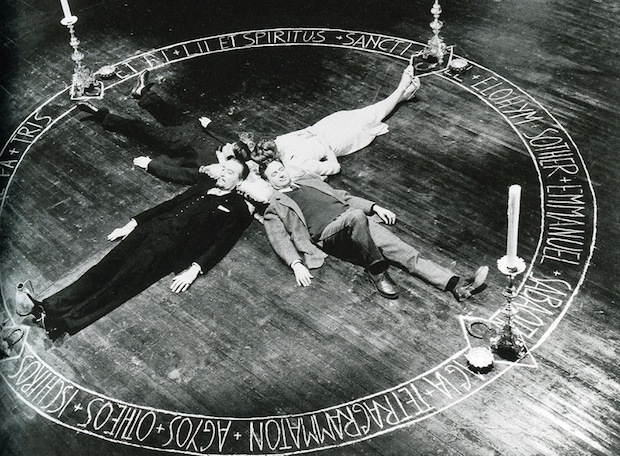
Lee and Gray are bolstered by some nice supporting performances from the likable Patrick Mower (Cry of the Banshee) and from Niké Arrighi (The Perfume of the Lady in Black) and Leon Greene (Flash Gordon, The Seven Percent Solution) as the doomed lovers who provide some real emotional depth to the film. And of course, anyone interested in Satanic cinema will love that the occult action is evident from the great opening credits onwards and basically never slows down. Matheson allegedly did research into some of Crowley’s own rituals for his script and delved pretty extensively into occult history. There are a variety of colorful Satanic rituals and one of the film’s best scenes involves a defensive ritual led by Christopher Lee, where the majority of the cast is stuck behind an elaborately drawn chalk circle.

It goes without saying that The Devil Rides Out comes with the highest recommendation and if you are on the fencing about delving into Hammer’s catalogue, this is a great place to start. Pick it up on region B Blu-ray — for those in the UK or with region-free players — or on region 1 DVD. I really wish Charles Gray had done more with Hammer, but he is damned enjoyable here and is one of the few actors other than Peter Cushing who is able to go toe to toe with Sir Christopher Lee.

Side note: This is one of a few films that uses the occult to provide an enforced happy ending, but for once I'm not upset about it at all.

Sunday, January 24, 2016

THE WITCHES

Cyril Frankel, 1966
Starring: Joan Fontaine, Kay Walsh, Alec McCowen, Ann Bell

“Give me a skin for dancing in.”

Gwen is working in Africa as a missionary when she is caught in the middle of a tribal rebellion and is brutally attacked by a witchdoctor. Some time later, after she has recovered in England, she’s offered a job teaching in a small country school by wealthy local Alan Bax and his sister Stephanie. Though she first regards the village of Heddaby as idyllic, she begins to notice signs of witchcraft — for instance a boy falls ill, Gwen finds a voodoo doll, and a man is suspiciously killed — and before she knows it, she has a relapse and breaks down again, to recover a year later, convinced the citizens of the town are dangerous witches that must be stopped before a young girl is sacrificed.

One of Hammer’s most neglected films, The Witches fits in a strange place in their oeuvre. It’s not quite as theatrically supernatural as their other witchcraft films like The Devil Rides Out or To the Devil a Daughter, but borrows plenty from their more underrated suspense films such as Paranoiac and Hysteria. Released just two years before Polanski’s Rosemary’s Baby, The Witches really doesn’t even feel like a Hammer film, but is in the vein of producer Val Lewton’s films, particularly The Seventh Victim, where the horror is subtle and understated and it’s often not clear whether the threat is real or in the mind of the protagonist.

This especially doesn’t feel like a Hammer film, because it lacks any of the studio’s recurring cast members or major stars, but benefits from a great — and final — performance from Joan Fontaine. Her character of Gwen is similar to her turn as the persecuted heroine in Rebecca more than 20 years before: innocent and sweet, but canny, aware of the danger that may befall her even though no one quite believes her. Another Hitchcock actress, Kay Walsh (Stage Fright) acts as a very strange foil as the antagonist Stephanie, who is not up against Gwen, but wants to recruit her to the cause. Walsh is overshadowed by Alec McCowen (yet another Hitchcock actor, most recognizable from his brilliant turn as the inspector in Frenzy) as the strangely perverse Alan, a man who pretends to be a priest and is clearly haunted by some unspoken trauma.

These demented siblings are right out of Hammer’s suspense films — their neurotic excess is on the same plane (if not as grandiose) as Oliver Reed’s in Paranoiac — and the seemingly rational Stephanie is every bit as nuts as her brother Alan. SPOILERS: In the film’s big twist, which occurs basically ten minutes before the movie is over, is that Stephanie is the head of a local coven and wants to sacrifice a teenage girl in order to attain youth and immortality. Or some such nonsense. Gwen’s assault is a powerful specter that looms over the film and it’s a shame that the second half of the film doesn’t exploit this nearly as well as the first, where there are such quietly symbolic scenes as a local butcher enthusiastically skinning a rabbit before he seems it to Gwen. She remarks that Heddaby seems “a nice place to get over things,” and when hiring her, Alan intentionally exploits her experience in Africa, pushing her to the point of near hysteria.

The Witches exists in a strange place in terms of occult cinema history, landing in the middle of two waves, but not quite fitting in with either. It was certainly influenced by the excellent, understated British horror films of the late ‘50s and early ‘60s — such as Night of the Demon, The Innocents, The Haunting, and Night of the Eagle but also acts as a quiet precursor to the more explicit films later in the decade like Rosemary’s Baby, The Devil Rides Out, Curse of the Crimson Altar, Wicker Man, and Blood on Satan’s Claw. Like Hammer films The Reptile and The Plague of the Zombies, as well as the slightly later The Oblong Box, it maintains a strong connection to the colonial themes that seem to haunt British horror at around this time.

Nigel Kneale’s (Quatermass and the Pit, The Abominable Snowman) script — from Norah Lofts novel The Devil’s Own — originally had elements of black comedy that were later removed, which is a real shame, as I think it would have made the film’s absurdities a little easier to swallow. In addition to the unbelievable twist — where Stephanie becomes Gwen’s champion and initiates her into the coven, hoping they can perfect the ritual together — the ritual sequence is pure camp. The “orgy” is really a group of fully clothed, middle aged people performing what looks like an avant-garde dance piece. 

Thanks to these two blunders, The Witches just can’t compare with the weirder and more stylish Eye of the Devil, another nearly forgotten supernatural horror film made in Britain in the same year. With that said, it’s definitely worth watching for any Hammer completists or anyone who enjoys understated occult horrors — of which there are definitely not enough of in the world. Pick it up on DVD in the US or on Blu-ray in the UK.

Sunday, October 4, 2015

Satanic Panic: Pop-Cultural Paranoia in the 1980s

I recently had the good fortune to be included in Spectacular Optical's second film anthology, Satanic Panic: Pop-Cultural Paranoia in the 1980s. Edited by film writers and programmers Kier-la Janisse (House of Psychotic Women) and Paul Corupe (Canuxploitation), this impressive volume was released a few months ago and is focused on various aspects of the Satanic Panic: the decade-long fear of a Satanic conspiracy that gripped the US, Australia, Canada, and the UK in the 1980s and into the early ‘90s.

Convinced Satan lurked everywhere, the media, government, Christian right, and parents targeted pop culture from music videos to role playing games, and more. The book's various chapters discuss things like the memoir Michelle Remembers, Russ Martin’s satanic erotic novels, Dungeons & Dragons, Christian propaganda, kids’ cartoons, horror films, news broadcasts, music censorship, MTV, heavy metal, Christian rock, and crimes like the McMartin trial and Ricky Kasso case. My own chapter is on heavy metal horror films like Trick or Treat, Rocktober Blood, The Gate, Black Roses, and many more.

In addition to Janisse and Corupe, some of my fellow writers include Gavin Baddeley (Lucifer Rising: Sin, Devil Worship and Rock n’ Roll), Rue Morgue’s Liisa Ladouceur and Alison Lang, David Flint (Sheer Filth!), Alexandra Heller-Nicholas (Rape Revenge Films: A Critical Study), Flavorwire’s Alison Nastasi, and many more. There are original illustrations from Rick Trembles and Mike McDonnell, and it's packed with stills, posters, comics, and plenty of great visuals.

The book is also the subject of a worldwide tour, with events and film screenings throughout Canada, in London, Austin, Australia, Boston, New York, and more. I'm conducting tonight's book launch in Philadelphia at PhilaMOCA. Join me at 7 p.m. for a multi-media tour of the satanic 1980s. Admission is $10 and I'll be selling books after the presentation. Happy Halloween!

Thursday, February 13, 2014

SATAN'S SCHOOL FOR GIRLS (1973)

David Lowell Rich, 1973
Starring: Pamela Franklin, Kate Jackson, Lloyd Bochner, Jamie Smith Jackson, Cheryl Ladd

A pretty young student, Martha, is on the run from something unseen and leaves her exclusive boarding school, the Salem Academy for Women, to flee to her sister Elizabeth’s apartment. Elizabeth and the police find her dead and hanging, but Elizabeth refuses to believe it’s a suicide. When the police won’t help her, she enrolls in Martha’s school to learn more. She immediately notices odd things: Martha’s old roommate warns her not to go, one of the girls at the Academy has a breakdown, and soon commits suicide. She finds a strange room in the school and convinces another girl, Roberta, that something is going on and they believe the strange psychology professor may be responsible. Elizabeth doesn’t realize that she is in far over her head and the conspiracy is more malevolent than she fears. 

Produced by television schlockmeister Aaron Spelling, Satan’s School for Girls has an almost equal balance between chills and cheesiness. In many ways, this is the poor man’s made-for-TV version of Dario Argento’s Suspiria mixed with a hefty dose of Brotherhood of Satan. As with Suspiria, there’s a girls boarding school, though focused on art instead of dance, a girl who runs away from school to her sister’s apartment and is hanged by a mysterious intruder, a death in a creepy attic, and more. There’s some nice imagery in the school, including cluttered basements and attics, candlelight, storms, blackouts, and a heavy Gothic feel, though this is obviously nowhere near the same level as Suspiria in terms of visuals. 

The early ‘70s was a great time for TV horror, including the two Kolchak films, Don’t Be Afraid of the Dark, Bad Ronald, Trilogy of Terror, and others, as well as a bevy of successful horror-influenced shows like Twilight Zone and Dark Shadows. As with the other acclaimed horror TV productions of the ‘70s, Satan’s School for Girls has no nudity and little on-screen violence, but there are several murder-suicides, a satanic plot, and cult full of ‘70s babes. 

There is some average, TV-quality cinematography and lousy editing, but there are surprisingly good performances and a very entertaining conclusion. Yes, there are some cheesy and unintentionally hilarious moments, but that just adds to the charm of Satan’s School for Girls. Though the title is outrageous and wonderful, it does sort of give away the direction in which the film is heading, but isn’t quite as Russ Meyer-like as I would have hoped. 

Lovely British horror actress Pamela Franklin (And Soon the Darkness, Legend of Hell House) stars and gives a solid performance as the curious and driven, though innocent Elizabeth. She’s accompanies by Charlie’s Angels Kate Jackson (also Dark Shadows) and Cheryl Ladd, who are both lovely to look upon and convincing in their roles as somewhat naughty school girls. Lloyd Bochner (Point Blank) and Roy Thinnes (Dark Shadows) co-star as the two professors with opposing philosophies.

Director David Lowell Rich does a competent, if workmanlike job and also directed Eye of the Cat (1969), A Lovely Way to Die (1968), The Horror at 37,000 Feet (1973), etc. Interestingly, the film was written by Arthur A. Ross (Creature from the Black Lagoon), who introduces some intriguing plot points that aren’t really played out to the fullest, such as the fact that none of the girls admitted to the school have any real family members. Something about this and the suicides feel a little like the superior Seventh Victim — a masterpiece of female isolation and suicide — and should have been further explored. 

Satan’s School for Girls is available on DVD in two different editions. Though it doesn’t completely succeed as a work of ‘70s satanic horror, it’s still a worthwhile entry in the ‘70s TV horror canon and comes recommended. The film was also remade in 2000 with Shannon Doherty, adding another layer to the strange Aaron Spelling connection.

Thursday, January 2, 2014

THE SENTINEL (1977)


Michael Winner, 1977
Starring: Cristina Raines, Chris Sarandon, Martin Balsam, Burgess Meredith, Beverly D’Angelo, Ava Gardner, José Ferrer

A beautiful, but troubled model is proposed to by her lawyer boyfriend, Michael, but she decides that she needs a little space before accepting. She moves into an old, but lovely brownstone in Brooklyn. Her neighbors are very odd, including a blind priest who sits by the window, an old man who throws a birthday party for his pet cat, and two “sisters” who are actually lesbians. Alison’s father dies and some of her neurotic history begins to return, including fainting spells, nightmares, and elements of PTSD. She later learns from her real estate agent that none of the people - except for the blind priest - live in the building and she apparently hallucinated the whole thing. 

Her suicidal thoughts return as she learns that the apartment building is not what it seems and hallucinations begin to consume her life. After one particularly terrifying night, she thinks she killed her father, though he is already dead. She and Michael learn that a group of strange, excommunicated priests own the building. They believe that it is a gateway to Hell and a new guardian is needed...

Based on Jeffrey Konvitz’s novel of the same name, Konvitz and director Michael Winner co-wrote this late ‘70s occult film that will appeal to lovers of the weird and unexpected. Part of The Sentinel’s charm is that so many elements - even those that ultimately come across as unsuccessful or tasteless - are unexpected. The screenplay feels original, even though it obviously borrows from other ‘70s Satanic horror and the earlier Rosemary’s Baby. There are many scenes that are effectively creepy, including a believable and unsettling nightmare scene.

Director Michael Winner is probably best remembered for Charles Bronson revenge classic Death Wish, as well as Oliver Reed vehicle Hannibal Brooks, a prequel to The Innocents - The Nightcomers - starring Marlon Brando, etc. While the directing isn’t all that inspired and relies heavily on the zoom lens, there are some wonderful shots of New York in the ‘70s in the beginning of the film that move deeper and deeper into the increasingly claustrophobic apartment building.

Cristina Raines (The Duellists) stars as Alison and though I’ve heard some complaints that she gives a flat performance, I think she is convincing as the shallow, troubled Alison. Chris Sarandon (Princess Bride, Fright Night) seems out of place as her mustachioed lawyer boyfriend whose questionable past emerges throughout the film. He looks so dated that it’s difficult to look at him without laughing, but at least he doesn’t have to wear the kind of costumes that he would later in Fright Night

There are dozens of cameos from now-famous actors like Martin Balsam, John Carradine, José Ferrer, Eli Wallach, Jerry Orbach, Christopher Walken, and Tom Berenger, among others. The most memorable is probably from Beverly D’Angelo (National Lampoons Christmas Vacation), who openly masturbates in front of Alison when she visits her neighbors for the first time. The lovely Ava Gardner plays Alison’s fashionable and elegant real estate agent and Burgess Meredith is great as her incredibly creepy neighbor. He becomes the ringleader of the tenants of the disturbing brownstone and adds a layer of the truly disturbing to the proceedings.

The Sentinel is far from perfect and suffers from a number of flaws, including an occasionally dragging pace. The film’s most surprising and offensive element is the conclusion, which introduces a number of physically deformed people as habitants of Hell. In poor taste to say the least, but it adds an element of exploitation that I can’t help but enjoy. Freaks it is not, however, and none of these actors or extras are presented with the least bit of empathy or understanding. While the entire film is steeped in a shallow obsession with the physical, centered on Alison’s unhealthy fixation on her appearance, it really culminates in the twisted conclusion. 

The Sentinel is available on DVD and is definitely worth checking out, even if it is an acquired taste and has some questionable elements. Anyone who enjoys ‘70s occult horror will find plenty to enjoy and the ending is a must-see. 

Monday, December 30, 2013

SATAN'S BLOOD


Carlos Puerto, 1978
Starring: Angel Aranda, Sandra Alberti, Mariana Karr, Jose Maria Guillen

Escalofrio (which means chills or shivers in Spanish) aka Satan’s Blood concerns a young married couple, Ana and Andres, who are out looking for an amusing weekend. They run into another couple, Bruno and Berta, who claim to be long lost old friends. They reluctantly agree to follow Bruno back to the couple’s house, though they don’t really recognize them. Unfortunately the house is a far drive out into the country. At the house the foursome immediately launch into a game with an elaborate Oujia board, which reveals some nasty secrets about both couples. Things take a turn for the menacing and confusing. Andres and Ana let themselves be bullied into staying the night and a number of events occur that make it unclear whether Bruno and Berta are benevolent Satan worshippers or have some other sinister purpose. 

If you’ve been reading this blog - or happened to glance at the title - you can probably guess that I love Satanic cinema. Any piece of ‘70s trash that has a hopefully naked girl hopefully covered in blood and worshipping Satan will glue my ass to the couch for an hour or two. Of course, there are plenty of Satanic films that mention Satan a couple of times, but otherwise waste an hour or more hinting at Satanic, sexual, and violent pleasures that will never unfold on screen. I can promise you that Satan’s Blood is not one of those films. Sure, it has some slow and silly moments, but overall there is enough gore, Satan, sex, absurdity, and nudity to entertain any horror fan.

Plus there’s an orgy, plenty of death, and a twist ending. While those normally irritate me, this one really packs a punch. I didn’t find it particularly surprising, but it was a nice ending to a delightful and little seen cult film. There are some good performances, though chances are you haven’t heard of any of the actors unless you’re very well versed in Spanish cinema. Ángel Aranda is the most famous of the bunch and also appeared in Mario Bava’s Planet of the Vampires and Sergio Leone’s Colossus of Rhodes. Direction was split between Carlos Puerto, who also wrote the film, and Juan Piquer Simón. Puerto directed Spain’s most famous horror star, Paul Naschy, in The Sniper (1977). Simón was responsible for a number of cult films in the ‘80s and ‘90s, including The Pod People, Slugs, The Rift, and Cthulhu Mansion. Most importantly, he directed one of my favorite films of all time, Pieces

Satan’s Blood is definitely recommended and is available on DVD from Mondo Macabro. There are some nice extras. There is an interesting, informative article about how the film fits into ‘70s Spanish cinema. In 1975 (post-Franco) a majority of the censorship in Spain disappeared and a rating known as “Clasificada S” was introduced. Oh yes, the ‘S’ is for sex. I had hoped it would be for Satan, but sex is almost as good. In general it refers to films like Satan’s Blood, which was one of the first to receive such a rating, that deal with sex, nudity, blood, gore, and/or the occult. All the good things in life, in other words. The other extras include an alternate opening, which is from the censored Spanish theatrical release. It is basically a lecture about the existence of evil and Satan, assumedly trying to justify the sex, violence, and Satanism about to follow. There are a variety of still galleries and a pretty cool trailer montage from Mondo Macabro. The best extra is a documentary, “The Devil’s Disciples,” where author and Church of Satan Reverend Gavin Baddeley gives a thorough run down of modern Satanism.

SATAN'S CHEERLEADERS


Greydon Clark, 1977
Starring: Yvonne De Carlo, John Ireland, Jack Kruschen, Kerry Sherman, Jacqueline Cole

Patti, Chris, Debbie and Sharon are young, nubile cheerleaders that get waylaid en route to a football game when their car breaks down. They get picked up by the school janitor, who happens to be a perverse Satan worshipper. The cheerleading coach, Ms. Johnson, is too meek and innocent to protect them when Billy the janitor tries to drive them into the woods and, with the aid of Satan's power, rape them. Unfortunately for Billy, Satan has other ideas. Billy has some sort of attack and the girls, though shaken and suffering slightly from amnesia, escape.

They wander to the Sheriff's house (Sheriff B.L. Bubb, played by the hammy John Ireland) and tell him their troubles. The Sheriff, who we already know is the leader of the local cult, claims he will help them and takes their statements while they wait at his house. One of the girls, snooping around, overhears that the Sheriff and his wife (the sinister Yvonne de Carlo) plan to sacrifice the virgin and kill the rest of them. The girls hatch an escape plan to try to call their parents or go for help, because poor Ms. Johnson has been kidnapped and Patti (the cute, blonde one) has stayed behind as a diversion. Patti, of course, is not all that she seems after her experience in the woods earlier and the cult is in for quite a surprise. 

One of the best worst movies I've ever seen, Satan’s Cheerleaders helps fill that particular void in my life that can only be soothed with movies about satanic cults. Of which I'm developing quite a stock pile, mostly from the ‘70s. The performances are about what you would expect. The four main girls are played by Kerry Sherman, Hillary Horan, Alisa Powell, and Sherry Marks, all of whom went on to do very little, with the exception of some TV episodes and Alisa Powell, who had a small role in The Toolbox Murders (1978). The prolific John Ireland pretty much plumbs the depth of his skills as the duplicitous Sheriff and Yvonne DeCarlo (The Ten Commandments, The Munsters) does her best at menacing the camera. Even the wonderful John Carradine as a cameo and, as always, is a great inclusion. 

Directed Greydon Clark made and acted in a number of exploitation films including Al Adamson’s Dracula Vs. Frankenstein, Hi-Riders, Uninvited, and Joysticks. I can’t say that his skill is dazzling, but whether intentionally or not, some of the scenes in Satan’s Cheerleaders are side-splittingly hilarious. 

This movie is ridiculous. I'm not sure if it's a horror-comedy or just a bad horror film, but it will appeal to the same type of viewers who are transported with delight every time they think about Psychomania or Werewolves with Wheels. In other words, its a typical '70s B-movie with a Satanic conspiracy, slutty cheerleaders, and brain dead dialogue. Nothing makes any sense, but it's wonderful regardless. With a few notable exceptions (Rosemary’s Baby being the most popular), there aren't a lot of well made, competently scripted Satanic films, but I love many of them anyway. Satan’s Cheerleaders is high on that list, simply because it is so much fun. 

It comes highly recommend, particularly if you want a fun party movie for a bunch of drunk horror fans. There is a cheap DVD available from VCI, but this is about the best you can expect. Though it isn't going to make any money in the near future, someone out there obviously loves it as much as I do. There is actually a Satan’s Cheerleaders tribute site that has the trailer, facts, trivia, a detailed synopsis, tons of sound clips, stills, links to actor info, and an extensive list of review links.

Aura Precis Mea, Satana Blessed Be.

Sunday, December 29, 2013

ALUCARDA

Juan Lopez Moctezuma, 1978
Starring: Tina Romero, Claudio Brook, David Silva, Susana Komini, Tina French

Alucarda, a wild girl seemingly not of this earth (she really reminds me of Pearl in Hawthorne's The Scarlet Letter) has been orphaned and is growing up at a convent. She may or may not be the child of the Devil. When young Justine is brought to live at the local convent after the death of her parents, Alucarda immediately befriends Justine and comes to love her. Despite the naiveté and innocence of both the girls, they flirt with lesbianism and satanism. They form a strange pact over the coffin of a supernaturally deformed corpse (named Lucy Western!), which begins their subsequent demonic possession and downward spiral into exorcism, death, nudity, and blood a-plenty.


Alucarda, la hija de las tinieblas aka Alucarda, the Daughter of Darkness holds a very special place in my heart and indeed is a very special film. Made in Mexico by Juan Lopez Moctezuma, close friend of the great Alejandro Jodorowsky, Alucarda is one of those films that both blends genres and defies convention. There was a brief period of time in Mexican film history where horror or fantasy weren't given much attention aside from the schlocky, but lovably Santo canon. Alucarda slid in to cult and horror cinema at the proper time and place. Though it is undoubtedly part of the satanic horror canon, there is nothing quite like it. If you’re a big fan of genre cinema, chances are high that you will absolutely love it. If you’re more into classic or mainstream cinema, you may be a bit confused. There are some parts that come across as a little silly, but for the most part this is a powerful, effective film that expresses the unique vision of a director overshadowed by his more imaginative friends and sadly overlooked by a government with other priorities. 

There are a number of things that set Alucarda apart. First and foremost are the disturbing and interesting costumes. Instead of the traditional black and white habits, the nuns look almost mummified, wrapped tightly in white shrouds. The shrouds are oddly stained with red, giving the nuns the appearance of having bled all over themselves. The set is beautiful and sufficiently creepy, alternating between the woods and the cave-like convent. The plot blends elements of Satan worship/possession and vampirism, yet unusually presents both girls -- Justine and Alucarda -- as inherently innocent. Though Alucarda invokes the Devil on a number of occasions, it seems to be some sort of inherent compulsion, given to her by genetics rather than a real desire to spread evil. Like Walerian Borowczyk’s nunsploitation masterpiece Behind Convent Walls, this plot element gives Alucarda a piercing commentary on the Church, which adds another layer to its already interesting and complex framework.

Based loosely on Sheridan le Fanu’s popular horror novella Carmilla, Alucarda has plenty of shocking subject matter. Aside from lesbianism, vampirism, and Satan worship, there are orgies, blasphemy, exorcisms, and murder. Ignored at the time of its release and still somewhat neglected, Alucarda has deservedly attained cult status. 

Sure, there are some silly and cheesy moments, but this is more a product of the time and less a criticism of the actual film. Overall it comes very highly recommended. There is a nice DVD available from Mondo Macabro, which is affordable, readily available, and has a number of nice special features. There is a 15-minute long documentary, which goes in-depth about Moctezuma, his involvement with Jodorowsky, the Mexican avant-garde scene, and the political issues of the Mexican film industry. There is a well researched text of Moctezuma's life, a filmography, and an interview. Randomly, there is a brief interview with director Guillermo del Toro, who comes across as intelligent and well-informed, and, as always, wildly excited. 

Thursday, December 26, 2013

RACE WITH THE DEVIL

Jack Starrett, 1975
Starring: Peter Fonda, Warren Oates, Loretta Swit, Lara Parker

Two couples - Roger and Kelly, Frank and Alice - pack up a brand new RV and drive across country for a skiing vacation in Colorado. Roger and Frank own a motorcycle dealership together and frequently race during the long drive. Their fun is interrupted in rural Texas when Roger and Frank accidentally witness a Satanic ritual. At first they think it is an orgy, but soon a woman is killed and the Satanists know that someone is on to them. They group begins to chase the RV and the couples barely escape with their lives. 

Roger and Frank report the incident to a local sheriff, while Kelly and Alice borrow some occult books from the library to try to decipher a strange note the Satanists left in a broken window of the RV. Just when they think they’ve escaped a number of strange things happen: their dog is murdered, rattlesnakes are planted in the RV, and the sheriff has begun to follow them. They buy a shotgun to protect themselves, but wind up in a vehicular battle with the Satanists. Will they ever escape?

Somewhat banking on the reputations of stars Peter Fonda and Warren Oates, Race with the Devil is sort of a twist on the types of films both actors appeared in during this period of their careers. Fonda loved doing his own stunts and performed many of them here, including the scene with the rattle snake inside the RV. By this time, he was known for Easy Rider and Dirty Mary Crazy Larry. While Fonda was associated with chase films and action movies, Oates was known for a number of westerns and his collaborations with Sam Peckinpah, including the Wild Bunch, Dillinger, Return of the Magnificent Seven, and hilarious war comedy Stripes. Oates had also appeared in one of the best chase films of all time, Two-Lane Blacktop. Fonda and Oates were also in The Hired Hand and 92 in the Shade together.

Loretta Swit and Laura Parker are memorable as the two wives. The female characters are pretty likable and perhaps a little more personable than I first expected. Loretta Swit was most famous for her role in MASH and Laura Parker had a long standing role in Dark Shadows as one of my favorite characters, Angelique. R.G. Armstrong also made an appearance as the Sheriff and would be known to genre fans for films like Evilspeak, Boss Nigger, and Children of the Corn.

Director Jack Starrett did a solid job with Race with the Devil and has a decent action/exploitation history overall. He also made the somewhat similar A Small Town in Texas and a number of blaxploitation films, namely Cleopatra Jones, as well as directing episodes of Dukes of Hazzard. Starrett previously blended genres with the biker war film The Losers, though Race with the Devil was his most financially successful.

Race with the Devil is not a perfect film and suffers from some typical ‘70s B-horror issues. The film’s main problem is that it tries to combine occult horror and the action/chase movie, combing entertaining elements of both but not really acing either one. The satanic cult, for instance, is so widespread and well connected that this plot point is simply ridiculous and feels overly contrived. The cult was also written to be fairly generic and merely provide the background for rural paranoia. The writers - which include exploitation director Lee Frost (The Thing with Two Heads) - could have done a lot more here. Regardless of these flaws, it was a huge hit on its release and has become a minor cult classic.  

Undeniably, there are a lot of entertaining things about Race with the Devil. Despite some of the film’s more ridiculous moments, the conclusion is well directed and perfectly climactic, ending with a ring of fire and a surprise twist. The feeling of suspense and dreads runs solidly through the second act and builds towards the conclusion. There are some nice chase scenes, including the one where Fonda fires a shotgun from the top of the RV. There’s also an enjoyable score from Leonard Rosenman (Prophecy), particularly the delirious opening theme.

Race with the Devil comes recommend and will appeal to a relatively large number of genre aficionados as it is a car chase film where the antagonists are not cops or a rival gang, but Satanists! The film has been released on DVD - though it has one of the worst covers I’ve ever seen - and on split DVD or Blu-ray with Dirty Mary, Crazy Larry

Tuesday, December 24, 2013

THE DEVIL'S RAIN

Robert Fuest, 1975
Starring: William Shatner, Ernest Borgnine, Tom Skerritt, John Travolta

Mark Preston must face off against Corbis, a Satanic priest who has cursed his family for several generations after they betrayed him and stole a powerful Satanic book. To get revenge, Corbis causes Mark’s father to melt in the rain and then forces his mother to join his Satanic church. Mark travels across the desert to the ghost town where Corbis’s church is located. They have a battle of faith, which Mark fails when he tries to shoot Corbis. He is captured and tortured. 

Meanwhile, Mark’s brother Tom and his psychic wife Julie hear about the fate of their family and go to investigate. Tom unfortunately witnesses his brother’s Satanic transformation during Corbis’s ritual, but learns the source of Corbis’s power. Can Tom, Julie, and their friend Dr. Richards, a psychic researcher, defeat Corbis in time? 

Though so far I’ve reviewed a couple of pretty great ‘70s Satanic horror films - Messiah of Evil and Werewolves on Wheels being two of my favorites - The Devil’s Rain is the ideal introduction to B-grade American satanic cinema of the ‘70s. Despite its low budget and unrelenting cheese, its air of undeniable weirdness makes it watchable almost 40 years later. Where else, for instance, can you see William Shatner satanically sacrificed and turned into an eyeless, wax abomination? Where else can you see Ernest Borgnine transform into a bearded, goat-horned devil?

The cast is impressive and there are a number of familiar faces from genre films. William Shatner and Ernest Borgnine absolutely carry the film and reach a level of histrionic acting that must be seen to be believed. They are the real reason to see The Devil’s Rain. Noir actress and director Ida Lupino (Food of the Gods) appears as Mark’s mother and George Sawaya (Repo Man) has a brief role as his father. Tom Skerritt (Alien) as Mark’s brother takes over halfway through the film as protagonist. He’s my only major complaint and his naturally serious demeanor just comes across as dull here. After such hammy performances from nearly everyone else in the cast, Skerritt is far too wooden and takes the production too seriously. 

John Travolta made his film debut here and dies quite spectacularly. There are also appearances from Woody Chambliss (Gargoyles), Eddie Albert (Dreamscape), Keenan Wynn (Piranha), and Erika Carlsson (Tintorera). Anton LaVey (founder of the Church of Satan if you’ve been living under a rock) was a satanic consultant on the film and also had a bit part. I can’t help but wonder what he thought of the film. 

Director Robert Fuest made a career in genre cinema with And Soon the Darkness, as well as the wonderful Vincent Price vehicle The Abominable Dr. Phibes and its sequel Dr. Phibes Rises Again. Sadly The Devil’s Rain effectively ruined his career because it flopped so badly, but has come to be regarded as a cult classic. The film looks undeniably cheap, but there are some nice production values, including the most ridiculous satanic stained glass window I’ve ever seen. With Phibes, Fuest also proved his sense of style and visual prowess. While The Devil’s Rain doesn’t quite reach those candy colored, art deco heights, there are some very interesting and genuinely creeping things going on here. My favorite part of the film - aside from Ernest Borgnine - are the Satanists themselves. For some reason the script never bothers to explain, Corbis uses “the Devil’s rain” to transform his followers into waxen looking figures with completely empty eyes. 

There are also plenty of ridiculous things going on. Shatner waves around an absurd magic amulet and he and Borgnine have a prayer off, with one shouting Christian prayers and the other shouting Satanic. Guess who wins? The ending, which is hard to really do justice to, involves about ten minutes straight of satanists melting. A final criticism is that it’s a shame that the film had a PG rating, because I think it could have gone a bit farther with the sexual elements of Julie’s kidnapping and intended sacrifice. There’s also a scene where Mark, while tied down, tortured, and prepared for sacrifice, accidentally attempts to kiss his hollow-eyed, presumably undead mother. Fuest could have taken that a bit further as well. 

I fear that my review of The Devil’s Rain makes it seem like a better film than it actually is. Make no mistake, it is compelling and watchable, but it works despite itself. Fans of cheesy cult cinema will love it, though I suspect everyone else will be baffled. That’s not such a bad thing. The Devil’s Rain is available on DVD and comes recommended. 

Thursday, December 19, 2013

THE MEPHISTO WALTZ

Paul Wendkos, 1971
Starring: Alan Alda, Curd Jürgens, Jacqueline Bisset, Barbara Perkins, Bradford Dillman

An unsuccessful pianist and middling music writer, Myles Clarkson, has the once in a lifetime opportunity to interview Duncan Ely, the world’s greatest living concert pianist. Ely takes an immediate liking to Clarkson when he notices the younger man’s perfect hands. Clarkson begins spending a lot of time with Ely and his beautiful, yet creepy daughter Roxanne, much to the irritation of Clarkson’s wife Paula. It turns out that Ely is dying of leukemia and is also part of a group of Satanists. When Ely is on his death bed, he and Roxanne perform a ritual that transfers his spirit/consciousness into Clarkson’s young, healthy body. 

Clarkson changes over night and rapidly becomes a famous pianist. Paula celebrates some of these changes, but also struggles with them. Her husband becomes busier and busier and obviously begins having an affair with Roxanne. Clarkson and Paula’s daughter dies, eventually pushing Paula into action. She begins investigating Roxanne and learns about the satanic cult. Paula realizes that she must face off against Roxanne and Clarkson before she is killed as well. 

Based on Fred Mustard Stewart’s (I can’t help it, but I think his name is hilarious) novel of the same name, The Mephisto Waltz is entertaining, but deeply flawed. The biggest criticisms I’ve read of the film seem to be centered around the fact that this is not Rosemary’s Baby. Duh. The title is probably a good indication of that. Unlike many other early ‘70s genre efforts, which were outright B movies, The Mephisto Waltz was made by a major studio and received general release. It also had the misfortune to be a satanic horror film stuck between Rosemary’s Baby and The Exorcist, which had not yet been released. 

Its flaws are few and easily numbered. Despite the great opening and concluding scenes, there is quite a drag in the middle of the film. The beautiful Jacqueline Bisset is quite good here, but Paula is the main character and most of the weight of the film is on her. She was definitely hampered by the script. It takes her character ages to figure out what is going on with her husband and then when she does, she sits around for half the film and doesn’t do anything about it. This makes her look weak, foolish, and unintelligent, not qualities you really want in a protagonist. When she finally does jump into action, the film really kicks off.

The other major issues is Alan Alda. Though he is wonderful elsewhere, here he was simply miscast and lacks the malevolence or charisma to play Clarkson post-possession. This is thrown into sharp relief by a great performance from Curd Jürgens (The Spy Who Loved Me), whom I love. It’s a shame he isn’t in the film longer, because he is perfect as Duncan Ely. Overall, the acting is a mixed bag, though Barbara Perkins (Valley of the Dolls) is fittingly slimy as Roxane.

Paul Wendkos also directed The Burglar (1957) with Jayne Mansfield, Gidget (1959) with Sandra Dee, several Gidget sequels, and Guns of the Magnificent Seven (1969) among many other films. His direction here is fairly utilitarian, which is a shame. There are some nice visual sequences though, such as Paula’s nightmares and the satanic rituals. 

Though this is a run of the mill occult drama, there are some horror elements that make it worth recommending. First and foremost, there’s an incest subplot. If you’ve been reading this blog at all over the past few years, you’ll know that for some reason I can’t get enough of incest subplots. At least in this case, Ely has the good graces to switch bodies with someone not related to his daughter before he has sex with her. (I think.) There are some other colorful elements, such as a mutated dog, children dying, Satan, etc. There’s no gore, but there is a fair amount of nudity. There’s a also wonderful score from Jerry Goldsmith.

The Mephisto Waltz is available on double feature DVD as part of MGM’s Midnite Movies series with The House on Skull Mountain. In case you were curious, Mephisto Waltz refers to four compositions by the great Franz Liszt. Composed for both piano and orchestra (between 1859-1885), the first is the most famous and is based on Faust. Suitably diabolical. Listen here, because it’s so very beautiful.