Saturday, June 28, 2014

POSSESSED (1947)

Curtis Bernhardt, 1947
Starring: Joan Crawford, Van Heflin, Raymond Massey, Geraldine Brooks

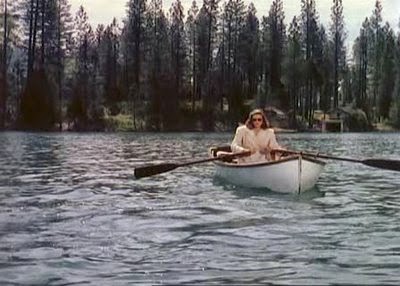
After wandering around the city with amnesia and only able to mutter the name, “David,” a very sick woman is admitted to the psychiatric wing of a hospital. As she recovers, a doctor helps her recount her story. She became a nurse for the Graham family and the invalid Mrs. Graham. She had a relationship with one of their neighbors, an engineer named David, but he broke things off after she became obsessive. Meanwhile, the disturbed Mrs. Graham drowns in the lake, presumably suicide. Graham keeps Louise on to care for his children, but soon falls in love with her and proposes marriage. She agrees, although she does not love him, but hopes it will help her get revenge on David. Sometime later, David comes back into their lives due to a work contract, and develops a relationship with Carol, Louise’s new stepdaughter. Louise’s obsession with him renews and she slowly becomes more and more unhinged… 

This strange blend of melodrama and film noir is an unusual entry in ‘40s cinema. It bears something in common with The Letter, Nora Prentiss, and Mildred Pierce, but is a convincing portrayal of one woman’s descent into madness. Joan Crawford was nominated for an Academy Award for Best Actress for her incredibly strong performance. She spent time interviewing psychiatrists and observing mental wards, which went wrong when one woman later sued Crawford and Warners Bros. The woman did not consent to Crawford and a few other studio people observing her electroshock therapy treatments.

Crawford’s Louise is the ultimate representation of the confusion — and mania — surrounding changing gender roles in the wartime and postwar worlds. In addition to her somewhat subservient, traditional occupation as a nurse, she longs for a traditional romantic role and wants David to marry her. He blames his profession and desire to move around from place to place, a literal way to avoid settling down. Like the film noir hero, he remains single and there is something unlikable about him, something not entirely masculine. Van Heflin (The Strange Love of Martha Ivers) is fittingly smarmy as David. The line between his complicity in Louise’s behavior is pleasantly blurred, making his role in the film less cut and dried.

Raymond Massey gives a solid performance, but his character — Mr. Graham — is as baffling as all the others. Why does he love Louise? Why does he insist on marrying her even though he knows she doesn’t love him? To the film’s credit, she does seem to warm up and begin to enjoy their life — he is a stable, positive contrast to David — but David’s constant appearance and her mania banishes this fleeting marital bliss. There is also a chilling air of manic depression about her interest in dining and dancing with her husband; her sudden, unexpected highs are simply too high, not believable.

The script leaves many questions unanswered and introduces too many ideas. For starters, Mrs. Graham’s suicide out on the lake makes this feel like a film noir and murder mystery, particularly with the eerie lake setting. Nothing is resolved and it doesn’t go anywhere, which is a shame. Louise’s insanity is another unanswered question. It seems that there should be some past trauma intruding on her life, but this is never addressed. Her obsession with David and subsequent possessiveness is simply a fact in and of itself. The one benefit to giving few explanations to any of the events is that it gives the film a dream-like quality, almost a fever dream as Louise wanders in and out of sanity.

Though there are plenty of melodramatic elements, there is a lot of film noir mixed in. Noir elements include flashbacks, fog, stark lighting, odd angles, and POV shots. The bleak ending is not at all redemptive, but there is some small hope for Louise’s recovery. Her husband, bafflingly, continues to standby and support her even though she is catatonic, insane, and a murderess. Louise’s mental breakdown scenes are oddly reminiscent of climactic moments from The Two Mrs. Carrolls and The Spiral Staircase, when women are trapped at home during the middle of a violent thunderstorm. In the latter two films, they are being pursued by violent killers, where as Louise is only being terrorized by her own mind.

On a final note, Geraldine Brooks is very likable as Louise’s step-daughter Carol, who is at first angry and resentful, but quickly warms to Louise’s presence in her family home. There is a slight echo of Mildred Pierce, with the spoiled, resentful daughter, but Carol’s cheery, light-hearted personality is a nice contrast with Louise’s growing sense of paranoia. Also keep an ear out for Franz Waxman’s wonderful score with elements of the Theremin to make Louise seem even crazier. Possession is available on DVD and comes recommended, particularly for fans of women-centric films noir and movies about portrayals female madness. Crawford might not hold a candle to Gloria Swanson’s Norma Desmond, but she is excellent in this thoroughly unglamorous role nonetheless. 

Thursday, June 26, 2014

NORA PRENTISS

Vincent Sherman, 1947
Starring: Ann Sheridan, Kent Smith, Robert Alda

Dr. Richard Talbot has an accidental run in with night club singer Nora Prentiss. She is hit by a car on the street in front of his office, so he treats her minor bumps and bruises. Talbot has been feeling constricted by his nagging wife and the precise, ironclad routine of his life. He and Nora clumsily begin an affair and his life changes almost overnight – he becomes selfish, neglectful, and constantly tardy. Unable to leave Nora and unable to ask his wife for a divorce, Talbot fakes his own death when a patient happens to die in his care one evening. He flees east to New York and begins a new life with Nora. Unfortunately, he becomes consumed with paranoia, convinced the police are a step behind him and they will never have any peace…

Nora Prentiss is an odd entry into the female-centric noir films of the mid to late ‘40s. It seems like it should be far more melodrama than it is and contains a number of interesting twists. The plot has a number of holes, but is pleasantly complex. Though the advertising suggests otherwise, the titular Nora Prentiss is not a femme fatale – she’s not even the protagonist, actually – she’s just a good-hearted nightclub singer looking for someone to love her. She does not actively contribute to Richard’s destruction – that is all of his own doing. She accepts that he must leave her for his wife and family and even leaves town to remove the temptation. It is Richard’s own insane idea to fake his own death and flee with her to New York; bizarrely, he doesn’t tell her about this until weeks into their trip when he begins to feel jealous or paranoid. She doesn’t leave him or cheat – though she has the opportunity to do both – and she sticks with him until the bitter end.

Actually, most of the film’s characters turn out to be different than they are initially presented and almost opposite than they would be in a more formulaic, conventional film noir. Robert Alda (The Man I Love) puts in a surprising turn as a nightclub owner with genuine feelings for Nora, while the sinister-looking Bruce Bennett (Dark Passage) is wildly miscast as a doctor. Seriously, the man constantly looks like he is either in the midst of plotting or executing a crime. The dependable John Ridgely (The Big Sleep) has a small role here as an unfortunate medical patient and looks extra handsome. Rosemary DeCamp (Yankee Doodle Dandy) is also well-cast as Richard’s understanding, well-meaning, and yet nagging wife. She could have easily turned into a shrew, such as the wife from Humphrey Bogart film Conflict (1945), which would have justified Richard’s increasing need to break free of his dull, confining life. Fortunately, the script does not make things that easy for him.

I don’t have a lot to say about star Kent Smith (Cat People). He was perfectly cast, but the dependable suburban-dad-gone-wrong is just not a character-type I enjoy or find interesting. He essentially plays the same character in the superior Cat People and Curse of the Cat People alongside Jane Randolph, whose all-American, world-wise yet goody-two-shoes sensibility is so similar to Ann Sheridan. Speaking of Sheridan, she seems almost miscast here, despite a solid performance. If you want to see her in an early noir, she’s absolutely adorable in They Drive By Night. Probably her biggest role was in I Was a Male War Bride, where she costarred with Cary Grant. It’s just difficult to believe that such a repressed, straight-laced character – Richard – would leave his regimented life of domestic bliss for someone as nice and as dependable as Nora. While this element certainly sets the film apart, it feels unbelievable.

Though it has its share of slow moments, there is plenty of doom, gloom, and frustration in Nora Prentiss to keep this moving towards its inevitable, if somewhat ridiculous conclusion, which I won’t spoil here. There’s some solid direction from Vincent Sherman (The Unfaithful, The Damned Don’t Cry, The Letter), who helmed his fair share of female-centric melodramas and films noir. James Wong Howe provides some excellent cinematography; the series of shots that open and close the film are absolutely mesmerizing and I spent much of the second act wishing for more of these. His expert use of expressionist shadows and angles elevates this to far more than the mediocre affair that it otherwise would – or should – have been. One of the film’s concluding shots is particularly breathtaking – Nora and Richard speak to each other through the mesh window of a jail’s visiting room. On one hand, it looks very much like a screen in a church confessional booth, and on the other, it looks like the character behind the mesh is slowly melting away to nothing.

Available on DVD, Nora Prentiss is not a must-see, but will please fans of more obscure, gloomy noir films with a suburban focus. It will also interest anyone who has seen a lot of films noir and is tired of the tried and true formula.

Wednesday, June 25, 2014

GILDA

Charles Vidor, 1946
Starring: Rita Hayworth, Glenn Ford, George Macready

“If I’d been a ranch, they would have called me the Bar Nothing.”

An unlucky gambler, Johnny Farrell, arrives in Argentina and is spontaneously rescued from robbery and violence by the wealthy Ballin Mundson, a Buenes Aires casino owner. He winds up working for Mundson and becomes his loyal right-hand man. The two agree that women don’t belong in gambling, but Mundson soon comes home with a sexy new wife – Gilda. He suspects that she and Johnny have a past, but they both deny it. The careless, unfaithful Gilda parties with various men, though Johnny follows her relentlessly; it is revealed that they had a disastrous past relationship. Mundson dies trying to escape two Nazis trying to collect on a debt; Johnny inherits the business and Gilda inherits his estate. They soon marry, though it turns out that Johnny has only married her to get revenge for her infidelity.

Though it is yet another film noir that examines the life of a beautiful, unhappy woman married to an older, wealthy man, there is nothing quite like Gilda. Often known as Rita Hayworth’s most successful film – which it undoubtedly is – I think it is unfairly neglected in the pantheon of great films noir. Be forewarned – much of the film is incredibly mean-spirited and it’s a somewhat frank look at spousal abuse. Despite her faults, Gilda is the clear victim and it’s impossible to dislike her regardless of what she may do to Ballin or Johnny. Though the story is initially set up as an interesting, gangster-themed film noir with the relationship between the down-on-his-luck Johnny and the sinister Ballin, it is pale and wan before Gilda’s arrival.

The film has an incredible amount of perversion and sexual subtext, considering the Production Code. The Ballin-Johnny-Gilda threesome is oddly foreshadowed by Ballin and Johnny’s initial third companion, Ballin’s “little friend,” an expensive black cane with a concealed blade that he always carries with him. This phallic, deadly object is the film’s only major indication of the homoerotic undertones to Ballin and Johnny’s relationship. Outside of the rushed, implausible happy ending, Gilda is openly portrayed as sexually promiscuous, a woman who will take fun, adventure, and attention wherever she can get it, even if it’s right under the nose of her husband or former lover.

Gilda's ultimate rebellion occurs during a third-act scene where she rushes onto the casino stage to embarrass Johnny, who has been keeping her prisoner and psychologically abusing her. She does a stirring, sexy yet desperate rendition of “Put the Blame on Mame,” complete with a strip tease where she asks the audience members to “help” with her dress zipper. The song sums up much of the film’s underlying issues – that a sexually independent woman who refuses to be contained by marriage, money, love, or propriety will inevitably be blamed for everything by the men in her life. Due to this psychological manipulation, Gilda is constantly imprisoned throughout the film – by Ballin, Johnny, and herself, through the institution of marriage, due to emotional neglect, and especially because of the period’s slowly changing gender roles and sexual mores.

Gilda is merely a possession for Ballin – as is Johnny – and there is no indication that they have an active sexual relationship. This is in keeping with other films noir centered on younger, sexual woman married to feasibly impotent, yet wealthy older man – and like those other films, wealth and in particular their mansion home serves as a prison more than a source of comfort or liberation. Gilda is trapped by Balinn’s home, wealth, and social status. While many other men find her alluring – of all ages, classes, and professions, as can be seen throughout the film – Ballin is is only attracted to dominance and control, fantasies he plays out with both Gilda and Johnny.

The film immediately capitalized on the worldwide paranoia that Nazis escaped to South America and assumed new identities with the strange plot of Ballin trying to escape ODESSA operatives. I honestly have no idea why they are after him, despite the fact that I watched the film two days ago. Though they are easily forgettable next to Gilda and the love triangle, they provide a nice backdrop of evil and perversion that further underlines Ballin’s icy, lethal character.

Glenn Ford (The Big Heat, 3:10 to Yuma) is particularly unlikable, masochistic, and misogynistic here as Johnny Farrell and he is upstaged at every turn by Rita Hayworth in her finest and most memorable performance. He is also often overshadowed by George Macready’s sinister, exotic Ballin Mundson (Detective Story, Count Yorga, Vampire), yet another version of the homme fatale seen in films noir like Laura, While the City Sleeps, Deception, and others.

While Gilda was Hayworth’s most successful film, parts of it also seem to mirror her private life. She was married several times and generally these relationships were incredibly abusive. She first married when she was 18 to her much older promoter, Edward C. Judson, who was physically abusive, controlling, and ultimately cleaned out her bank account. Though she briefly had a happy marriage with Orson Welles – he helped rewrite the script for Gilda – he was constantly busy and neglectful, and did not want to settle down. This was followed by an abusive marriage with the philandering Persian Prince Aly Khan – Hayworth was the first princess-actress in Hollywood – and another abusive and financially draining marriage with struggling singer Dick Haymes, as well as a fifth failed marriage. The unhappy Hayworth longed to retire from Hollywood, but had to keep working due to financial struggles caused by a series of abusive husbands who drained her bank accounts, as well as her somewhat extravagant lifestyle. She suffered from alcoholism nearly all her life and with Alzheimer’s for two or three decades before her death.

Hayworth’s beauty and sex appeal was somewhat of a curse for her; though it ensured her fame, she complained that the men who courted and married her thought they were marrying the brash, extroverted Gilda, not the shy, introverted, and nervous Rita. Though she was proud of the many musicals she made with Fred Astaire, she felt bitter at years of mistreatment at the hands of Columbia. Despite the fact that she was their top star, she was not allowed to choose her films, was given a poor financial agreement, and was often punished for her marriages or bad press related to her relationships. She became one of the biggest, if not the biggest, sex symbol of WWII – she was known as the “Love Goddess” – though the sad culmination of this was the fact that the first atomic bomb dropped on Hiroshima was named Gilda and allegedly plastered with a poster of her, to Hayworth’s rage and horror.

Gilda comes with the highest possible recommendation and is a fascinating portrayal of misogyny and spousal abuse in WWII and postwar America. The film is available on DVD and newcomers should check it as soon as possible – Hayworth is simply unforgettable.

Tuesday, June 24, 2014

THE POSTMAN ALWAYS RINGS TWICE (1946)

Tay Garnett, 1946
Starring: Lana Turner, John Garfield, Cecil Kellaway, Hume Cronyn

A young wanderer, Frank, stops at a diner in the middle of nowhere and becomes entranced by Cora Smith, the owner’s young wife. The voluptuous Cora quickly begins an affair with Frank, because she is bored by Nick, her older husband. Cora is ambitious and wants to be able to support herself financially; she wants to take the diner from Nick. Soon Cora and Frank plot Nick’s murder. Though their first attempt is botched, they try again, eventually succeeding. Cora’s lawyer suspects the truth, though he has no concrete evidence, and leads the two through a long trial involving betrayal and backstabbing.

Based on James M. Cain’s novel of the same name, this is the third adaptation after Le Dernier Tournant (1939) from France and Ossessione (1943) from Italy. Though the studio had the rights for more than decade, they were afraid to make the film because of the Production Code, which frowned up things like adultery and murder. Fortunately an earlier film based on another of Cain’s novels – Double Indemnity – paved the way for explosive combinations of sex and violence.

The Postman Always Rings Twice actually has much in common with Cain’s other two famous novels adapted for the screen, Double Indemnity and Mildred Pierce. In Double Indemnity, Phyllis Dietichson (played by Barbara Stanwyck) is married to an older, wealthy man. She begins an affair with an insurance salesman and the two plot to murder her husband and collect the insurance money. Cora is also married to an older man and though not wealthy, he owns his own home and a diner. She too plots with a lover to murder her husband, hoping to inherit his business. In Mildred Pierce, the titular woman appears to be well-off in suburban California, but strives for more in order to support her two spoiled daughters. She takes a side job as a waitress and soon earns enough to open a restaurant, which turns into a successful chain.

Cora is a cross between these two women, but possesses an odd sort of innocence that both Mildred and Phyllis lack. There are two notable changes from Cain’s novel – both related to Cora’s character. The first is the lack of sadomasochistic sex, where Cora and Frank are passionately drawn together, but also hate each other and want to cause one another physical harm. While Cora is certainly a sexual being in the film, she is less bitter, violent, or hateful than the Cora of the novel, as can be seen in the wildly different ending (Cora and Nick resolve to live happily ever after, but – SPOILER – Cora is killed in an accidental car crash, which Nick is prosecuted for).

The second and more detrimental change is that Lana Turner is an entirely different Cora than Cain’s. The Cora of the book is not beautiful or glamorous; she’s a trashy roadside waitress. This element of cheap sex is something Barbara Stanwyck was able to nail (see what I did there?) in Double Indemnity, but Turner is far too clean, appealing, and glamorous. Turner’s beauty, fashionable clothes, and obvious sex appeal make it difficult to believe that her ambition in life is to become a successful restaurant owner. Frankly, it’s difficult to picture her in the situation at all. Where Mildred Pierce tackles a similar theme – an ambitious woman works her way from waitress to wealthy restaurateur – the only reason it’s believable that this is Joan Crawford’s dream is because she is trying to provide the best for her children (and peripherally, herself) in the quickest way she knows how. Cora’s diner, on the other hand, is out in the middle of nowhere and seems an unlikely source for a sudden profit.

Regardless of these issues, this is Turner’s best role by far (though that isn’t really saying much) and she is pushed to her limits as an actress her. She is the focus of one of the greatest opening sequences in all of cinema. Frank is alone in the diner and a lipstick tube rolls across the ground towards him. Looking towards it, he glimpses Cora’s long, naked legs, white short shorts, a white top exposing her midriff, and a white turban-like wrap around her head. I’m not sure which is more eye-catching – her bare legs, exposed skin, and obvious sex appeal, or the fact that she is clearly a femme fatale and wears blindingly white costumes for much of the film.

John Garfield (Force of Evil) is excellent as Frank Chambers, a likable but frustrating drifter. As Frank does to Cora, Garfield plays somewhat of a supporting role to Turner, serving to constantly remind us of her desirability. Cecil Kellaway (Hush, Hush Sweet Charlotte, The Beast from 20,000 Fathoms) is pleasant as Nick, so happy go lucky that it’s difficult to watch Cora and Frank’s murderous plot unfold. Hume Cronyn (Shadow of a Doubt) basically steals the film as a fast talking, double-crossing, constantly plotting lawyer who complicates the situation between Cora and Frank.

Unfortunately, while The Postman Always Rings Twice is unable to complete with Double Indemnity or Mildred Pierce, it is a worthwhile film and comes recommended. Thanks to the ending, it feels less like a film noir and more of a precursor to the erotic thriller – taken on this count, it is a solid film. Postman is available on DVD, though Lana and her whites have fortunately also made it to Blu-ray.

Monday, June 23, 2014

DECEPTION (1946)

Irving Rapper, 1946
Starring: Bette Davis, Claude Rains, Paul Henreid

A pianist, Christine Radcliffe, finally locates the love of her life, cellist Karel Novak, after years of searching. They were separated during the war and Karel was placed in a concentration camp and assumed dead. They have an emotional reunion and quickly marry. Karel moves into her elegant loft apartment full of fine art and fur coats, but becomes suspicious when she claims to be a poor music teacher. Christine was actually having an affair with famed composer Alexander Hollenius, who becomes insane with rage and jealousy when he learns of her marriage. Christine is desperate to keep their affair from the equally jealous Karel, but Hollenius soon tricks Karel into taking a solo in a major performance of Hollenius’s new symphony. Christine is convinced Hollenius has something malicious up his sleeve and hopes to intervene before it’s too late…

Based on Louis Verneuil’s play Monsieur Lamberthier, this was filmed once before, but has its most memorable incarnation in Deception. Though the film received mixed reviews and was Warner Bros. only Bette Davis vehicle to take a hit financially, the film holds up well thanks to some incredible set design, wonderful German Expressionist-influenced cinematography, and strong performances from all three leads. Reuniting with director Irving Rappert a few years after Now, Voyager (1942), Bette Davis, Paul Henreid, and Claude Rains are all captivating and charismatic, even if the script is ridden with plot holes and histrionics.

As with The Letter and Mildred Pierce, this has plenty of elements of melodrama, thanks mostly to the fact that the bulk of the film surrounds a love triangle. Deception has elements in common with both Laura and The Letter – both concerned with love triangles – and the latter being an earlier vehicle for Davis. In Laura, a powerful and controlling, if effete man is obsessed with the female protagonist and murders her when he thinks she is leaving him for another man, her fiancé. In The Letter, Davis’s character shoots a man in cold-blood out of jealousy; though she claims self-defense and lies about their relationship, as he was her lover.

Like The Letter, the plot of Deception is complicated by the fact that none of the characters are particularly likable or sympathetic. While Karel is near-abusive with his jealousy, it is all founded – Christine lies to him throughout the entire film and there is a mention of past jealousy. On the other hand, she rationalizes away all his flaws, due to his (unspoken) years in a concentration camp. There aren’t enough scenes defining their love for one another; outside of their opening reunion, a few moments of tenderness would have gone a long way.

In my eyes, Bette Davis can do no wrong, but here she comes close to being the villain of the piece or, at best, looking ridiculous. Though she seems to love Karel, her lies are an ever-mounting snowball of distrust and dishonesty that will inevitably end badly. She is equally horrible to Hollenius and abruptly ends their close romantic and sexual relationship to get married – with basically no warning or explanation. She reacts like he is an abusive psychopath – and perhaps he is, but the film never shows this. His murder at Christine’s hands is nearly inexplicable and hardly seems justified. Rains has played plenty of obsessive, psychopathic lovers – The Mystery of Edwin Drood (1935) and The Unsuspected (1947) being two diverse examples – and his murder and Christine’s behavior would have been far more justified if he was secretly abusing and stalking her as in these other films.

Part of the problem is that Rains is just too likable and charismatic as Hollenius. Not only does he out-act Davis and Henreid, but many of his scenes are absolutely fantastic. He tortures Christine and Karel at a pre-performance dinner by ordering extravagantly, causing their meal to take hours. In another scene where Christine confronts him early in the morning, he is lying in bed reading newspaper comics and deftly banters with her, adding a hefty dose of humor and making Christine seem like a hysterical idiot.

Like Clifton Webb’s character in Laura, Hollenius could be described as an “homme fatale,” loosely a male version of the femme fatale. These characters are sprinkled throughout noir; they often successful, hedonistic, well-dressed, and seductive. Though they are not often physically attractive, they seduce with wealth, power, charm, and flattery. They are also deceptive and cunning. Controlling and manipulating other characters brings them great pleasure and many of them have an air of repressed homosexual desire. These characters are capable of blackmail, social or financial ruin, and even murder.

Aside from Rains’ fantastic performance, Deception is worth watching for its excellent visuals. A mix of film noir and Gothic atmosphere, the set pieces from art director Anton Grot (Mildred Pierce) are marvelous, particularly Hollenius’ ornate mansion and Christine’s starkly shot, spacious New York loft apartment that overlooks much of the city. There are plenty of wonderful shots of Davis looking both elegant and sinister as she sneaks up a staircase or blows out a candelabrum. It seems to be constantly raining in the film and though the typically urban environment of noir doesn’t play a large role in terms of plot, the murky cityscape is a permanent fixture in Davis’s penthouse apartment.

Though Deception perhaps has too many melodramatic moments to appeal to all fans of film noir, it still comes highly recommended. Fans of Davis, Henreid, and especially Rains should consider this a must see. I don’t believe this it’s available on DVD, but you can find it streaming on Amazon.

Friday, June 20, 2014

THE STRANGE LOVE OF MARTHA IVERS

Lewis Milestone, 1946
Starring: Barbara Stanwyck, Kirk Douglas, Van Heflin, Lizabeth Scott

“Don’t look back, baby. Don’t ever look back.”

A young girl – Martha Ivers – lives with her miserly, controlling, and abusive aunt, but longs to run away with her friend Sam. One fateful night, she accidentally kills her aunt during a thunder storm and Sam leaves without her. Her tutor, Mr. O’Neil, and his son Walter go along with her story that the old woman slipped and had an accident.

Years later, Sam returns to Iverstown – named for Martha’s family – where she is a wealthy industrialist. Mr. O’Neil forced her to marry Walter, who has become district attorney. He loves his wife, but he has turned to alcoholism because she continually rejects and controls him. Sam, meanwhile, has met a lovely, yet troubled young lady, Toni, and is considering a future with her. Martha is delighted that Sam has returned, but soon Walter convinces her that he is only there for one thing… to blackmail them for every cent they’re worth.

Based on the story "Love Lies Bleeding," by  John Patrick, the film was written by Robert Rossen (All the King’s Men, The Roaring Twenties) and Robert Riskin (It Happened One Night, Mr. Deeds). It falls in with a series of female-centered films noir from this period set in small-towns beset with corruption. Unlike the majority of film noir set in urban environs, the Iverstown of Martha Ivers is industrialized, small town America. Other films of this type that come to mind are Mildred Pierce or Otto Preminger’s Fallen Angel; all three make powerful statements about domestic life, small town values, and the inevitable spread of corruption.

Issues of class are at the heart of the film – like the titular character of Mildred Pierce, Martha has made something of her life, but essentially came from nothing (her father was poor, her mother was from a wealthy family) and was forced to assume the last name (and identity) of a society heiress. Instead of descending into a life of leisure, she has worked long and hard to develop industry in Iverstown, particularly where her iron mill is concerned. A woman running a mill is an unusual role for the time period and I can’t help but feel that David Lynch was influenced by Martha Ivers for Twin Peaks. The latter’s Catherine Martell has much in common with Martha – both women are in loveless marriages with husbands they don’t respect, though the hostility comes from the controlling, manipulative women. They are both ruthless and predatory, women toughened by life in order to compete in a small-town man’s world. Neither Martha nor Catherine is without sympathy and it is easy to see how men fall for their dangerous schemes.

As with other small town/suburban-themed films noir, Martha Ivers has plenty of elements of melodrama. The developing relationship between Sam and Toni is the biggest culprit and include teary scenes where Toni admits she has made mistakes, but tries to explain that she went wrong at the hands of a man. I personally found these tedious, though Lizabeth Scott admittedly had a lot working against her, considering that she had the weakest role and it’s impossible to avoid comparing her to Barbara Stanwyck. Toni, a down-on-her-luck criminal, should be more sympathetic and likable than Scott is able to convey, but she merely comes off as weak and pathetic, a lost woman who is looking for someone to take care of her.

Stanwyck, one of the finest actresses of film noir and ‘40s cinema in general, plays a thoroughly complex role here as Martha. Martha is an unusual femme fatale in the sense that she is a victim and was essentially forced into her role by the people and circumstances around her – her aunt and her tutor, the fact that Sam left without her, and Walter’s inability to stand up for her early in their lives. Conversely, she seems to have reached a point where she enjoys the power; she doesn’t feel guilt about having an innocent man executed, she merely doesn’t want to be uncovered. She manipulates and belittles Walter, in an echo of their relationship as children.

Martha Ivers was Kirk Douglas’s film debut and while it’s fitting that his first movie was film noir, it’s difficult to really picture him as a weak character. Regardless, he’s excellent and steals the film from everyone except Barbara Stanwyck, because… it’s Stanwyck. Western star Van Heflin (3:10 to Yuma, Stagecoach, The Prowler, Possessed) manages to hold his own here, though he’s not quite as charismatic as Douglas or other famous tough guys like Humphrey Bogart or Robert Mitchum. Like so many film noir protagonists, Sam is a loner, a drifter, a war veteran, and a career gambler to boot. Heflin is convincing and adds a somewhat more laid back, light hearted air to the role. Martha’s interest in Sam seems to be because he is an unsuccessful drifter, a forceful man with a potentially violent, criminal element. Really, Heflin’s Sam comes across as a man looking for adventure, someone who refuses to be tied down by or caught up in small-town drama or corruption.

There are some other excellent side roles, including Darryl Hickman (Leave Her to Heaven, Alias Nick Beal, The Set-Up), who is cast against type as the young Sam. Judith Anderson (Rebecca) is gleefully unlikable as Martha’s horrible aunt, whose sticky end sets the course for the entire film. If Anderson had been on screen any longer, she likely would have stolen the film.

Director Lewis Milestone made his career with All Quiet on the Western Front, but does solid work on Martha Ivers. The film’s strongest moments lie less in his direction and more in the charisma of Barbara Stanwyck, Van Heflin, and Kirk Douglas. The film’s odd plot and unique blend of noir and melodrama is enhancing by early hints of the Gothic – a young heiress trapped in a threatening old house by a malevolent caretaker. Martha’s aunt’s murder takes place during an ominous thunderstorm and the lights in the house flicker on and off. While I would have liked to see more of this element throughout the film, it is an usual work with a particularly tense spin on film noir’s ever present psychosexual theme.


The Strange Love of Martha Ivers, despite its out-of-place name that evokes BDSM, comes highly recommended. This mix of a great script, some wonderful performances, and a typically amazing score from Miklós Rózsa (Spellbound) cannot be missed. The film is fortunately available on DVD and Blu-ray after years of languishing in the public domain.

Thursday, June 19, 2014

LEAVE HER TO HEAVEN

John M. Stahl, 1944
Starring: Gene Tierney, Cornel Wilde, Jeanne Crain, Vincent Price

“There's nothing wrong with Ellen. It's just that she loves too much.”

A lovely young woman, Ellen, meets a writer, Richard, on a train ride west. They quickly fall in love, though Ellen is there to mourn her father, with whom she was inseparable. She likes Richard, because he reminds her so much of her father. She casts aside her fiancé, an attorney, and essentially tricks Richard into marrying her. Though they are happy at first, Ellen is desperate to be alone for their honeymoon, but Richard invites her mother and sister to visit, and his disabled younger brother, Danny, to live with them. Ellen’s insane jealous deepens by the day. She is cold to her mother and sister, and tries to get rid of Danny by sending him back to the hospital. When that doesn’t work, she casually lets him drown out on the lake near their cottage.

A distraught Richard doesn’t suspect her at first, but their marriage has obviously taken a turn for the worse; he spends all his time with her sister. Ellen wins his attention back by becoming pregnant, but is repulsed by the child growing inside her. She throws herself down the stairs, killing the baby, but is still unable to have Richard all to herself…

Based on a novel of the same name by Ben Ames Williams, the excellent script was penned by Jo Swerling of It’s a Wonderful Life (1946), another film about domestic unhappiness. Director John M. Stahl (Magnificent Obsession, Imitation of Life) does a solid, confident with one of the most unusual, singular films of the ‘40s. Though Leave Her to Heaven is generally classified as film noir, it is one of the rare entries in the series to be shot in color, Technicolor, no less. This was Fox’s most successful film of the ‘40s, which belies its incredibly unpleasant subject matter.

Similarly to Mildred Pierce, Leave Her to Heaven has elements of melodrama that serve to confuse and disorient, particularly when some truly lurid, horrible acts occur. Leave Her to Heaven approaches noir subject matter in a totally fresh way. It does have a femme fatale – Ellen – but she is not a murderess because of greed, she is simply obsessed with Richard and determined to have all his love for herself. Film noir commonly treads the troubled ground of trying to make sense of changing gender roles during WWII and post-war America – this literally takes us to a scene of domestic bliss and turns both marital happiness and gender roles on its head.

There is seemingly one horrifying scene after another, each building in intensity. Ellen admits to being obsessed with her recently deceased father and dumps his ashes all over herself during an odd memorial ceremony where she rides on horseback through the desert. Her behavior worsens after her marriage to Richard, culminating in the drowning of his brother and, somehow even worse, throwing herself down the stairs to induce a miscarriage. This is domestic life at its most horrible and nightmarish.

The two murder scenes – where Ellen kills Richard’s brother and then their unborn child – are vivid and terrifying. In such moments, it is difficult not to see this as a horror film. The cold, psychopathic Ellen, as she watches Richard’s sweet, disabled brother thrash around and then drown in the lake – prefigures Hitchcock’s Psycho or Michael Powell’s Peeping Tom, as well as Patricia Highsmith’s Tom Ripley. As with Peeping Tom, there is a tragic element to the story as well. Looking at Leave Her to Heaven through the lens of nearly 70 years, it’s easy to see that Ellen is unwell and is likely suffering from a treatable personality disorder.

It’s clear that Ellen’s mother and sister treat her with kid gloves, indicating that they know something is very wrong, though no one, at any point, attempts to help her. From the first ten minutes of the film, they are reluctant to mention her father’s death, as if they are trying to pretend it never happened. Her obsessive relationship with her father is uncomfortable and has an inevitable incestual slant. Their relationship is never openly discusses; this impenetrable silence extends to other areas of the film, quickly.

It’s weirdly easy to sympathize with Ellen and though she handles it in a monstrous way, her plight is certainly a frustrating one. All she wants is some time alone with her husband and – presumably – sex. She complains that the walls of their cottage are thin and the acoustics are annoying perfectly, implying that everyone in the house will hear what’s going on in the bedroom. Not only does her husband refuse her any alone time by presenting a constant, unending stream of visitors and family members, but he also consistently surprises a woman who states time and time again that she hates surprises. To add insult to injury, he redecorates her beloved father’s room and has the incredibly bad taste to dedicate his book (the first he has written during their marriage) to her sister, who he has been spending all his time with.

Gene Tierney is excellent in the role and this is truly her film. She was nominated for Academy Award for the film and brings both her beauty and icy reserve to Ellen. One of the most popular noir actresses of the ‘40s, Tierney was fresh off of Laura (1944), another film about obsession – though in that film she was the victim, not the perpetrator. Oddly, she was also in the similarly titled Heaven Can Wait (1943), Ernst Lubitsch’s film about marital bliss. Sadly, Tierney herself suffered from mental health issues throughout her life, namely depression, which made it difficult for her to work at times. Thanks to a friendship with Humphrey Bogart – developed during The Left Hand of God (1955) – he encouraged her to seek psychiatric treatment after recognizing symptoms that his sister also allegedly suffered from. The early years of her treatment were unpleasant. She was given shock treatment, which she hated, and she ran away from the hospital. She attempted suicide and was institutionalized off and on for several years, though kept up with her career.

Ellen’s suicide is yet another indication of untreated mental illness, frustration, and sexual repression. Like the typical femme fatale, she ruins the life of the protagonist, as well the “good girl” trope – in this case, her sister. She poisons herself and frames her sister, who nearly goes to prison for murder. Her last act is ultimately one of self-destruction, though it’s impossible to see a truly happy ending in the film as Richard wearily makes his way back home, after two years in prison.

Hungarian actor and director Cornel Wilde (High Sierra, The Big Combo) is decent as Richard, but he’s essentially playing a passive cookie-cutter character, though it works perfectly in the film. Like several other film noir protagonists, Richard is a writer and was presumably a loner before his marriage to Ellen. In typical film noir style, he struggles with masculinity and, in this case, fails at nearly every turn. Ellen is a better outdoorsman and can out-swim, hike, and ride Richard. He is unable to protect any of his family members from her and didn’t even propose marriage – she essentially tricked him into it. He is also unable to sexually satisfy his wife, rejecting sexual, romantic love for a family-saturated version of domestic bliss. He is also utterly passive to the last. Instead of acting on his environment, he is pushed through the film by the women around him, particularly Ellen. Finally, and most frustratingly, he fails to ever know or understand his wife.

Keep an eye out for a young Vincent Price, who makes a somewhat surprise appearance as Ellen’s attorney fiancé. Though he disappears for most of the film, he returns at the end for an incredibly bombastic trial scene that is one of the best in ‘40s or ‘50s cinema. As always, he’s an excellent orator and is almost diabolically captivating. Price previously appeared as Tierney’s fiancé in Laura, so it’s nice to see them together again after such a short time.

In addition to the solid script and excellent performances, the incredible visuals are another remarkable component to this unusual film. The wonderful art design from Lyle Wheeler and Maurice Ransford has a degree of precision and control not seen in many other films. Not a single object or color is out of place, and nearly everything seems designed to either contrast or enhance Tierney. And though the majority of the film takes place in natural setting – in the woods, by a lake, in the desert – it feels more like a clothing catalogue than scenes of the wilderness. This controlled, prescribed element also adds a strong feeling of fantasy to the film. While more traditional film noir works often operate under nightmare logic, this manages to trump them all with its bold, almost lurid, unrealistic colors and some fantastic cinematography from Leon Shamroy.

Leave Her to Heaven is a strange, unsettling work, and one that will likely leave you with a bad taste in your mouth. It is available on DVD and comes with the highest possible recommendation. On a final note, and one that I hope with further sum up this filmic experience, is the meaning of the title. It comes from a conversation between the ghost and title character in Hamlet: "Leave her to heaven, and to those thorns that in her bosom lodge to prick and sting her" (Act I, Scene V).