Wednesday, December 17, 2014

THE NIKLASHAUSEN JOURNEY aka NIKLASHAUSER FAHRT

Rainer Werner Fassbinder, Michael Fengler, 1970
Starring: Michael König, Hanna Schygulla, Margit Carstensen, Kurt Raab

Hans Boehm, a musician and shepherd in medieval, feudal Germany, visits the village of Niklashausen and claims to have received a visitation from the Virgin Mary. He begins preaching a message of revolution, where the church and state will be overturned for peace and equality and property rights will be banished. His small band of followers grows and he receives support from around the country side. When his message becomes successful, his followers are killed and he is crucified and burned at the stake.

Fassbinder co-wrote and co-directed this made-for-TV film with Michael Fengler, one of his producers and also his partner on Why Does Herr R. Run Amok? This is certainly one of Fassbinder’s most avant-garde works: a medieval period piece full of anachronisms, probably to stimulate Brecht’s alienation affect. Hans Boehm was an actual shepherd in the fifteenth century and much of Fassbinder’s loose story is faithful to Boehm’s actual biography. He did allegedly have a vision where the Virgin Mary inspired a message of social equality, which he preached around the countryside. Boehm nearly instigated a peasant revolt, but was arrested, tried for heresy, and was executed.

Fassbinder attacked the left as often as the right and The Niklashausen Journey is a good example of him getting jabs in with both groups. This is really a satire of political idealism and belief in the concept that only three people are enough to begin a revolution. Fassbinder folded in elements of revolt in contemporary, divided Germany and even the Russian Revolution. The film examines the nature of revolution and seems to state that it is the same across cultures and time periods: it ends in violence regardless of which side triumphs. The relationship between performance art, cinema, and revolution is complicated here by the necessary relationship between art and commerce – or revolution and commerce.

Boehm cannot accomplish his goals of peace and cleansing without financial support, which he gets from Countess Margarethe (a wonderful performance from Fassbinder regular Margit Carstensen), a greedy, sex-hungry woman who taunts her paralyzed, sick husband and desires Boehm. A character known as the Black Monk -- Fassbinder himself rebelliously flaunting an anachronistic leather jacket and sunglasses -- also craves luxury while spouting textbook socialist rhetoric. So despite Boehm’s innocence and ignorance of the Countess’s sexual motives, he is convinced by his more knowing friends to enter into an agreement with her.

The use of politics and anachronistic elements within a period piece seem to be influenced by Godard (a standard influence for Fassbinder’s early films) and by Pasolini’s superior The Gospel According to St. Matthew (1964). While Fassbinder’s presence as the leather-clad Black Monk was particularly effective, Michael König’s Boehm is dressed like a hippie, often doesn’t bother to wear a shirt, and has a sort of feminine appeal with his passivity and long, blonde hair. This somewhat androgynous character is the film’s least fascinating. He is outdone by Fassbinder, the always amazing Kurt Raab (Why Does Herr R. Run Amok?) as a gay bishop, living in the lap of luxury and surrounded by beautiful, half-naked men, and my Carstensen as the lustful Countess.

While this has some brilliant moments – such as a scene where three women covered in blood give a Greek tragedy-style choral call for vengeance while standing in a dump yard – the scenes tend to be repetitive and are often overly long. If you can get past the dull parts (I was particularly frustrated by the drumming in the beginning of the film), this is probably Fassbinder’s most beautiful early film, with many surprisingly pastoral sets and a lush color palette. Despite the apparent departure from stark black-and-white crime dramas like Love is Colder Than Death and Gods of the Plague, this is a continuation of Fassbinder’s developing themes, particularly the disturbing exchange of love/affection and money haunted much of his career. This is also an important glimpse into Fassbinder’s life in the theater, one that will fascinate his fans.

The Niklashausen Journey is available on DVD thanks to the ever wonderful Raro Video, who released a two-disc set with Rio das mortes. This ambitious and politically confrontational work comes highly recommended, though it has its challenging moments. It’s uneven, but is ultimately satisfying and I’m not sure why it is relatively ignored within Fassbinder’s catalog. And besides, can you imagine turning on the television in the ‘70s and finding this on the screen?

Tuesday, December 16, 2014

THE AMERICAN SOLDIER aka DER AMERIKANISCHE SOLDAT

Rainer Werner Fassbinder, 1970
Starring: Karl Scheydt, Elga Sorbas, Jan George

"W as in war, A as in Alamo, L as in Lenin, S as in science fiction, C as in crime, and H as in Hell."

Ricky, a Vietnam vet with an American solider father and a German mother, returns to Munich after the war. He is convinced to take a job as a hit man; he’s hired by three disgruntled policemen under pressure to close out a few undesirable cases. Between killings, he has several liaisons with women, visits his icy mother and disturbed brother, and reunites with his beloved friend Franz. But the German underworld proves to be a place of violence and betrayal where no one, not even Ricky, is safe.

Based on a one-act play that Fassbinder wrote and directed, The American Soldier is an altered version adapted for the screen. It is also supposedly based on Irving Lerner’s 1958 film noir, Murder by Contract. A man takes a job as a contract killer when he needs money, but his two contacts eventually betray him. The American Soldier was initially supposed to be a vehicle for Fassbinder’s then-boyfriend Günther Kaufmann (Gods of the Plague), but as their relationship began to self-destruct, he reimagined the production. Some biographical elements remain – Kaufmann had an American G.I. father and a German mother, though Karl Scheydt. Though he was new to the Anti-Theater group and this was his first film, he would go on to appear in later films like The Niklashausen Journey and Merchant of the Four Seasons.

Many other members of his regular troupe appeared, including director Marguerethe von Trotta as a maid, Ulli Lommel as a gypsy, Igrid Caven as a nightclub singer, Irm Hermann as a whore, and Kurt Raab as Ricky’s brother. The American Soldier is certainly one of Fassbinder’s most violent, abrasive films. The cast of characters – whores, dirty cops, gamblers, gypsies, and more – are straight off the pages of a pulp novel. This is also more overtly misogynistic than his earlier films. Women are at best ignored, at worst murdered. In one particularly grating scene, Ricky throws a prostitute out of his car (presumably because she talks too much) and shoots her with blanks, laughing at her fear and humiliation.

This film makes up a loose trilogy with Love is Colder Than Death and Gods of the Plague. All three are influenced by American film noir and the films of Jean-Luc Godard and Jean-Pierre Melville. Each has a slow build and some sluggish moments within the script, but explosive social criticism. The trilogy also all includes the character Franz Walsch. Played by Fassbinder in Love is Colder Than Death and The American Friend (and Harry Bauer in Gods of the Plague), Walsch is a minor criminal, a wannabe outlaw and anti-hero. He is perhaps at his most charming here as Ricky’s childhood friend and muscle. Their close-knit relationship is the only example of genuine affection or tenderness within the film.

The other relationships are violent, brief, or exploitative. Ricky is like a blend of La Samouraï’s Jef Costello and Kiss Me Deadly’s Mike Hammer. He treats other characters much like Spillane: though he does have some morals, he manipulates women and is quick to explode with violence towards the citizens of the underworld. Two of the film’s most fascinating scenes address this issue of relationships. In the first, which blends humor and melancholy, a hotel maid (von Trotta) interrupts a sex scene between Ricky and a temporary girlfriend to tell a story about two doomed lovers – this is essentially the plot of Ali: Fear Eats the Soul (1974). In the second scene, Ricky visits his very strange family, which includes his cold, aloof mother and needy, autistic-seeming brother.

The film’s moving theme song, “So Much Tenderness,” was written by Fassbinder and his regular composer Peer Raben. Fittingly, Günter Kaufmann performed the vocals. It is both poppy and haunting and works perfectly with the film’s themes, as well as its incredibly transgressive conclusion. The film ends with a four-minute, slow-motion death scene that must be seen to be believed: Ricky’s brother rolls around with Ricky’s body as he dies, in a blending of sexual agony and grief.

The American Soldier will certainly be an acquired taste, but it is one of Fassbinder’s most haunting early works. It comes recommended and should be particularly enjoyable for anyone who has a love of film noir. Find it in Eclipse Series 39: Early Fassbinder from Criterion, which also contains most of his other early films, including Love is Colder Than Death, Katzelmacher, Gods of the Plague, and Beware of a Holy Whore. The whole set comes highly recommended, though it would have been nice for Criterion to throw in some extras.

Monday, December 15, 2014

WHY DOES HERR R. RUN AMOK? aka WARUM LÄUFT HERR R.?

Rainer Werner Fassbinder and Michael Fengler, 1970
Starring: Kurt Raab, Lilith Ungerer

Herr R., a draftsman, lives an orderly life. His lovely wife wishes he would get a promotion, in order to buy her more things, and his boss hopes he will advance. His young son struggles somewhat in school because of a speech impediment, but Herr R. helps him with homework. His parents come for a mostly pleasant visit, though his mother criticizes his wife for being vain and irresponsible. He and his wife go out with friends and he drinks a little too much. Herr R.’s life is mundane and dull, but soon he violently forces his way out of the routine.

Considered Fassbinder’s fifth film, there has been some speculation that his involvement was minimal. He supposedly co-directed Warum läuft Herr R.? with Michael Fengler, who acted as a producer on some of Fassbinder’s work (such as Gods of the Plague and The Marriage of Maria Braun) and also co-directed The Niklashausen Journey with Fassbinder. Fengler has claimed repeatedly that Fassbinder was barely on set and that he probably should not have received a directing credit. Fassbinder’s star, actress Hanna Schygulla, also said in an interview that this film should be considered Fengler’s work. Regardless of which man was responsible for what, it’s not difficult to view this as a Fassbinder work.

There are many similarities with some of his later films and the theme – bourgeois repression – was certainly one of his favorites. There are similar anti-bourgeois notes in Fear of Fear (1975) and Mother Kusters Goes to Heaven (1975). Fear of Fear, a film similar to Herr R, but from a wife’s perspective, is about a woman who begins to go mad after the birth of her second child. Both films contain a repressive mother-in-law, doctors carelessly and unsympathetically diagnosing away problems, and Raab appears as the woman’s tormented neighbor. He is the only character to understand her misery, but she runs from him in fear. As in Herr R, he hangs himself.

Fassbinder apparently referred to Herr R as “the most disgusting film I ever made,” but much of the violence and horror is on a psychic level. Herr R’s violent acts – SPOILER ALERT – at the conclusion, where he beats his son, his wife, and her friend to death with a candlestick and then hangs himself is a production of nihilistic exhaustion, rather than rage. The horror of an ordered life, divided up into meetings and appointments, is expressed with some black humor, but this is undoubtedly one of Fassbinder’s bleakest films. Herr R.’s life is so dull, so tedious, that his acting out in any way – and his death – is a much-needed moment of relief. Somehow, even Herr R’s coworkers seemed relieved when his body is found, hanging by his own tie, in the office bathroom.

Kurt Raab, one of Fassbinder’s regular actors (and set designers) is not quite as sublime as in Fear of Fear, but he gives a wonderful, understated performance. There is something sad and lost about Raab’s slightly pudgy face and big blue eyes, which Fassbinder exploited for a number of films. His Herr R – named after Raab himself – is ordinary, kind, and sympathetic, and yet there is also something pathetic and even repulsive about him. He carries the film and steals it away from any of the other performers, including Fassbinder regulars and members of his Anti-Theater cast: Lilith Ungerer (Katzelmacher) as Frau R, Fassbinder’s mother, Lilo Pempeit, Harry Baer, Hanna Schygulla, Ingrid Caven, Irm Hermann, and Peer Raben.

It is worth noting that, in a few ways, this does not feel like a Fassbinder production. It varies widely from his first four feature films – Love is Colder Than Death, Katzelmacher, Gods of the Plague, and the made-for-TV movie Das Kaffeehaus. Much of the dialogue is improvised, hinting that this is perhaps a collaborative group work in the style of the Anti-Theater plays. Fassbinder genuinely frowned on improvisation and took control of most of his productions. Herr R is also less stylized than Fassbinder’s other films with shakier, more uncertain camera work.

Whether this is Fassbinder’s film or Michael Fengler’s, it undoubtedly fits within the larger framework of Fassbinder’s career. It requires patience, as many of the early scenes are agonizingly slow in their detailed portrayal of the minutiae of Herr R’s life. Overall, Herr R is rewarding and is certainly one of the must-see works from early in Fassbinder’s career. Fortunately, you can find it on DVD, though without many frills. Fans of Kurt Raab and suburban/bourgeois hysteria films will be delighted by this bleak, tightly controlled work that benefits from multiple viewings.

Friday, December 12, 2014

DAS KAFFEEHAUS

Rainer Werner Fassbinder, 1979
Starring: Margit Carstensen, Ingrid Caven, Hanna Schygulla

Also known as, The Coffeehouse, this 1970 made-for-TV film is a theatrical adaptation of Das Kaffeehaus, based on a work by eighteenth-century Venetian playwright Carlo Goldoni (the original is titled La bottega del caffè). This film is similar in many ways to Fassbinder’s second feature-length movie, Katzelmacher: a group of bored and frustrated friends and acquaintances gather to discuss their love lives and their feelings… but mostly their financial woes. Various affairs occur, as well as the suggestion of sadomasochism, and minor betrayals. As in Katzelmacher, their bourgeois woes, inherent repression, and boredom turns their social activities into a prison and a source of horror or violence. In this case, a one-room structure they can’t or don’t escape from.

Goldini’s characters work well with Fassbinder’s usual themes of bourgeois financial anxiety and emotional cruelty. The original play follows Ridolfo, a servant turned businessman, his former client’s spoiled son with a gambling addiction, and the son’s neglected wife. What began as a three-act comedy of manners, confused identity, and romantic drama is more in line with the avant-garde theatrical techniques used in Fassbinder’s first few films, where his characters are remote, unemotional, and somewhat otherworldly. Though some of the characters are completely absent from the stage during certain scenes, there are many instances where they remain frozen in the background as part of the set, like ghosts or somnambulists.

Fassbinder apparently only loosely based his production on Goldini’s play (which I have not read). Goldini’s original was set in a casino and neighboring hotel, while Fassbinder moves the action – or lack thereof – to a much more bourgeois environment: the titular coffeehouse. His set is a single stage with a white background, white carpet, and a couple of plain chairs. In this sense it is very similar to the simplicity of Love is Colder Than Death. In both, style is stripped bare with little more flare than the actors striking poses or remaining still for much the play’s duration. The takes, perhaps understandably, are very long and this is much more like a filmed play than his other theatrical made-for-TV movies, such as the later Bremen Freedom (1973) or Nora Helmer (1974). Unless I missed something, the camera didn’t seem to cut at all during the film’s running time.

The regular Antiteater (Antitheater in English) players and stock characters Fassbinder would use for many of his films appear here, including Margit Carstensen, Ingrid Caven, Hanna Schygulla, Kurt Raab, Harry Baer, and Fassbinder’s then-lover, Günter Kaufmann. This is one early work where Fassbinder himself is conspicuously absent. I can’t really say much about the performances, as they are intentionally dialogue-heavy, flat, and full of Brecht’s A-effect. This is the sort of thing spoofed in American animated sitcoms like Family Guy or The Simpsons, with dramatic, yet simple costumes and unexplained, dramatic screams at the ends of acts. Certainly an acquired taste.

The original play Das Kaffeehaus is relatively unknown to English-speaking audiences, which may make it seem like a fairly random selection for Fassbinder to adapt, but it has something of a history within German theater and television. There were productions throughout the ‘20s and ‘30s, and the first television version was made just a few years prior in 1964. Fassbinder, of course, made it his own. He kept the loose period costumes, but used many of his Antiteater techniques. There is certainly less comedy and a heightened sense of melancholy or despair. Fassbinder and his group performed this before filming the television production and, despite the jarring avant-garde elements, it feels well-rehearsed.

For rabid Fassbinder fans, this is fascinating because it’s essentially your only chance to see the Munich Antiteater group on film as they were on stage. It provides an important link between his cinematic creations and the group work that inspired and shaped them. It is probably unnecessary for everyone else, though it is also relatively difficult to get ahold of. There is no DVD release and though it’s on Youtube right now, it lacks subtitles. (Thankfully I speak enough German to get by.)

GODS OF THE PLAGUE aka GÖTTER DER PEST

Rainer Werner Fassbinder, 1970
Starring: Harry Bauer, Hanna Schygulla, Margarethe von Trotta, Günther Kaufmann

Picking up loosely where Love is Colder Than Death left off, a criminal named Franz is released from prison. He immediately meets up with his girlfriend Joanna, a singer at a cabaret. She becomes frustrated when he ignores her to meet up with his brother, who is soon killed. Franz begins a new relationship with a woman named Margarethe, which soon turns into a threesome with Franz’s friend called the Gorilla, an underworld figure who was hired to kill Franz’s brother. Franz and the Gorilla begin planning a heist, so the threesome can live in comfort, much to Margarethe and Joanna’s dismay.

Gods of the Plague is similar to Fassbinder’s early work, but it’s also a clear departure, a more stylized and mature expression of his early themes. Later in his life, Fassbinder would consider it to be his fifth best film. This can be considered the second film in a loose trilogy with Love is Colder Than Death and The American Soldier. All contain film noir elements are essentially Fassbinder’s interpretation of a combination of American and French crime films. The trilogy centers on a leather jacket-wearing character named Franz, who is played by Fassbinder himself in Love is Colder Than Death and The American Soldier. Harry Baer (Katzelmacher) takes on the role for Gods of the Plague and is excellent. His portrayal of Franz is different than Fassbinder’s; sexier and more assured, though almost somnambulistic. He allows the other characters to direct his actions and even, in one scene, to undress him as he remains motionless.

The nudity here is both erotic and casual. While Love is Colder Than Death has an undercurrent of homosexual desire and Franz and Bruno have a proxy relationship through Joanna, in this film there is openly a threesome between Franz, Margarethe, and the Gorilla. This was possibly influenced by the presence of Günther Kaufmann, who co-stars as the Gorilla. Fassbinder wooed Kaufmann and the two were in a tempestuous relationship for several years, despite the fact that Kaufmann was married with a family. Fassbinder bought him expensive gifts (including several pricy cars, which Kaufmann subsequently destroyed) and their relationship often reached dramatic heights until it imploded – on the set of Whity – a few years later.

Compared to the Franz-Joanna-Bruno relationship, this new interpretation has far more warmth and affection. This seems to be primarily due to Kaufmann’s portrayal of the Gorilla, with his frequent hugging and generous smiles. The Gorilla is almost unnaturally expressive, compared to the film’s other more reserved characters and Fassbinder previous characters in Love is Colder Than Death and Katzelmacher. This may be a good place to start for those new to Fassbinder, as the Gorilla and Margarethe are less abstract and closer to characters in a standard drama. New German Cinema director Margarethe von Trotta is wonderful here as the enigmatic, sensitive Margarethe.

The use of the same/similar characters throughout Fassbinder’s early films has a somewhat surreal effect. Hanna Schygulla returns as Joanna, though this time she isn’t a prostitute, but a cabaret singer (at a club called Lola Montez, a reference to the Ophuls film about a courtesan who rises through society to be the king’s mistress), though she plays out the same drama – her jealousy causes her to inform on Franz, this time leading to his death, rather than imprisonment. Franz and the Gorilla’s big heist is planned at friend’s supermarket – in Love is Colder Than Death, Joanna and Bruno stole a number of things from a similar (the same?) market. Fassbinder’s regular players -- Ingrid Caven, Kurt Raab, and Irm Hermann -- also appear in small roles that adds some humor to the film’s romantic, serious tone. Fassbinder himself can be seen briefly as a man buying porn magazines. (One of the film’s most amusing conceits is that the woman selling pornography is also selling information, but forces each customer to peruse her selection first.) Lilo Pempeit, Fassbinder's mother, appears as Franz’s mother in one of the film’s most emotional scenes in an odd blending of fiction and reality.

Franz’s dream for the future oddly echoes Jorgos’s words about Greece is Katzelmacher – he wants to go to an island and drink wine, eat seafood, and bask in the sun. As with its more overt sexuality, Gods of the Plague is also more open about the characters’ middle-class financial anxiety. Advertising and artwork is more obviously important – Joanna sits next to a Marlene Dietrich poster, a giant poster of a model that looks exactly like Margarethe is plastered above her bed, and she spoils Franz by buying a poster of an emperor that he resembles. It is clear that all three images represent the corresponding character’s ideals. Joanna, for instance, wants to be worshipped and idolized; it is likely the fact that Franz ignores her that inspires her to betray him. Franz gets himself into trouble to begin with because though he seems cool, tough, and aloof, he wants to be wealthy and pampered.

Though it lacks much of the humor and whimsy of Love is Colder Than Death, Gods of the Plague is a more emotional film. It comes recommended and is an important evolution of Fassbinder’s key themes: bourgeois anxiety, cruelty in relationships, and a desperate longing for love. Find it in Eclipse Series 39: Early Fassbinder from Criterion, which also contains most of his other early films, including Love is Colder Than Death, Katzelmacher, The American Soldier, and Beware of a Holy Whore. The whole set comes highly recommended, though it would have been nice for Criterion to throw in some extras.

Wednesday, December 10, 2014

KATZELMACHER

Rainer Werner Fassbinder, 1969
Starring: Hanna Schygulla, Rainer Werner Fassbinder, Lilith Ungerer

A group of friends who are frustrated – sexually and financially – spend their days sitting at cafes, drinking beer, smoking cigarettes, gossiping, and having affairs with each other. A Greek worker, Jorgos, moves into the area and rents a room from Elisabeth, one of their friends. They become upset by his presence and rumors circulate about his sexual prowess and Communist principles. The group’s romantic dreamer, Marie, falls in love with him, while the others begin to plot violence.

A sexual slur referring to foreign workers, particularly those from the Mediterranean, “Katzelmacher” is the subject around which this film revolves. Though Jorgos is not present for the majority of the movie’s running time, what he represents to the German characters is more important than his individual identity. This second feature from Fassbinder, based on his own play of the same name, is the first of his “bourgeois” films, which all focus on the dull trauma of middle-class life. Katzelmacher in particular examines fascism on a daily level and hints that the legacy of WWII and the Holocaust may be that hatred and intolerance has not disappeared, but simply found more mundane mask.

As with all his early films, particularly the previous Love is Colder Than Death, the characters are flat and emotionless. They seem to be somnambulists in a state of inertia where they are unable to act or think on their own, merely react to their environments. The boredom and slowness of daily life is seen as repressive and claustrophobic to these very ordinary twenty-something. Their boredom and frustration leads to violence, which is initially depicted as mild and routine. Characters are emotionally or physically abusive with no obvious consequences. The mild domestic violence and prostitution that occurs is more disturbing than similar scenes in Love is Colder Than Death. When a would-be thug slaps his prostitute girlfriend in the first film, it is not a particularly surprising act and is within the bounds of the world of fantasy violence adopted by the characters. Here, it is far more jarring that bourgeois young adults engage in prostitution – both men and women – hit their partners for minor annoyances, and have a conversation discussing the easiest way a man can hit his girlfriend to cause an abortion.

The scene of the men beating Jorgos is surprisingly pathetic, an act that is disturbing not because of the degree of violence, but because of Jorgos’ innocence and ignorance (Fassbinder himself appears in this role and is utterly charming) and the suddenness with which they attack him. The act is not really premeditated, but the prejudice, xenophobia, and hatred has been there all the time, boiling under a surface of calm civility. In this way, Katzelmacher introduces nearly all of Fassbinder’s important future themes. There is violence inherent in a repressive society, which all of his “bourgeois” film are concerned with. Despite only a few films with overt references to the Third Reich, nearly all of his movies suggest that the legacy of hatred and intolerance from WWII had not disappeared, despite post-war peace and prosperity. This hatred is also mirrored on the individual level with cruelty and manipulation as the key factor in close relationships in Katzelmacher (and Fassbinder’s later films).
                       
And yet, the most horrifying thing about Katzelmacher is that these characters are all presented as normal. Like Hannah Arendt’s “banality of evil” in reference to Adolf Eichmann, these characters reflect the the tedium inherent in normative social interactions – instead of zoning out in front of the television, they sit at cafes and gossip about friends and neighbors; they have affairs and complain about their romantic partners. The group includes many of Fassbinder’s regular cast of performers, including his star, Hanna Schygulla, as the lovely Marie. Though she seems to be innocent and romantic, she is also exploiting Jorgos for the exotic fantasy he and his homeland represent. Irm Hermann (The Merchant of Four Seasons) is supremely disdainful as Elizabeth, another character who is charmed by Jorgos -- because he pays rent on time, unlike her needy boyfriend.

This film was a minor splash, compared to Fassbinder’s later works, but was successful enough to guarantee a future for his career. The visuals are less extreme than Love is Colder Than Death, but are still influenced by the avant-garde theatrical techniques Fassbinder used for the stage – flat, distanced, and seemingly emotionless. They make take some getting used to for audiences not familiar with Brecht or Godard.

Katzelmacher continues Fassbinder’s early trend of confrontational filmmaking meant to challenge with seemingly every frame. It’s not my favorite of his early works, but still comes recommended. Find it in Eclipse Series 39: Early Fassbinder from Criterion, which also contains many of his similarly-styled early films, including Love is Colder Than Death, Gods of the Plague, The American Soldier, and Beware of a Holy Whore. The whole set comes highly recommended, though it would have been nice for Criterion to throw in some extras.

Tuesday, December 9, 2014

LOVE IS COLDER THAN DEATH aka LIEBE IST KÄLTER ALS DER TOD

Rainer Werner Fassbinder, 1969
Starring: Ulli Lommel, Rainer Werner Fassbinder, Hanna Schygulla

Franz, a minor criminal, is called to meet with a larger crime syndicate who insists that he join their organization. He refuses and his beaten. A handsome young gangster, Bruno, is sent to follow Franz back to Munich. Though Franz gives him an old address, Bruno eventually tracks him down through the lovely Joanna; Franz is both her pimp and boyfriend. To gain Franz’s trust, Bruno kills a man he’s hiding from, along with a waitress who witnesses the shooting. Though he is arrested, there is no evidence. Bruno, Joanna, and Franz’s threesome intensifies and they plan a bank robbery, though Joanna begins to get cold feet…

Rainer Werner Fassbinder’s first feature film followed on the heels of such early New German Cinema efforts as Volker Schlöndorff’s Young Törless and Alexander Kluge’s Yesterday Girl (both released in 1966). Though Love is Colder Than Death was met with negative reception upon the film’s release, Fassbinder effectively revolutionized and took over the movement. This nihilistic blend of American gangster movie, film noir, Jean-Pierre Melville’s Le Samouraï (1967), Godard’s Band of Outsiders (1964), and Brecht’s theatrical philosophies, this would set the stage for Fassbinder’s prolific early period and insure an increasing amount of critical attention. Love is Colder Than Death is an experimental, emotional detached, and challenging work, the thrilling herald of a hypnotic career from one of cinema’s geniuses.

Dedicated to directors Claude Chabrol, Eric Rohmer, Jean-Marie Straub, and characters Linio and Cuncho from spaghetti western classic, Bullet for the General (1966), Fassbinder immediately begins the film with a declaration of his influences and inspirations. Though Love is Colder Than Death is essentially a stark crime film with complicated relationships and a somewhat tragic conclusion, it is sprinkled with some welcomes instances of dark humor. The cinematic in-jokes Fassbinder uses – such as naming one of the victims Erica Rohmer – would continue throughout his career. There’s a particularly hilarious scene where Bruno and Joanna rob a store, covering up the crime with a purchase of toilet paper.  This feels like a comic extenuation of the illicit drugstore meeting in Double Indemnity. There are many references to other films, including another funny scene where Franz stumps a shop girl with his question to find a pair of sunglasses like those worn by the cop in Hitchcock’s Psycho.

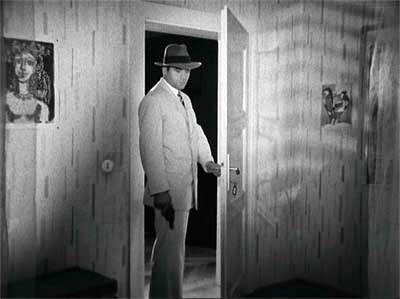
But these light moments are few and far between. This is a film full of seemingly emotionless protagonists with basic dialogue and a stark set. The cinematography from Fassbinder’s early collaborator Dietrich Lohmann is almost oppressive in its flatness and emptiness. The characters congregate in empty rooms with blank, white walls. When they go out into Munich, the streets are ominously empty.  I’m sure this was unintentional and is due to Fassbinder’s budget, but it serves to illuminate the fantasy world growing around the three criminals. Fassbinder suggests that they are trapped in the capitalist system just like everyone else and are mistaken to glorify crime (over normative social values).

Franz, Joanna, and Bruno are as inhibited as the bourgeois characters that haunt Fassbinder’s later films. They adorn costumes – leather jackets, fedoras, overcoats, and dark glasses – and pretend to be ruthless murderers and arch-gangsters. But they are trapped by this pretending, as they are unable to forge a new path for themselves. The gay subtext present in the relationship between Franz and Bruno – who clearly desire each other – is a theme that would not be fully realized until later in Fassbinder’s career. The complex, often homoerotic relationships between men is a regular feature of American gangster movies and, even more so, film noir. The sense of perpetual frustration and longing between Franz and Bruno is the film’s emotional core, though they are forced to channel these feelings through Joanna.

Their interactions through her – which soon turns into Franz forcing Joanna to have a sexual relationship with both men – seem to become obvious, and it is likely a sense of jealousy that inspires her to call the police before their planned robbery. She seems to sense that their desire for each other is stronger and she will eventually be abandoned. Here, Fassbinder is likely including – or predicting – elements of his own life. Though he identified as homosexual and had many boyfriends, he generally also had a primary female partner. Interestingly Hanna Schygulla (Joanna) was one of the few actresses who worked with him repeatedly but only maintained a distant friendship. She is excellent here, and Joanna introduces some of the common themes Schygulla would represent throughout Fassbinder’s films: naiveté, selfishness, and vanity, mingled with a sense of loss or abandonment.

Fassbinder gives a solid performance here as the enigmatic, animalistic Franz. It’s incredible to think that he directed such an impressive first film and wrote the script, designed the sets, and starred. His co-star, the handsome Ulli Lommel, was not from Fassbinder’s theater group, he went on to become a regular fixture in Fassbinder’s films. Also look out for other regular players in small roles, such as Katrin Schaake, Liz Soellner, Gisela Otto, and composer Peer Raben and future Fassbinder star Kurt Raab in small roles. Also keep an ear out for Raben's excellent and chilling score, a composition that feels fresh and unique despite its coldness.

Love is Colder Than Deal is a confrontational and challenging film, one that examines the conditions that lead to crime within society and individual failures. Find it in Eclipse Series 39: Early Fassbinder from Criterion, which also contains many of his similarly-styled early films, including Katzelmacher, Gods of the Plague, The American Soldier, and Beware of a Holy Whore. The whole set comes highly recommended, though it would have been nice for Criterion to throw in some extras.