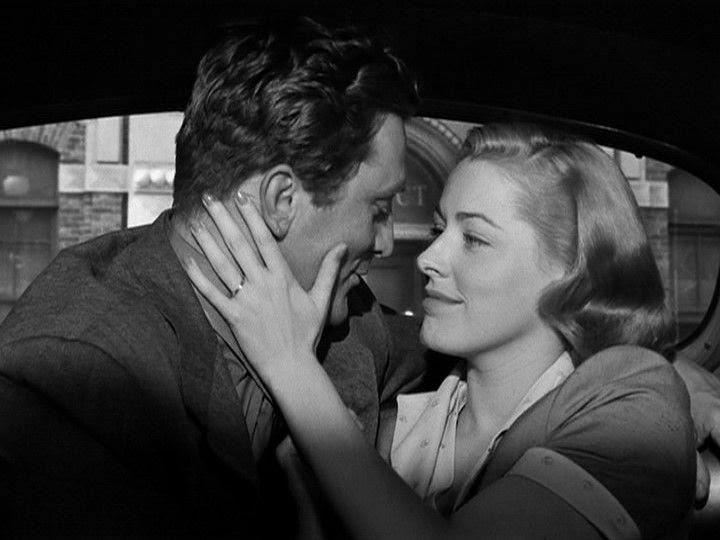
Thursday, November 13, 2014

THE BIG COMBO

Joseph H. Lewis, 1955
Starring: Cornel Wilde, Richard Conte, Brian Donlevy, Jean Wallace

Lt. Diamond is determined to bring down a local gangster, Mr. Brown, though no one else at the police department believes this is possible. Diamond becomes obsessed with Brown’s melancholic, suicidal girlfriend, a blonde beauty named Susan who is followed everywhere by two of Brown’s murderous henchmen, Fante and Mingo. When Susan tries to kill herself and mutters “Alicia” in half-consciousness, Diamond becomes convinced that this is his only lead, a clue to the identity of a woman from Brown’s past. Tired of Diamond’s meddling, he has the man tortured by Fante and Mingo, though Diamond learns that Alicia was Brown’s wife and she is suspiciously missing. As Diamond gets closer to the truth, he figures out that only Susan and Alicia – the women in Brown’s life – could dig up enough evidence to put him away permanently.

Director Joseph Lewis’s The Big Combo is one of the finest, if somewhat underrated noir efforts. Also responsible for Bonnie and Clyde-precursor, Gun Crazy, and the pleasantly surprising thriller, My Name is Julia Ross, Lewis had a varied career that included westerns (Gunsmoke) and horror films (The Invisible Ghost with Bela Lugosi), though he never rose above B-films. His work is certainly worth exploring and The Big Combo is perhaps the best of these films, thanks to two excellent contributions. Cinematographer John Alton (He Walked by Night) bathed the film in shadow and was responsible for one of the most iconic scenes in noir (as seen above), while composer David Raksin (Laura, Force of Evil) provided a jazzy, if somber score.

Though it was made relatively late in the game, the film explodes with subversive sexuality and violence. Mr. Brown is undeniably a seducer, and women are ultimately his weakness. His first wife, Alicia, left him for another, more powerful man. This sexual frustration was the boost Brown needed to reach his full power; he then murdered the rival gangster, dumped his body in the ocean, and took charge, while Alicia went into hiding. Susan, his suicidal girlfriend, both loves and hates Brown and presumably stays with him equally due to fear and attraction. There’s a scene where it is implied that he gives Susan oral sex and that this is why she stays and has put up with years of torment; it’s amazing that this made it past the censors.

Mr. Brown is also undeniably cruel and sadistic. In a jarring scene, he tortures Diamond by tying the inspector down, inserting a hearing aid into his ear, and blasting jazz music at painful, deafening volumes. He later forces Diamond to drink alcohol, leaving him somewhere drunk and humiliated (this is also a popular tactic in Raymond Chandler’s novels). Brown’s two henchmen, a young Lee Van Cleef (The Good, the Bad, and the Ugly) as Fante and Earl Holliman (Forbidden Planet) as his partner Mingo, are equally attracted to violence and do not shrink at assignments to beat or murder. There’s been some more recent critical speculation that the two men are perhaps gay lovers, as they are never apart and even sleep in the same room. I think this is perhaps simplifying or dumbing down their relationship, as Fante and Mingo seem attracted to violence, rather than sex, and this is the basis of their unshakable bond.

My only issue with The Big Combo is in its casting, particularly the two leading performances from Cornel Wilde (Leave Her to Heaven) as Diamond and Richard Conte (Whirlpool, Cry of the City) as Mr. Brown. Wilde, a sort of bland Every Man, is just not charismatic to command the film. Diamond is an afterthought compared to characters like Brown, the excellent Jean Wallace (Wilde’s then-wife) as Susan, or even Helen Walker (Nightmare Alley) as Alicia, to say nothing of Fante and Mingo. And though Richard Conte is near perfect as Mr. Brown, I’ve always disliked the actor – he pretty much ruined Thieves’ Highway for me – and I can’t think of him as anything but a smarmier Frank Sinatra spin-off.

Aside from those minor complaints, The Big Combo comes highly recommended and is available on Blu-ray. The fast-paced script, surprising levels of sex and violence, mystery, and suspense make this one of the greats and it is certainly a contender for best noir dialogue of the ‘50s.Noir fans will want to keep an eye out for noir veteran Brian Donlevy (Kiss of Death, Hangmen Also Die, The Glass Key) as an aged toughie, a former boss defeated and effectively neutered by Brown.

Monday, November 10, 2014

PICKUP ON SOUTH STREET

Samuel Fuller, 1953
Starring: Richard Widmark, Jean Peters, Thelma Ritter

Skip McCoy, a pickpocket, steals a young woman’s wallet while on the subway. It turns out that Candy, the young woman, was sent by her ex-boyfriend, Joey, to deliver an envelope with contents unknown to her. The envelope actually contained microfilm with stolen government secrets, because Joey is actually a communist spy. An FBI agent tailing Candy, with the help of police Captain Dan Tiger, uses other underworld contacts to find out the identity of the thief. When located, Skip denies the theft and claims to know nothing about the microfilm. Soon he and Candy meet and, though Skip doesn’t believe her, she has fallen in love with him and tries to keep him away from Joey and the other communists before it’s too late.

Director and writer Samuel Fuller – later known for such controversial films as Shock Corridor and Naked Kiss – made his mark in film noir with this grimy classic. It bears certain things in common with Jules Dassin’s Night and the City, including the star, Richard Widmark. Both films depict cities torn by war, marked with a stark, documentary-like realism that captured post-war urban life and a particularly hopeless, gritty sense of disappointed dreams, of good people driven to the underworld because they lack any alternative. Both Fuller and Dassin also fled the U.S. due to political pressures and ended their careers in Europe. While Dassin was driven out by the looming communist specter, Pickup on South Street captures this underlying sense of surveillance, claustrophobia, paranoia, and the pervading threat of Communism.

The Production Code, often a thorn in Fuller’s side, had trouble with the frequent violence, including a scene where Candy is nearly beaten to death and then shot, and another where Moe is shot in the head and executed. Unlike many other noir efforts, Pickup on South Street does not balance cops, criminals, and regular people. Here the regular people are criminals – stoolies, pickpockets, and prostitutes – and the film succeeds in portraying them as complex, feeling, and human. There is no black and white morality at work, save with the shadowy communists. They feel more like a red herring, an empty plot device meant to stir up fear in contemporary viewers.

Apparently in the French release of the film – a country with numerous communist politicians and public figures at the time – the stealing of government secrets was replaced with a loose plot referencing the drug trade. I could see either working equally well, as Fuller’s tale merely serves to locate urban suffering and both moral and physical decay, apparent in dingy apartments, dirty streetcars, dimly-lit restaurants, police precincts, and Skip’s rundown shack at the waterfront. In this way, it is similar to the previously mentioned Night and the City (1950), as well as Bertolt Brecht’s much earlier Threepenny Opera. The characters are all guilty, criminal, or untrustworthy on some level, but many of them are likable and we can’t help but root for their desperate attempts at survival.

Though Fuller’s writing and direction are incredibly solid, it’s the cast that helped make this one of the best all-around film noir efforts. I can’t imagine anyone other than Richard Widmark in this role. Though he had a diverse career – I first saw him in Kiss of Death, where he is a maniacal gangster that tortures people and pushes an old lady in a wheelchair down the stairs while laughing maniacally – he’s particularly excellent as an antihero. He has a face that just spells trouble and misbehavior, which is why he’s so effective here as the inherently good-hearted and honest “three time loser.” Jean Peters (Viva Zapata! and future wife of Howard Hughes) is lovely and likable as Candy, a foil for Skip because she falls hard and fast in love with him and he refuses to believe her. But the film perhaps belongs to Thelma Ritter (Rear Window), who gives one of the best performances of her career as Moe. She’s a tough stoolie with a kind heart, motherly concern, and the yen to have a proper funeral. She actually works as an informant to save up for a real burial plot and a fancy casket.

Pickup on South Street comes highly recommended and is a film noir that must not be missed. Fortunately, it’s available on DVD through Criterion, who have released a number of Samuel Fuller’s films over the years. If you aren’t wild about spy films or Cold War-themed movies, that theme barely factors in here and most of the film revolves around Widmark’s pickpocket and life in the New York underworld.

Sunday, November 9, 2014

DETECTIVE STORY (1951)

William Wyler, 1951
Starring: Kirk Douglas, Eleanor Parker, William Bendix

A typical day at the 21st police precinct begins with the arrest of a shoplifter, a young, desperate woman who witnesses the events that transpire around her. Detective McLeod says a romantic farewell to his lovely wife, Mary, before he attends to Arthur, a young man who stole money from his boss. McLeod is distracted by a case he has been working on for several months, the prosecution of Dr. Schneider, a suspected abortionist with several dead patients. Meanwhile, McLeod and his partner interrogate two thieves, Gennini and Abbott. The day comes to ahead when McLeod’s boss, the Lieutenant, learns that there is a connection between Dr. Schneider, and McLeod’s wife, Mary…

Based on Sidney Kingsley’s play of the same name, director William Wyler (Roman Holiday, Desperate Hours) took advantage of limited sets are used to heighten the claustrophobia and track the emotional breakdowns of McLeod and several of the criminals throughout the film. Aside from a series of very strong performances, Detective Story is notable for two plot elements that went against the Production Code. First is the mention of abortion, which is not stated outright but is skirted around — Mary admits that she was pregnant and forced to take care of the situation, McLeod describes Dr. Schneider’s office as like a slaughterhouse, and his most recent patient dies on the operating table. Though the element of a backdoor abortionist is relatively minor within the film at large — McLeod’s drama with his wife becomes the central plot around which everything else revolves — it’s still memorably grisly.

This was also the film that prompted the Production Code to change their policy that a police officer could not be killed on screen. Without giving anything away, I can say that it was allowed here because it’s crucial to the film’s plot and was not presented as a premeditated act, but something that occurred in the heat of moment. McLeod is also an example within noir of a flawed, violent cop. McLeod’s father was a criminal, which is meant to explain so much of his rage and hatred, his bad temper and occasionally violent explosions. There is surprisingly a lot of sympathy and understanding from many of the other cops towards the criminals in the police station, which is in contrast with McLeod whose mindset is “once a criminal, always a criminal.”

Detective Story is definitely Kirk Douglas’s film. As McLeod, he offers yet another example of his wide range and ability to portray an unlikable, yet sympathetic character. His violent, troubled cop must contend with far more than his inner demons — he must also face the fact that his sweet, innocent wife was once a gangster’s girlfriend, got herself pregnant, and sought an abortion. Eleanor Parker (Caged, The Sound of Music) is wonderful as his wife Mary, though the script limits her from reaching her full potential in the role. She received an Academy Award nomination for her performance, alongside then newcomer Lee Grant (In the Heat of the Night) as the shoplifter. Grant was in the original play and reprised her role to acclaim; unfortunately for her, she was one of many blacklisted by HUAC and didn’t return to work in Hollywood for more than decade.

Look out for other welcome performances from other noir regulars like William Bendix (Lifeboat) as McLeod’s partner, Cathy O’Donnell (They Live By Night) as the young thief’s love interest, and George Macready (Gilda) as the cold, sinister abortion doctor. The wonderful Joseph Wiseman (Dr. No) puts in a memorable turn as Gennini — in one of his first performances — a burglar beginning to psychologically crack throughout the course of the day’s events. And though the set is small, it is well shot and helps crystallize the environment of abortion, violence, theft, murder, and psyches bought to a dangerous boil by the hot weather and building tension. Detective Story — ultimately an investigation of the circumstances that make people turn to crime — comes recommended and is available on DVD. 

Friday, November 7, 2014

THE PROWLER (1951)

Joseph Losey, 1951
Starring: Van Heflin, Evelyn Keyes

Susan, a housewife alone at night, calls the cops to report a prowler in her backyard. Webb Garwood, one of the officers who arrives, becomes smitten with Susan and her comfortable lifestyle. Her husband works as a radio DJ and is away nearly every night, so Webb begins checking in on Susan. He soon pushes for a romance and the lonely, love-starved Susan eventually allows him to seduce her. Their relationship develops, particularly when Webb finds out that her husband has a life insurance policy, but she refuses to run away with him. One night Webb pretends to be a prowler and kills Susan’s husband. He convinces everyone it is an accident and he Susan marry. But then she reveals that she is several months pregnant, and soon everyone will know of their affair…

For whatever reason, The Prowler is somewhat lesser known alongside Double Indemnity, Sunset Boulevard, Out of the Past, and other famous noir works. But The Prowler is insidious as it is disturbing, the tale of a bad cop who seduces a woman and kills her husband. Van Heflin (Act of Violence, 3:10 to Yuma) gives off a quality of ambiguity that is used at its best here as the antihero Webb. Actually, I don’t even know if Webb could be referred to as an antihero. He’s morally black, motivated purely by greed and narcissism; at no time does director Joseph Losey depict him as sympathetic.

The fact that Webb is a cop is perhaps what made this film so shocking for its time. Authority figures, particularly policemen, were almost never cinematically tarnished in the ‘40s or ‘50s, with the possible exception of minor characters who quickly receive their just desserts. And here, Webb hates his job — actually looks down on the police force and compares it to other, more menial blue collar professions — and is an antisocial loner who seduces another man’s wife, murders the man, essentially all for his life insurance policy. Violent cops in films like On Dangerous Ground or Where the Sidewalk Ends are represented as inherently good men driven to violent ends and they are always punished — or at least psychologically tormented — for their misdeeds. Webb is irredeemable, little more than a psychopath, and obsessed with wealth and advancement. Like the Laurie Starr in Gun Crazy, he wants to amass a fortune and a life of comfort without putting forth any work at all.

Despite the occasional appearances of a few side characters, this is essentially a two-person film. Van Heflin’s Webb is contrasted with Evelyn Keyes (wife of director John Huston) as the lonely, innocent Susan. If Webb represents the dark side of greed and the lust for success implied by the American dream, Susan represents a different kind of dark side. She is a woman confined and nearly destroyed by the dream of the perfect family, of middle-class bliss. She is locked in the house by a controlling husband and denied her dreams — nothing more than a family — and simply exudes pent up sexuality. Her husband is a radio DJ who expects her to listen to — and report back on — every single show, and creepily ends each broadcast with the catch phrase, “I’ll be seeing you, Susan.”

One of the film’s strongest points is the connection between this phrase, the actual prowler at the start of the film, and Webb as a coveter, a man who lurks in the shadows, drooling over someone else’s success. Despite its lovely cinematography, The Prowler is a sunny, brightly lit film. Aside from a few scenes shot at night, this blazing light serves to focus the constant sense of claustrophobia and paranoia, which emanates from Webb stuck, like a tiger in a cage, in his tiny bedroom, or Susan trapped in a bleak, lonely image of domestic bliss. The Prowler is also somewhat unique for its depiction of pregnancy and childbirth. Though they were sordid subjects through the ‘60s, they are depicted in full detail here and are an integral part of the film’s second act.

Director Joseph Losey had a short, but fairly controversial career and was soon blacklisted, after which he fled to Europe for the rest of his life. The Prowler, his masterwork, was written by another blacklisted artist, Dalton Trumbo, who penned the script in secret. It is certainly an indictment of '50s culture in America and is one of the nastiest films of the decade. It's a bleak, perverse little film that comes highly recommended. Available on DVD, it’s definitely worth a purchase and not a rental. 

Wednesday, November 5, 2014

THE HOUSE ON TELEGRAPH HILL

Robert Wise, 1951
Starring: Richard Basehart, Valentina Cortese, William Lundigan

In Belsen concentration camp, a young woman, Viktoria, is grief-stricken when her friend Karin dies. She knows that Karin is an heiress with a young son and a wealthy aunt living in California, so she steals Karin’s identity papers, hoping to use them if she survives. After liberation and time in a displaced persons camp, she eventually makes her way to New York. She learns that Sophia, Karin’s aunt has died, but is determined to reunite with Karin’s son, Christopher who is the heir to Sophia’s fortune. She meets Christopher’s guardian, Alan, and agrees to marry him after he falls in love with her. They become a reasonably happy family – Karin/Viktoria, Alan, and Christopher – living in Sophie’s magnificent house in San Francisco. Christopher’s governess, Margaret, dislikes Karin/Viktoria and soon she becomes paranoid that someone in the house is trying to kill her.

Robert Wise’s final entry in the classic film noir roster is not one of his best films – it’s difficult to compete with films like The Body Snatcher, The Set-Up, The Day the Earth Stood Still, The Haunting, or The Sound of Music – but it still has a lot to offer. Though many films in the noir series focus on the aftermath of war and the struggle of adapting to life on a dramatically changed home front, few of these films directly address the concentration camps. Orson Welles’ earlier film The Stranger (1946) is a key example and concerns an escaped Nazi pretending to be a professor in a small New England town. This idyll is interrupted when a Nazi hunter sniffs out his trail and he grows increasingly paranoid and violent.

The House on Telegraph Hill, unfortunately, takes another approach with similar material. Viktoria, a concentration camp survivor, steals the identity of her friend and – like Orson Welles’ Nazi – hides herself in a suburban family. Karin’s real identity disappointingly fades away and I think the film would have been much stronger if her trauma came back to haunt her in a more substantial way. Instead, there are hints of it. The bombed-out playhouse, where Christopher was nearly killed and where she almost falls to her death, remind her of bombed-out buildings in Poland. This seems to trigger her paranoia and for a sizable chunk of the film, it is unclear whether Karin is succumbing to madness or someone is actually trying to kill her.

There are plenty of moody, Gothic elements and the film focuses on a heroine gradually succumbing to paranoia, along the lines of Gaslight, Rebecca, Suspicion, or The Two Mrs. Carrolls. The central plot mirrors several of these films, in which a husband – the mask of handsome, charming sanity – is actually trying to kill his wife. The House on Telegraph Hill unfortunately glosses over the important plot element that Viktoria has survived the horrors of a concentration camp, stolen another woman’s identity, and married a man she does not love in exchange for comfort and financial security. Though she does quickly come to love Christopher and regard him as a son, she is living a lie. It seems that the Production Code would typically require her to be punished or at least to come clean, but her false persona is basically ignored by the film’s midway point.

Italian actress Valentina Cortese (Thieves’ Highway) is fittingly sympathetic as Viktoria, strong and fragile in turns. Richard Basehart (He Walked by Night) nearly steals the film from her as the increasingly creepy husband and, perhaps oddly, the two married just before filming began and would remain together for the next decade. William Lundigan (The Sea Hawk) is pleasantly handsome, if a bit dull as Viktoria’s white knight and love interest, Major Bennett, though Fay Baker (Notorious) has perhaps the least screen time as the nanny, Margaret, but gives a wonderfully icy performance.

The House on Telegraph Hill is available on DVD or streaming on Amazon. It comes recommended for fans of female-themed noir movies or Gothic thrillers. Keep your eyes peeled from the lovely shots of the house and the San Francisco setting, which were captured by cinematographer from Lucien Ballard (The Wild Bunch). Robert Bassler, the film’s producer, also worked on Gothic serial killer thrillers The Lodger and Hangover Square, and The House on Telegraph Hill would make a nice triple feature with those two films.

Tuesday, November 4, 2014

THE ASPHALT JUNGLE

John Huston, 1950
Starring: Sterling Hayden, Louis Calhern, Jean Hagen, James Whitmore

Doc, a criminal recently released from prison, immediately begins setting up a plan to steal more than a million dollars in jewelry. He soon assembles a team made up of Emmerich, a lawyer and their financial backer, Ciavelli, the safecracker, Gus Minissi, the getaway driver, and Dix Handley, the muscle. Emmerich agrees to front them some money and says he will take responsibility for selling off the jewelry. Though they each approach the job professionally, a nearby store’s alarm alerts the police and Ciavelli accidentally gets shot in stomach during their escape. Things go from bad to worse, as a man hunts begins for them, Emmerich fails to come up with their money, and he plans to betray them.

The Asphalt Jungle is not only an important film noir, but one of the most influential early caper films. The 11-minute, excellently staged heist scene is not only the centerpiece of the film, but went on to influence numerous crime films, including Rififi, Bob le Flambeur and other Jean-Pierre Melville films, The Killing, Ocean’s Eleven, The Italian Job, and many more. Adapted from a novel by W. R. Burnett, Burnett is not as popular as his contemporaries like Dashiell Hammett or Raymond Chandler, but wrote a number of successful, influential novels and scripts. He also penned Little Caesar, as well as director John Huston’s earlier crime film, Bogart-vehicle High Sierra (1941).

I have to admit that The Asphalt Jungle is neither my favorite noir nor my favorite of Huston’s films. It doesn’t do anything new in terms of the noir canon, but does add something to the ever developing genre of crime films. The crooks here are treated as individual characters, as complex beings that exist on a gray scale, not just a continuum of black and white, moral and immoral, good and evil. There is the sense that these characters are all doomed, not because of the fatalistic universe they live in (as with much other film noir), but because of their flawed personalities and the poor choices they have made.

Aside from the impressive heist sequence, much of The Asphalt Jungle is also very talky and not a whole lot happens for the first half of the film. This period of inactivity is rescued by a number of fine performances. Sam Jaffe (The Day the Earth Stood Still) stars as Doc, with Anthony Caruso (Watch on the Rhine) as the safecracker, and James Whitmore (Planet of the Apes, Them!) as the hunchback driver Minissi. Sterling Hayden (Johnny Guitar) appears in one of his first leading roles as the tough-talking, but inherently sensitive dreamer, Dix. His dream is to use his share to buy his father’s farmland and he falls in love with Doll (Jean Hagen of Singin’ in the Rain and Adams Rib) even though he pretends not to care about her.

Though these characters are all relatively well-developed and more complex than your average movie criminal (at least in ‘40s and ‘50s cinema), they are overshadowed by the smooth, sly, and sophisticated Louis Calhern (Duck Soup, Notorious) as Emmerich, the corrupt lawyer. There is something appealing and maybe sympathetic about Emmerich, a high-class lawyer attracted to a life of crime, who has abandoned his wife in favor of a much, much younger mistress. His flighty mistress is unforgettably played by Marilyn Monroe in her first role. Though her acting certainly isn’t top notch, it’s impossible to take your eyes off of her. Her role might be minor – she’s in the film for maybe five minutes total – it’s easy to understand why she went on to have such a huge career.

The Asphalt Jungle is available on DVD and comes recommended, though it doesn’t really rank on my list of top films noir, crime caper movies, or John Huston works. Its influence is undeniable though, and it’s worth watching to see how it went on to shape an entire genre of movies framed around lengthy heist scenes, following by injured men, man hunts, hideouts, and double-crossers.

Monday, November 3, 2014

GUN CRAZY

Joseph H. Lewis, 1950
Starring: Peggy Cummins, John Dall

Bart Tare, an ex-reform school student and former soldier in the Army, can’t quite get over his fascination with guns. After the war, his sister and friends have high hopes for his future. He is inherently good-hearted and non-violent until he meets Annie Laurie Starr, the sexy sharpshooter at a local carnival. She, too, is obsessed with weaponry and they begin a whirlwind romance, which gets them fired from the carnival. They marry and honeymoon, but Laurie is determined to become wealthy without working. She quickly involves them in a crime spree that escalates from gas station robbery to bigger heists and murder. A manhunt ensues, but Bart is persuaded to join her on one final robbery, which spells their doom.

Gun Crazy is undoubtedly the finest effort of the prolific, yet underrated director Joseph H. Lewis (Cry of the Hunted, The Big Combo). Written by the gifted Dalton Trumbo (I Married a Witch, The Prowler, Roman Holiday), Gun Crazy was credited to Millard Kaufman because Dalton was on the McCarthy-inspired Hollywood black list. The plot is certainly steeped in a sense of frustration and paranoia. Bart doesn't know why he is obsessed with guns. He isn't inherently violent or power-mad, and he's not a bully. Trumbo's script implies that there is just something off about Bart. He could have wound up settling down and leading a conventional life, if not for his near-fated introduction to Annie Laurie Starr.


John Dall (Rope) and Peggy Cummins (Curse of the Demon) are excellently cast and incredibly well-matched as Bart and Laurie. It's strange that neither of these actors went on to bigger fame after these two amazing performances, but there is something unconventional about both Dall and Cummins. John Dall is handsome, yet subtly disturbing. He went on to costar in Hitchcock’s Rope alongside the similar Farley Granger -- Granger had also previously starred in a film about doomed young lovers running from a crime spree with They Live By Night. Cummins is the real showstopper. In many ways, she is the ultimate femme fatale: her sexuality is consuming and animalistic, she obsessed with gaining wealth without working for it (a dark version of the American dream), and loves guns and violence.


Despite the whitewashing, sterilizing effect of the Production Code, the film is wrought with a sense of frenzied, near-hysterical sexuality. In the end, it is ultimately the sexual attraction and dependence on one another that destroys Bart and Laurie. Had they split up, they could have separately made it to safety, but instead they are hunting through a swamp like a pair of wounded animals. Though Gun Crazy influenced future crime films, it is also a key example of amour fou – insane, doomed love – and is an obvious precursor to films like Bonnie and Clyde and Badlands, and more embarrassing later efforts like Natural Born Killers.


Though it is undeniable that there is a noir influence on Gun Crazy, Joseph Lewis manages to transcend clichés – or at least use them in his favor – to present a film relatively unique for its time. There are certainly few female characters like Annie Laurie Starr in all of ‘40s or early ‘50s cinema and it is a rare case – probably disturbing at the time – that the female protagonist is more murderous and bloodthirsty than the male. Lewis also used later noir’s documentary style to his advantage. The impressive bank heist shot, for example, was done in one take with plenty of improvisation from the actors and well-disguised cameras.


Gun Crazy comes recommended. It’s available on a basic DVD and will please fans of noir and crime drama. It’s a must-see if you like Bonnie and Clyde or Badlands, and Twin Peaks lovers will also want to keep an eye out for an early performance from a teenage Russ Tamblyn (Dr. Jacobi), appearing here as the young Bart. And if you think '50s films are boring, Gun Crazy will likely change your mind.