Saturday, November 24, 2012

LICENCE TO KILL

John Glen, 1989
Starring: Timothy Dalton, Carey Lowell, Robert Davi, Talisa Soto, Benicio del Toro

Timothy Dalton’s second and final film as Bond is his best and makes me wish he had continued with the series. Though he signed on for three films, six years of legal battles over the control of the series delayed filming and caused Dalton to leave. Licence to Kill marks more than just his departure and signifies a major change in the series. This is director John Glen’s fifth and final Bond film, along with actor Robert Brown who appeared as M in five films after Bernard Lee’s death, writer Richard Maibaum who helped write every Bond film up to this point and title designer Maurice Binder who made the Bond opening sequence so famous. This is also producer Albert Broccoli’s last full contribution. 

Bond and Felix Leiter are heading to Felix’s wedding when they are interrupted to help capture drug lord Franz Sanchez. They make it back to Felix’s wedding just in time, but Sanchez escapes by bribing a DEA agent and returns to torture Leiter by half-feeding him to a shark and arranges to have his wife raped and killed. Bond swears revenge and when M tries to assign him elsewhere, he resignes from MI6 and goes rogue. Bond enlists the help of Pam Bouvier, an ex-CIA pilot who worked with Leiter and is next on Sanchez’s list. A very worried Moneypenny secretly gets Q to fly to the Republic of Isthmus (a stand-in for Panama) to help Bond. Ultimately, Bond wins Sanchez’s trust and infiltrates his organization, determined to ruin Sanchez’s life and business before killing him. 

Though seriously flawed, this violent revenge film is much better than The Living Daylights and deserves to be remembered as an uncharacteristic, yet strong entry in the series. Dalton plays a much more brutal Bond and is excited to kill as many henchmen as possible and the even crueler prospect of manipulating Sanchez into killing those loyal to him. This humorless, nearly sexless film is very bleak and we get the sense that a psychotic Bond is moving inexorably toward the end, where he seems determined to get himself killed once his job is done. Dalton harkens back to the literary Bond, a dark, troubled character who is haunted by the fact that he psychologically resembles his enemies. The references to Bond exorcizing his own demons over the death of his wife have been hinted at throughout the series, but never fully realized until now. 

This is the first film not to use the title of a Fleming story, though it combines elements from a novel and other stories. The plot is mostly influenced by ‘80s action movies and Japanese Ronin films. Revenge is not a new theme for a Bond film and Licence to Kill essentially succeeds where For Your Eyes Only failed, but the attempts to commercialize the series with references to Lethal Weapon, Miami Vice and other ‘80s action films from the period is too cliched. With a decent score from Lethal Weapon’s Michael Kamen and solely American and Mexican locations, it seems like the producers were trying to take this as far from the Bond series as possible. Fortunately the appearance of the beloved Desmond Llewelyn as Q helps to humanize the film and brings some much needed warmth and humor.

Though the film has a rapid pace, the action scenes feel like someone was checking off a list in order to make sure they met the Bond standard. The murky plot and bad dialogue are not helped by a series of weak supporting performances. Carey Lowell has some great scenes as the tough, resourceful Pam Bouvier, but she is unfortunately reduced to jealous squabbling over who Bond is and is not sleeping with. This draws attention to the larger issue of sex and monogamy that plagues the two Dalton films. He is nearly celibate in The Living Daylights, but here he is fortunately rescued by the lovely Talisa Soto, who plays Sanchez’s unfaithful girlfriend Lupe. 

Drug lord Franz Sanchez, played by Robert Davi, is one of the elements that really dates this film. Davi does as good of a job as he is able with the role, but the fact remains that he is stuck playing one of many ‘80s drug lords. His henchmen are mostly given awful dialogue and terrible personalities, with the exception of the quiet, sinister Dario, played by a young Benicio del Toro. Also keep your eyes peeled for Ed Killifer (Big Ed from Twin Peaks), a double-crossing DEA agent and for Wayne Newton, a TV evangelist who works for Sanchez. Newton provides some brief, but much needed comic relief and is a welcome inclusion. There's also a nice performance from the sinister looking Cary-Hiroyuki Tagawa (Mortal Kombat) and Christopher Neame as an undercover team also attempting to bring down Sanchez. 

Though Licence to Kill did not fare well critically or in the box office, it should be judged on its own merits and not alongside From Russia With Love or Goldfinger and certainly not the Roger Moore films. This comes highly recommended to fans of ‘80s action flicks or revenge films. It is available in a wide range of DVD releases, though I’m reviewing the MGM two-disc Ultimate Edition, which is also included in the Ultimate Edition box set volume two. Special features include two commentary tracks - one from director Glen and various actors, the other from producer Michael G. Wilson and various crew members - a nice documentary, Inside Licence to Kill, narrated by the wonderful Patrick Macnee and a slew of other featurettes. License is also availabe on Bu-ray. 

Friday, November 23, 2012

THE LIVING DAYLIGHTS


John Glen, 1987
Starring: Timothy Dalton, John Rhys-Davies, Maryam d'Abo, Jeroen Krabbe, Art Malik

While I have a lot of love for Timothy Dalton's Bond, I have to admit that The Living Daylights is one of my least favorite films in the franchise. The fifteenth Bond film and the first starring Dalton as 007 is clearly an attempt to revitalize the series and bring back a serious, action-oriented focus, which is a success in some ways, but as a Bond film, The Living Daylights is deeply flawed.

Koskov, a Soviet general, defects and requests Bond's protection. Bond stops an attractive blonde sniper and cellist from assassinating Koskov, also realizing she is not a professional and something is suspicious. While under the protection of the British government, Koskov discloses a KGB plan to kill as many British and American agents as possible, supposedly headed by KGB boss General Pushkin. Koskov then disappears, allegedly recaptured or killed by KGB assassins. Bond goes back to Czechoslovakia (remember when it was still called that?) for the cellist, Kara, who is actually Koskov's naive girlfriend. The two follow his increasingly dangerous trail across Europe and into the Middle East, which leads them to a confrontation with an arms dealer in Afghanistan.

The direction is reasonably solid, as this was helmed by the trustworthy John Glen, who has the distinction of being the most prolific Bond director to date. The title and basic plot is taken from the Fleming story of the same name, but unfortunately diverges from some of the normal Bond traits. Maryam d'Abo as Kara all but ruins the film. She is the only significant female character, but is unmistakably not a Bond girl. She's naive, irritating and, despite being beautiful, is utterly sexless. Much like the rest of the film. There's an amazing intro where Bond falls from the sky via parachute and lands on the boat of a bored woman in a bikini, but this is the only hint of sexual conquest in the entire film.

There is also a sad lack of humor. We get a few one-liners from Dalton, but his serious, sensitive Bond seems uncomfortable with the normal zingers delivered with aplomb by Connery or Moore. Saunders, an M16 agent assisting Bond, provides a little comic relief with his obvious intolerance for Bond's shenanigans, but is underused. There are some nice appearances from the standard, reoccurring characters like M, Q (pointing out an in-development ghetto blaster), Moneypenny and even Felix Leiter, who kidnaps Bond through the clever use of party girls in a convertible, but it feels like these supporting characters are rushed through the film as quickly as possible.

While there are some excellent action sequences, the inevitable car chase scene is one of the most ridiculous things I've ever seen and ends with Bond and Kara using a cello case to sled down a mountain and over the Austrian border. The beautiful Aston Martin V8 Vantage Volante is unfortunately out of place and Bond seems to grimace every time he uses the special features.

Last in my list of major complaints is that there is no focused villain. The alleged KGB defector Koskov is lazy, gluttonous and would rather lounge by the pool making out with babes than pursue any real scheme. The American arms dealer is equally annoying and has maybe one full minute of screen time. The main henchman is a blonde Russian named Necros who moonlights as a revolutionary. The only blonde Russian I want to see kicking ass is Red Grant.

There are some reasons to see the film, though. As I said, The Living Daylights attempted to take the series in a new direction, exploring realism and more serious themes like espionage and Cold War politics that have mostly been ignored since From Russia with Love. The script is not afraid to present a sympathetic Bond, who can instantly turn into the icy, sociopathic spy, but also has a softer, romantic side. There is a likable, honorable KGB director, played by the sassy John Rhys-Davies. My favorite sequences in the film are shot in Afghanistan and involve some very lively Mujahideen rebels. Art Malik's Kamran Shah is one of the best characters in the film and I wish he had been introduced earlier than the final quarter.

The Living Daylights is available as a single disc Special Edition DVD from MGM, though I am reviewing the two disc Ultimate Edition, which is also included in volume one of the Ultimate Edition box set. The extensive special features include two documentaries and an audio commentary from John Glen and various cast and crew members. There’s also a Blu-ray. 

And don't forget: СМЕРть Шпионам.

Tuesday, November 20, 2012

NEVER SAY NEVER AGAIN

Irvin Kershner, 1983
Starring: Sean Connery, Kim Basinger, Klaus Maria Brandauer, Barbara Carrera, Max von Sydow, Rowan Atkinson

I am going to strongly resist the urge to make any bad puns about never watching this ever again throughout the course of this review. Because really, there are two solid reasons to watch this utterly pointless, non-Eon remake of Thunderball. The first is Sir Sean Connery. Though older and perhaps a bit slower moving, he’s still the Bond we know and love and his assured handling of the role almost saves the film. The title is actually a reference to the fact that he said he would never play Bond again. (The fact that they couldn’t come up with a better title should tell you something.) The second reason is Klaus Maria Brandauer, one of my favorite German actors, who co-stars as Largo. I have nothing against Adolfo Celi or his eyepatch, but Brandauer simply blows him out of the water. He is the most human villain in any Bond film and thus one of the most believable. He also hops on board the crazy train about midway through the film and refuses to get off.

Never Say Never Again has essentially the same plot as Thunderball with a few slight alterations and some allowances for Connery’s advanced age. M, who wants to drive all the 00s into retirement, sends Bond to a spa to recuperate from training and to get back in shape. He discovers a bandaged man being beaten by his nurse, Fatima Blush, and later witnesses the man using a retinal scan machine. The man is Jack Petachi, a U.S. Air Force pilot in the employ of Largo and SPECTRE. Petachi has gotten a retinal implant so that he can imitate the President of the United States in order to steal a few nuclear missiles for SPECTRE. The evil organization plans to either bribe NATO or begin destroying the world. Fatima disposes of Petachi, but Bond follows her to the Bahamas to try to make contact with Domino, Petachi’s sister and Largo’s beloved mistress. Under Largo’s orders, Fatima attempts to kill Bond on several occasions, but he escapes, mostly unscathed, and makes contact with Domino. He follows Domino and Largo to the south of France, where he Largo face off via a video game and Bond finally disposes of the insane Fatima. He tells Domino that Largo killed her brother and he has to convince her to help him find the missiles before it’s too late. 

Kevin McClory is responsible for the creation of this bloated, mostly boring film. McClory, Ian Fleming and Jack Whittingham began the Thunderball script together back in the '60s. When early plans of a film were cancelled, Fleming went ahead and converted it to a novel. McClory, in turn, sued, and was given some of the filming rights, allowing him partial credit on the Eon production and giving him the license to make this remake. Apparently he has been trying to make a third version in recent years, which is one of the saddest things I’ve ever heard. 

Never Say Never Again is not actually a terrible film. It would be hard to argue, for example, that it is worse than A View to a Kill, but it is incredibly frustrating, mostly because its existence is utterly pointless. As I mentioned earlier, it's a much better swan song for Connery than Diamonds Are Forever and all of Brandauer’s scenes are quite good. Everything else is either outright bad, frustrating or boring. Max von Sydow, one of my favorite actors of all time, is wasted as a cartoonish Blofeld. Barbara Carrera has some good scenes as the insane Fatima, but she pales in comparison to Thunderball’s Fiona Vulpe. Kim Basinger’s has a sort of idiotic charm, but she is completely miscast as the main Bond girl and completely out of her league in terms of acting ability. Edward Fox is a terrible, snotty M and Rowan Atkinson is wasted as the bumbling comic relief. 

Director Irvin Kershner (The Empire Strikes Back) makes the most of the material, providing some solid action scenes, but the running time is entirely too long, making the second half drag on into eternity. He can’t fix a lousy script, which starts off reasonably well, but gets worse as it moves toward the lackluster conclusion. I really need to stress that my problem with Never Say Never Again is mostly that I’m outraged it was made in the first place. I don’t have any problems with the much earlier, non-Eon Casino Royale, but the fact that McClory attempted to one up Eon this late in the game is both offensive and utterly foolish. I honestly don’t know what he was expecting. Only owning partial rights to Thunderball meant that he had no chance of restarting the series on his own, so what was the point? The ‘80s was a troubling decade for the Bond franchise and this is no exception. Like several other ‘80s Bond films, Never feels incredibly dated between the anticlimactic video game challenge, the jazzercise workouts and the horrifically bad score. 

I only recommend this film to serious Bond fans. You will find at least a few things to enjoy, namely Connery and Brandauer’s strong, charismatic performances. The Blu-ray is the best option and includes some special features, such as a commentary with Kershner and a number of featurettes. 

Sunday, November 18, 2012

OCTOPUSSY

John Glen, 1983
Starring: Roger Moore, Maud Adams, Louis Jourdan, Steven Berkoff, Desmond Llewelyn

Bond is sent to investigate the death of 009, who was found in East Berlin carrying a fake Fabergé egg. The real egg turns up at an auction house in London, where Bond instigates the buyer, Afghan prince Kamal Khan, and switches the real with the fake. Bond follows Khan to India and is introduced to his lady friend, Magda, who has an unusual octopus tattoo. She seduces him and steals the original egg, which Q has implanted with a tracking device. Bond is captured by Khan and his bodyguard Gobinda, but escapes and learns that Khan is secretly working with Soviet General Orlov. Bond finds his way to the floating place of Octopussy, the wealthy, beautiful owner of several businesses and the leader of a smuggling ring. Her carefully guarded palace is solely outfitted with dangerous, attractive women, all of whom belong to her octopus cult and are marked with peculiar tattoos. Octopussy, Khan and Orlov plan to rendezvous for a jewelry smuggling operation in East Germany during a performance of Octopussy’s circus troupe, but Orlov has other plans. He intends to set off a nuclear warhead at a performance in a US Air Force base, either instigating a war or an opportunity for the Soviets to invade. It is up to Bond and Octopussy to stop him. 

I’m happy to say that though Octopussy isn’t the highest point in Moore’s career, it maintains some of the seriousness found in For Your Eyes Only, while including some of the humor and over the top action sequences from in previous entries. Though the title is taken from a Fleming story, the plot is mostly original, but borrows from Fleming’s “The Property of a Lady.” The fun action sequences and exotic locales rank as the top two reasons to see this film. Though not attempting to go to quite as big as Moonraker, Octopussy ranks high on the spectacle scale and includes an Indian jungle hunting scene, a rickshaw chase and elaborate fight scene in an Indian marketplace, and quite a lot a lot of airplane shenanigans (airborne adventures in general, if you take the hot air balloon into consideration). There are some perplexing, slightly ludicrous scenes that take place in the circus, but if you’ve ever longed to see Bond dress up as a clown, here’s your chance. The film also greatly benefits from the beautiful, colorful central location in Udaipur, India, where the locals were apparently completely supportive of the production and exciting by the idea of Bond in their midst. There is also the very fortunate return of John Barry as the composer, which makes this film seem much less dated than either For Your Eyes Only or A View to a Kill.

Moore is obviously aging, but is still on good form here and is willing to put up with a number of indignities, including wearing a bear suit, dressing up as a clown and swinging through the jungle on a vine, giving a Tarzan-like yell. Bernard Lee is finally replaced as M with the unmemorable but inoffensive Robert Brown. It is particularly nice to see Q (played by beloved long time Bond regular Desmond Llewelyn) so much in this film. He travels to India with 007 and even involves himself in the violent conclusion. Maud Adams is quite appealing as Octopussy and it’s nice to see a Bond girl closer to Roger Moore’s age. While she doesn’t do a whole lot, she’s an intriguing character and is mostly placed on equal standing with Bond. Her subordinate Magda is also very lovely and her scenes seducing and stealing from Bond are a fine early point in the film. 

Like For Your Eyes Only, there is no strong central villain. This actually hurts the film, though the charming Louis Jordan as Khan does his best, as does Steven Berkoff as General Orlov. They have a number of compelling, if predictable henchmen, including Gobinda, who is basically the Indian version of Odjobb, a troupe of scary gentlemen with some exotic bladed weapons, and a pair of Russian, knife-throwing twins. Octopussy is certainly flawed, mostly by its inane plot, long running time and ineffectual villains, though these are all things we have come to expect from the series at this point. Despite these elements, it is a delightful, fun entry and comes highly recommended. It is certainly Moore’s last good Bond film, which is remarkable, considering he intended to retire after The Spy Who Loved Me, but was convinced to stick around for four more films. It is also certainly better than the non-Eon Bond film released the same year, Never Say Never Again, Sean Connery’s bizarre final appearance in the series. 

Octopussy is available on a number of DVDs, including the Ultimate Edition two-disc, which is also part of the Ultimate Edition box set volume four. As usual, this release is loaded with special features, including a commentary track from director John Glen, a documentary, Inside Octopussy, narred by Patrick Macnee, and a short feature about Peter Lamont’s design work on the Bond series. Octopussy is also available on Blu-ray. 

Friday, November 16, 2012

MOONRAKER

Lewis Gilbert, 1979
Starring: Roger Moore, Lois Chiles, Richard Kiel

“Bollinger? If it’s ’69 you were expecting me.”

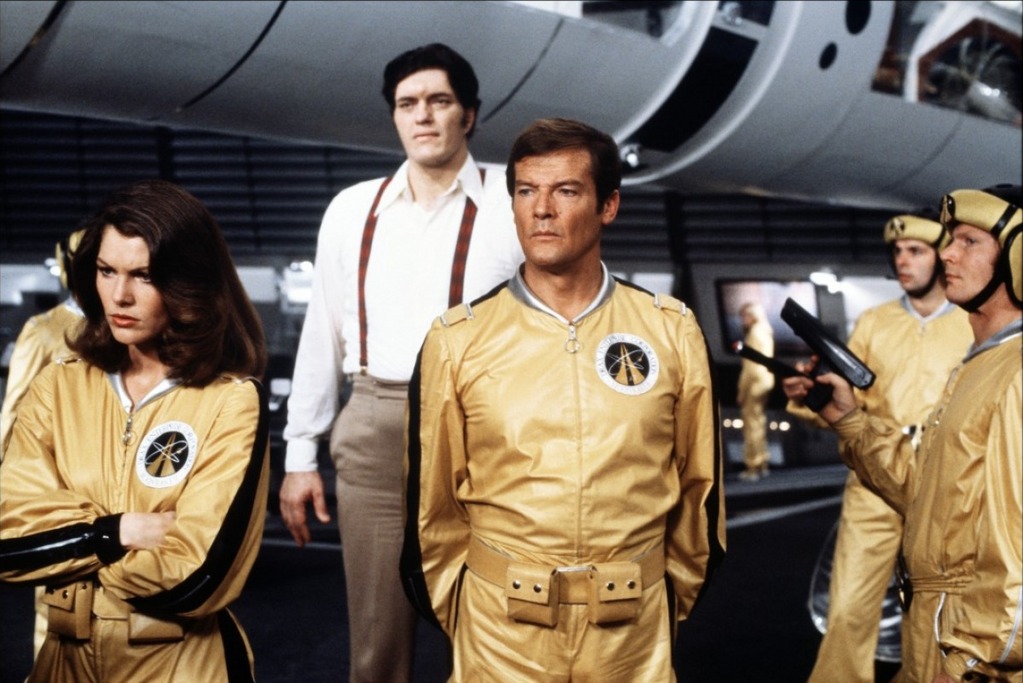
Though Moonraker is frequently lambasted and is listed as one of the worst in the Bond series, I absolutely adore it. This frivolous, cartoonish film is a prime example of Bond at his most entertaining, so it should only be avoided by people who hate fun. The ridiculous plot is almost an exact copy of The Spy Who Loved Me, except to cash in on the recent success of Star Wars, Bond moves from under the sea to outer space, where another megalomaniacal villain wants to destroy the earth and begin his own civilization. 

After surviving a high-altitude assassination attempt by Jaws, Bond is sent to California to investigate the hijacking of a Drax Industries Moonraker space shuttle. He meets Drax Industries owner Hugo Drax, his henchman Chang, his personal pilot, Corinne Dufour, and astronaut Dr. Holly Goodhead. Bond survives several more assassination attempts and steals blueprints from Drax’s personal safe with Corinne’s aid. Drax later has her attacked and killed by his hunting dogs. Bond travels to Venice, escapes Drax’s henchmen yet again, and discovers a hidden lab with glass tubes full of toxic nerve gas. He discovers that Drax is relocating to Brazil and follows him there, where he also reunites with Dr. Goodhead, who is actually a CIA agent. They agree to team up, but are soon captured by Jaws and witness Drax’s Moonraker shuttles taking off. They follow Drax into space and hope to stop his diabolical plan to wipeout humanity on Earth and begin his own Nazi-eqsue civilization on a secret space station. 

Director Lewis Gilbert is in good form during his final Bond outing. Though this lags in the overly long second act, Gilbert and set designer Ken Adams went all out for scenes that range from mountain tops, airplanes, space, a shuttle assembly plant, the jungle, and the canals of Venice. The ridiculous, non-stop action set pieces are the real reason to watch this film. Beginning with a tremendous opening scene, one of my favorites in the film, Bond is pushed out of a plane by Jaws, but Bond gets the parachute (not a Union Jack design) and Jaws inexplicably lands on a circus tent, transitioning into a nice credits sequence with an unfortunately lackluster song by the returning Shirley Bassey. There are a litany of absurd gadgets and a number of unbelievable action sequences including a fight to the death in a glass museum, a gondola chase in the Venice canals and Bond’s near strangulation by the biggest, most fake looking python seen until Anaconda. All this is, of course, topped by Bond’s nonsensical mission to space and the destruction of Drax’s space station. 

Moore is clearly a little past his prime here, but is not afraid to have fun with the role and dishes out one-liners at every opportunity. Lois Chiles is icy, lovely and somewhat believable as the astronaut-turned-CIA-agent Dr. Goodhead, though her transition to willing love interest in the second half is a bit too abrupt. Like Barbara Bach’s XXX in The Spy Who Loved Me, she is (almost) a match for Bond and fortunately more than just eye candy.  It’s a shame Denise Richards’s abominable physicist character in The World is Not Enough didn’t take more cues from her. The lovely Corinne Cléry gives a satisfying, though brief performance as Drax’s pilot and Bond’s first conquest. Her death is one of the few dark, suspenseful moments in the film. Unfortunately Michael Lonsdale is wasted as a very boring Hugo Drax and his random Japanese henchman Chang (given a Chinese/Korean name for no apparent reason) is given no characterization whatsoever. 

The real star of this film is Richard Kiel as Jaws, returning after a menacing performance in The Spy Who Loved Me. Here Jaws becomes absolutely cartoonish, the coyote to Bond’s roadrunner. In a baffling, though enjoyable move, the studio has him side with Bond at the end of the film, presumably because he has fallen in love with a tiny, blonde pigtailed woman. He also has a great, terrifying scene during Carnival where he appears in an ally and nearly chomps the head off of Bond’s sultry ally (Emily Bolton). 

Though there are some difficult, plodding moments in the second hour of the film, the pace is generally nonstop. As one of the most fun Bond films ever made, I can’t help but recommend Moonraker, which anyone with a well-developed sense of whimsy will surely enjoy. Moonraker is available on a variety of DVDs, including the double-disc Ultimate Edition, also part of the Ultimate Edition box set volume 4. There are a lot of extras, including two commentaries, one from Roger Moore and the second from Lewis Gilbert and various cast and crew members. Also included are two documentaries, “Inside Moonraker,” narrated by Patrick McNee, and “The Men Behind the Mayhem,” which focuses on special effects. Most of these extras are also included on the Blu-ray.

Thursday, November 15, 2012

THE SPY WHO LOVED ME

Lewis Gilbert, 1977
Starring: Roger Moore, Barbara Bach, Curd Jürgens, Richard Kiel

The Spy Who Loved Me is undoubtedly Moore’s best Bond film. The first with an original story, this plays to Moore’s strengths and allows for moments of welcome silliness, balanced by some incredible, large-scale action scenes. This is also the first Bond film since On Her Majesty’s Secret Service to have any emotional depth, due to Bond’s complicated relationship with KGB agent XXX. Bond is called in to investigate the disappearance of British and Soviet ballistic-missile submarines and heads to Egypt to locate plans for a submarine tracking system. He meets Major Anya Amasova aka KGB Agent XXX, who also wants to steal the plans. M and KGB head General Gogol decide the two agents should team up and agree on a temporary truce. They recover the plans, but barely escape a fight with Jaws, a giant man with lethal, steel teeth who works for millionaire-scientist Karl Stromberg. As 007 and XXX grow closer, they realize Stromberg intends to use his new supertanker and a secret, underground base for nefarious purposes - to destroy the world’s major cities and begin a new, Atlantean civilization deep in the ocean. 

This film introduces some new elements into the series: a memorable henchman who would survive to reappear in the next film, cooperation between the U.K and the Soviet Union and a strong female lead/love interest. Barbara Bach has received some criticism for her semi-weak portrayal of XXX, but her character represents the leaps and strides Bond girls have made throughout the series. Though she occasionally has to be rescued, there are plenty of moments where she gets the best of Bond. There’s also a welcome appearance from the absolutely beautiful Caroline Munro, who regularly appeared in British horror films during this period. 

Curd Jürgens is an excellent Stromberg, but his diabolical, anarchic plans are the worst part of the film. He wants to start a nuclear war and reestablish civilization under water. Really? Like villains before and after him, his talent is somewhat wasted, but he does the best that he can with the role. Richard Kiel’s Jaws, on the other hand, is wonderful and makes a welcome return in Moonraker, where he reaches new, delirious heights (literally). All the usual suspects appear - M, Q and Moneypenny - and we are introduced to KGB commander General Gogol (Walter Gotell), who would return for several films. This film also marks a dramatic change in the series. Co-producer Harry Saltzman was forced to sell his share of the franchise for financial reasons and thus ended his long partnership with Albert Broccoli. 

The Spy Who Loved Me also benefits from some wonderful action sequences, particularly the opening where Bond has to evade KGB during a sky chase in the Swiss Mountains. Stuntman Rick Sylvester's leap off a cliff is one of the longest fall sequences in film history and is immediately followed by Bond's use of the beloved Union Jack parachute. I will never get tired of Bond fighting on trains and the excellent scene in this movie is no exception. Though it’s a little unbelievable that the best spy in Russia has to be rescued by Bond, the ensuing fight with Jaws is exciting and the scene’s conclusion is fittingly romantic. The bombastic finale in the supertanker where Bond takes charge of captured British, American and Soviet naval crews to defeat Stromberg is one of the best in the series. Though there is a heavy emphasis on gadgets in this film, most of them result in some amusing scenes, such as the watch that prints out directions from MI6 headquarters. Q outdoes himself with the Lotus Esprit that converts into an underwater vehicle; it definitely one ups Scaramanga's flying AMC Matador from The Man with the Golden Gun. 

The credits song, written by Carole Bayer Sager and performed by Carly Simon is one of the most memorable in the series and though Marvin Hamlisch’s disco influenced score hasn’t aged particularly well, it’s still a lot of fun. Fun is really the name of the game with this film and I, surprisingly, have no complaints. The Spy Who Loved Me comes highly recommended and is available on multiple DVD releases. I’m reviewing the Ultimate Edition two-disc, which is also included in the Ultimate Edition box set volume 4. The numerous extras include a commentary track with Lewis Gilbert, designer Ken Adams and more of the crew. There’s an informative making-of documentary and a shorter documentary about Adams’s career with the Bond franchise. The Blu-ray includes many of these special features. 

Tuesday, November 13, 2012

SEVEN PSYCHOPATHS

Martin McDonagh, 2012
Starring: Colin Farrell, Sam Rockwell, Christopher Walken, Woody Harrelson, Tom Waits

Marty, an alcoholic screenwriter, is struggling to write the script for his current project, Seven Psychopaths, which is already overdue. His loyal friend Billy, an actor/con artist, tries to inspire him by telling him stories and by placing an ad in the local paper “calling all psychos.” One of the first psychos, Zachariah, responds to the ad and tells them his story. He and his wife are vigilante killers that travel the country and brutally murder serial killers and other very bad men. But he and his wife have split up and he is desperate to find her and get her back. One of Billy's side jobs includes stealing dogs with his friend Hans, then returning the pooches and accepting the reward money to cover hospital bills for Hans’ sick wife. When Billy accidentally/on purpose captures a mob boss’s adorable Shih Tzu, the shit hits the fan and Billy, Marty and Hans are forced to drive into the desert and go into hiding. 

While Seven Psychopaths is basically a flawed attempt at taking a new look at the crime genre, it is way more interesting than anything else you are likely to see in the theater this year (or probably next). In general, I enter any film written, directed and produced by the same person with a healthy dose of skepticism. When said person also casts a stand-in of themselves as the main character, it is usually a recipe for disaster, but Irish playwright and In Brughes (2008) writer and director Martin McDonagh overcame my trepidations with this witty, imaginative tale about a struggling screenwriter. At its heart, Seven Psychopaths is a film about the importance of storytelling - the fictional stories that entertain and distract us, the stories we tell about ourselves that shape our identities, and the stories we live, weave, and retell with friends. 

Known for his dark comedies, McDonagh has crafted a film that is part comedy, part gritty crime film, and part buddy-road trip movie. His somewhat unpredictable, blood-soaked plot is bolstered by some very strong performances, namely Sam Rockwell, who completely steals the film with an almost overly energetic performance. Christopher Walken gives one of his best performances, never falling into predictable Walken territory, and refusing to caricaturize himself. Colin Farrell, whom I usually find intolerable, let himself step into the background of the film as the empathetic, believable Marty. Woody Harrelson and Tom Waits are both delightful, as always. Waits was the real reason I wanted to see this film and he does not disappoint. 

Though enjoyable and unpredictable, Seven Psychopaths is flawed, partly because it beats you over with the head with the fact that it is self-aware, intelligent, and clever. While the film is fun and purposefully defies expectation, it is simply too meta for it’s own good. Adaptation had similar problems, but reached heights of storytelling grace and depths of horrible annoyance that Seven Psychopaths does not, fortunately so in the latter category. The existentially rambling third act gets stuck questioning whether or not violent is appropriate, illustrated by the slightly ham-fisted stories of the Vietnamese monk and revenge-fueled Quaker. 

Overall I recommend the film. It is certainly one of my favorites of 2012 and is a brave attempt at challenging genre, more of which needs to be seen in American cinema. Plus Tom Waits and fluffy bunnies. And that adorable Shih Tzu, who, for the record, does not get shot.