Tuesday, May 7, 2013

DRÁCULA (Spanish-language, 1931)


George Melford, 1931
Starring: Carlos Villarias, Lupita Tovar, Barry Norton, Pablo Alvarez Rubio

When I first saw Drácula, I was fascinated by the film’s production history and wondered how many times in cinema a film had been simultaneously shot in two languages with two different directors and two separate casts, but on the same set? It turns out this happens more than you would think. Universal practiced this a few times in the ‘30s, including on a remake of The Cat and the Canary, The Cat Creeps, where a duplicate Spanish-language version was filmed at night as La Voluntad del muerto with the same director as Drácula, George Melford, and star Lupita Tovar. (It also happened in the ‘60s occasionally with German krimi films, but dual language movies these tended to have overlapping casts and the same director.) 

This somewhat complicated history makes the Spanish-language version of Drácula an interesting experiment and worthy of at least one careful viewing, particularly by fans of Dracula. Shot at night on the same set as Browning’s Dracula, the Spanish Drácula is generally considered to be a sexier and more emotional version of its English language counterpart, supposedly due to its Latin flavor and the advantage of looking at Browning’s film every day. This is an opinion shared by many fans and critics since the film was rediscovered in the ‘70s.

To be honest, I’m not sure if I agree with this. The film is, unavoidably, very similar, so similar that I'm not going to bother providing a synopsis. There is the same plot, almost the same dialogue, the same set and the same cues for the actors. In a way, the fact that this was replicated so closely is kind of astounding. It is an interesting experiment in cinema, but undoubtedly suffers from some glaring flaws. While many films have remakes and sequels, Drácula is one of the few that is almost exactly the same film as its predecessor, if it isn’t fair to refer to Dracula that way.

So how is it actually different? There are four major things. First of all, we have the Count. In her introduction to the film, Lupita Tovar, who plays Eva, the Spanish-language version of Mina, notes how similar Bela Lugosi and Carlos Villarias were. I completely disagree. While they are somewhat alike in appearance, they play completely different Draculas. Villarias has hypnotic, captivating eyes, and he is a much more physically expressive, theatrical Dracula. So physically expressive, that most of the time it comes across as ridiculous and hammy. One of my favorite scenes is in the beginning of the film when Renfield accidentally cuts himself during dinner. Excited by the sight of blood, Dracula leans in for the kill, but sees the crucifix around Renfield’s neck. Instead of recoiling with a look of demonic terror/fury on his face, he simply looks like he’s eating something that tastes TERRIBLE. 

The second difference in Drácula is that this physical exaggeration is mirrored by everyone, particularly when it comes to their facial expressions. Sometimes it almost seems like we're watching a pantomime or a silent film, which is likely to be distracting to modern film viewers who have little familiarity with early cinema and its unique acting techniques. On the other hand, this may delight viewers who find Dracula too talkie and static. The third, very welcome difference is the heightened level of eroticism. There are sexier costumes and more beautiful women, particularly the gorgeous Lupita Tovar. She is at once alluring and innocent and waves away some of the parlor room dust that settled over the English-language Dracula and it female lead, Helen Chandler. Tovar is a fascinating figure. This Mexican actress and beauty wound up marrying Paul Kohner, a producer at Universal and starred in a number of films directed by George Melford, such as East of Borneo (1931), as well as Mexico’s first talkie, Santa (1931), and in a strange crossover she appeared in The Veiled Lady (1929, now lost) with Bela Lugosi. At 102, she is one of the oldest actresses still alive from the silent film era. Director Melford was known for a number of films, including To Have and To Hold (1916), The Sea Wolf (1920), and Rudolf Valentino vehicle The Sheik (1921), in addition to an acting career. 

The final difference, which doesn't seem possible if you watch the original Dracula first, is that Spanish-language version has much more exuberant rubber bats. For example, if you were to play a rubber bat drinking game, I feel certain that it would impossible to get through the entire film without alcohol poisoning. The major reason I don’t like this film as much as the English language Dracula is because it is so over the top in parts. I don’t want to give the impression that it is a bad film. Really, it is nearly the same film, but minus the element (Lugosi) that makes Dracula stand the test of time.

The Spanish-language Drácula is available in Dracula: The Legacy Collection box set, which also contains the original Dracula and its three sequels, Dracula’s Daughter, Son of Dracula, and House of Dracula. There are two discs, though one is annoyingly double-sided. There are a fair amount of special features, though they all only deal with the original Dracula. There is an original documentary, The Road to Dracula, which is narrated by Carla Laemmle, niece of the great producer. It discusses both the original film and the Spanish version. Not a terribly exciting documentary, but I guess it would be interesting if you are new to Dracula. An introduction by Tovar that provides a quick run down of Drácula’s history is the only extra specifically for the Spanish-language version.

Bela Lugosi (1882 - 1956)


Though there have been many since -- Christopher Lee, Frank Langella, Jack Palance, and even Gary Oldman -- there will only be one original Count Dracula. Known the world over for his dark, mesmerizing stare, thick accent, and velvety black cape, Bela Lugosi played the role many times throughout his life and will forever be remembered as the bloodthirsty gentleman from Transylvania, even though he was really from the neighboring Hungary. 

Born Béla Ferenc Dezső Blaskó in Lugos, Austria-Hungary, the iconic actor took his stage name from his hometown, which is now known as Lugoj, Romania. He got his professional start with small roles on the Hungarian stage, though he later claimed to be a major star in his home country. Lugosi was a decorated infantry lieutenant and later captain in the Austro-Hungarian Army during WWI, though shortly after the war he was forced to flee Hungary due to the Hungarian Revolution in 1919. He moved across Europe and finally traveled to a new home in the U.S. He continued acting on stage in Hungarian, German, and phonetic English, and in a handful of silent films until he was cast in Horace Liveright, Hamilton Deane, and John Balderston’s stage adaptation of Dracula on Broadway in 1927. He soon traveled with the production and acted in other plays around the same period. Lugosi got his cinematic start in various silent films throughout the ‘20s, both in Germany and the U.S., though he mostly had bit parts. 

Despite his successful run in the stage play, Lugosi was not initially slated to play Dracula. It is rumored that Universal first intended this to be a collaboration between German Expressionist director Paul Leni and silent film star Lon Chaney. But after both Leni and Chaney passed away from illnesses, Tod Browning was put in the director’s chair and there was a rush to cast the film before shooting began. Lugosi was given the part at the last minute simply because he was cheap, but the role would quickly become unanimous with his brooding stare and unmistakable (and often imitated) accent.

Though Lugosi played Dracula well over a thousand times on stage, beginning in 1927, only two of his performances as the iconic Count were captured on screen: the first time in Dracula and again almost two decades later in the horror-comedy Abbott and Costello Meet Frankenstein (1948). Dracula (1931) was his first major film, though he went on to make a series of interesting and acclaimed horror and sci-fi flicks in the ‘30s: Murders in the Rue Morgue (1932), the first of many movies where Lugosi played a mad scientist working with a homicidal, mutated ape, White Zombie (1932), Island of Lost Souls (1934), The Black Cat (1934), one of the few films where he received equal billing with Boris Karloff and their best work together, Mark of the Vampire (1935), The Raven (1935), The Invisible Ray (1936), and many more. In addition to Dracula, he had parts in some of the other Universal classic monster series, such as the role of the demented and deformed Ygor in Son of Frankenstein (1939) and The Ghost of Frankenstein (1942), and the lycanthropic gypsy in The Wolf Man (1941). 

His career began to take a down turn in the ‘40s, when he was typecast in cheaper and flimsier films, most of which were produced by Monogram Pictures, nicknamed “poverty row” in Hollywood. Some of these films will delight fans of early Universal horror, but many of them were outright ignored during the time, such as Black Friday (1940), The Devil Bat (1940), Invisible Ghost (1940), The Black Cat (1941), The Corpse Vanishes (1942), The Ape Man (1943) and Return of the Ape Man (1944, which features nary an ape), and  Zombies on Broadway (1945). He also appeared in Val Lewton’s excellent Boris Karloff-vehicle The Body Snatcher (1945) as a humble, elderly servant who is killed by Karloff when he attempts to blackmail him. This is a sad, very visual example of how far he had fallen since Dracula. The ‘50s saw a career revival for Lugosi in the form of schlockmeister Ed Wood, who adored Lugosi and cast him in a number of films, including Glen or Glenda (1953) and Bride of the Monster (1955). Some footage of Lugosi was included in Plan 9 from Outer Space (1959), but he passed away before filming was complete and Wood’s wife’s chiropractor had to stand in for the remainder of the film. 

Lugosi had a romantic, but difficult life. In addition to his five marriages, one of which was broken up by a semi-long term affair with famous silent film actress Clara Bow, he struggled with drug addiction and a series of poor financial decisions. His morphine addiction was caused by a painful back problem that is believed to have come from his time in the war and worsened later in life. His poor financial decisions began when he was cast in Dracula as a last resort and paid $500 per week. He made less money than some of the side actors, a trend that would continue throughout his career in genre films with Universal. He also turned down the role of the monster in Frankenstein, allegedly because he thought the make up would make him unrecognizable. After Boris Karloff rose to fame because of this role, Lugosi was forced to play second fiddle to him for nearly the rest of his career. Somewhat sadly, he did eventually play the role of Frankenstein’s monster in the almost comic sequel and monster mash movie Frankenstein Meets the Wolfman (1943). His strong accent and refusal to don monster make up typecast him and he was stuck in horror films, horror-themed sci-fi movies, and horror comedies. 

Lugosi is undoubtedly beloved by horror fans of all generations. Towards the end of his life, he was supported by a number of fans, some of them celebrities (such as Frank Sinatra, who allegedly paid one of his rehab bills). He became good friends with the then young Forrest J. Ackerman (Famous Monsters of Filmland), who wound up with a lot of Dracula and Lugosi-related props, except, of course, the Dracula cape that Lugosi was buried in. After his heart attack in 1956, he was buried in this cape at the request of his wife and son and, at his funeral, friend and horror actor Peter Lorre famously joked that maybe they should put a stake in his heart just to be on the safe side. 

There are, unsurprisingly, dozens of Lugosi resources. Though there are a number of biographies, I don't believe any of them are definitive. Dracula scholar David J. Skal's Hollywood Gothic: The Tangled Web of Dracula from Novel to Stage to Screen is a good place to start. For further online information about Lugosi, I recommend this blog and this heartfelt article from Lost Magazine about Lugosi’s relationship with Forrest Ackerman, though there are tons of sites. Obviously watch as many of his films as you can. This set is a great place to start and this site has a lot of Lugosi movies streaming for free.

Monday, May 6, 2013

DRACULA (1931)


Tod Browning, 1931
Starring: Bela Lugosi, Helen Chandler, David Manners, Dwight Frye, Edward Van Sloan

Dracula is one of those films that has always hovered on the edge of my consciousness. I grew up watching the original Lugosi film, eating Count Chockula (even though I hate chocolate and am mildly allergic to it, I persisted), collecting various Dracula paraphernalia, and around age 9, first reading Bram Stoker’s novel. I’m not really sure how to write critically about the original film version of Dracula, because I have always accepted it as a filmic milestone, the granddaddy of Western horror films. 

The film is not directly based on Bram Stoker’s novel; instead it is an adaptation of Hamilton Deane’s play, which was the first successful, authorized dramatic adaptation of the novel. (Murnau’s earlier Nosferatu, an unlicensed, loose adaptation, was nearly destroyed because Stoker’s widow Florence had an iron grip on her husband’s work and legacy and was notoriously hard to deal with.) The plot of Dracula is similar to the novel, but with some notable changes. Renfield travels to Romania to do business with Count Dracula. He is placed under the Count’s evil thrall and returns with Dracula via sea voyage. Dracula introduces himself to London society as a mysterious yet well-mannered foreign noble. He soon attraction attention from Lucy Weston and begins a series of nocturnal visits, where he drains her blood. When Lucy dies, her friend Mina Seward becomes Dracula’s newest interest. Her father, Dr. Seward, and her fiancé, John Harker, enlist the aid of Dr. Van Helsing to try and save her from a cold-blooded, demonic fate.

The film deviates from the novel in a variety of ways, mostly in character and set. The basic plot is the same, but like Deane’s play, the film has more of a drawing room pot-boiler feel than the action packed novel. Due to set and budget constraints, the scenes where Dracula and Renfield travel via ship are used from stock footage and the dramatic  concluding chase through Eastern Europe is completely omitted. This is really the only problem with Dracula. It is wonderfully atmospheric, creepy and suggestive, but unfortunately is a bit slow due to the heavy emphasis on dialogue over action. And then there are the fake rubber bats.

Directed by the great Tod Browning with cinematography from the arguably greater Karl Freund (who is rumored to have directed some scenes), Dracula injected fresh blood and a boatload of cash back into Universal Studios. The ailing studio had a small budget for the film, which meant that producer Carl Laemmle, Jr. had to trim down the production, skimping mainly on action and lavish Transylvanian sets. Bela Lugosi, whom modern audiences still think of as the quintessential Dracula, was really an affordable last resort. Though Lugosi starred successfully in the stage production, Laemmle and Browning allegedly intended Dracula to be a Lon Chaney vehicle. Chaney and Browning had a successful 10 film partnership with some truly demented films like The Unknown, but the great actor unfortunately died of cancer before shooting. Lugosi was eventually offered the role because the price was right and joined the cast at the last minute, along with David Manners (Harker) and a number of others. But it is undoubtedly Lugosi that made Dracula the success that it was. His captivating performance alone makes the film well worth watching, even if it is not quite the energetic, thrillfest a modern audience might hope for. 

Dracula: The Legacy Collection is a must have for any horror junkie. It also contains the Spanish version of Drácula, filmed on the same set at night with a different cast, Dracula’s Daughter, Son of Dracula, and House of Dracula. There are two discs, though one is annoyingly double-sided. There are a fair amount of special features, though they all only deal with the original Dracula. The film can be viewed with its original score, which is a montage of popular classical music (Tchaikovsky, Wagner, etc), or with a new score composed by Phillip Glass and performed by the Kronos Quartet. There is also an excellent commentary track from film historian David J. Skal, who is also co-editor of the Norton Critical edition of the novel and wrote The Monster Show, a book about the genesis of Universal horror and its later influence on American horror. There is an original documentary, The Road to Dracula, which is narrated by Carla Laemmle, niece of the great producer. It discusses the original film and the Spanish version. 

There are, unfortunately, some draw backs. This is supposedly a restored edition of Dracula, but there is little evidence of this. It looks pretty much on par with the first DVD release from ‘99. The disc navigation is pretty asinine and some people have had trouble with the packaging (though I haven’t experienced it myself) and occasional disc problems. An annoying detail, and in my opinion, the biggest drawback, is that these films were released together (at least, in part) to promote Stephen Sommers’ film Van Helsing. Dracula, sadly, has disc space wasted on an interview with Sommers on the set of Van Helsing with his lead actors all discussing (ok, reading from cue cards about) Dracula.

As a side note, I also have to compare this to the 75th Anniversary edition release. As the third Dracula released in only a few years, I can’t help but feel that this is just a cash ploy. It does, hands down, have the best visual and audio transfers, but it doesn’t really look cleaned up enough to be considered the ultimate transfer. It comes with the Spanish Drácula and the extras are a mix of things available in the Legacy Collection, along with some new features. There is a new documentary called Lugosi: The Dark Prince, a feature called Monster Tracks that has weird and interesting pop-up facts during the film, and an additional commentary track by Steve Haberman. In my opinion the only real benefit to this disc is a 95 minute documentary, Universal Horror, narrated by Kenneth Branagh with clips of rare films and a lot of interesting interviews. Like I said, I think it’s a money waster. The Legacy Collection is only $10 more, has most of the special features and includes three additional films, including House of Dracula, which cannot currently be found anywhere else on DVD. 

To confuse the issue further, there is also a newly released Blu-ray, which so far is the finest visual transfer. This is part of Universal Classic Monsters: The Essential Collection, which includes Dracula, Frankenstein, Bride of Frankenstein, The Mummy, The Invisible Man, The Wolf Man, Phantom of the Opera, and Creature from the Black Lagoon. Obviously this is an essential set, but as someone who already knowns multiple releases of all these films, it’s a hard sell. The video quality is absolutely amazing and this is the best visual release of Dracula to date. It includes all the special features from both previous Dracula editions (both Legacy and 75th anniversary) and the Spanish Drácula. The only drawback is that the three sequels are missing, which means that you need to own both the Legacy and Blu-ray editions if you want the complete Dracula experience. 

KNIGHTRIDERS

George A. Romero, 1981
Starring: Ed Harris, Tom Savini, Gary Lahti, Patricia Tallman

Not to be confused with the ‘80s TV show starring David Hasselhoff, George Romero’s sadly neglected cult epic Knightriders has finally seen the light of day, coming to Blu-ray from Arrow Films on April 22nd. Written and directed by Romero and filmed in his beloved Pittsburgh, this is one of his few non-horror films and, as a result, has been ignored by genre loyalists too long. Knightriders relates the winding, iconic tale of King Arthur and his court by way of a late ‘70s motorcycle gang whose primary form of employment is performing in a traveling Renaissance fair, starring Ed Harris in his first major film role.

Billy (Harris) is the leader of a renaissance-obsessed motorcycle gang who entertains at renaissance festivals by jousting on their bikes. Billy, or King William as he is known, struggles with living up to his Arthurian ideals and realistically running a troupe whilst providing for everyone at the same time. A promoter looks to represent them, going against Billy’s ideals, but attracts some of his group. After making a number of bad decisions, Billy’s main rival, Morgan (Tom Savini), attempts to take the gang away from him by forcing members to chose between Billy’s romantic idealism and Morgan’s lucrative practicality.

This dreamy, mythic, and very personal film is an acquired taste, but the odd cast of characters will likely appeal to cult fans. In addition to Harris and Savini, author Steven King makes an appearance, as does Romero regular Ken Foree. Though the film runs long at almost two hours, Knightriders is an interesting look at the faded idealism of the late ‘70s and will delight many genre fans because it is essentially a combination of Excalibur and other fantasy films and more melodramatic biker stories akin to Sons of Anarchy. As with Anarchy, the central figure of Knightriders is a man in a Shakespearean struggle to find a place in his world, and though he is the leader, his intense idealism always leaves him longing for something more.

Billy is a difficult, ultimately tragic figure, but Harris fittingly carries this compelling yet imperfect film on his shoulders. Knightriders is mostly only successful when Harris is on screen, as when he is not the central focus, the film suffers from too many superfluous characters and side plots. Though the group dynamic can be interesting, the financial woes of a band of outlaws are really just not that compelling. There is a surprisingly well-handled side story about a gay character accepting his sexuality and coming out, but the featured women are almost offensively one-dimensional. Savini, an actor in his own right, is fortunately at his best here and provides an excellent counterpoint to Harris.

Presented in an aspect ration of 1.84:1, the film looks absolutely beautiful, and Arrow has a done a great job with their restoration, which is a 1080p transfer encoded with MPEG-4 AVC. Although there is some mild evidence of aging, the color of the film looks particularly vivid and wonderful for an outdoorsy, warm-toned film. Arrow, as usual, doesn’t seem to have done a heavy-handed job of correcting the image, and I suspect here it looks the best and most organic that it ever will. This release definitely blows the original Anchor Bay DVD release out of the water. The English LPCM 2.0 is the only audio track available, but it is lossless and sounds fantastic. The action sequences are clear, dialogue is clean, and the soundtrack from Donald Rubinstein sounds robust, but well mixed. Arrow has also included optional English SDH subtitles for the film.

There are a number of great extras that really make this release the essential Knightriders. There is a wonderful commentary track featuring George Romero, Tom Savini, John Amplas and Christine Romero. Also included are a series of lengthy interviews: Ed Harris speaks about his first starring role, Tom Savini discusses his role as the rival Morgan, and actress Patricia Tallman relates her experiences on the set. Further included is the theatrical trailer and TV spots. As with most of Arrow’s releases, the original artwork is available on a reversible sleeve and the collector’s booklet has some nice writing on the film from critic Brad Stevens, an interview with Donald Rubinstein, and an archival interview with Romero, as well as still and posters.

Even though it might not be a complete success, this is totally unique entry in Romero’s catalogue is a compelling filmmaking experiment. Knightriders is not a film for everyone, but fans of Romero or late ‘70s/early ‘80s cult cinema will want to check it out. No, this is not a classic Romero horror film, but, alongside the also-undervalued Martin, Knightriders is likely the director’s most personal and emotional work. It comes recommended and is one of my favorite of his films. Anyone into motorcycle-themed films will also find a lot to enjoy here. The Arrow release is region 2/B Blu-ray and DVD dual format edition, so it is only playable those with multi-region DVD or Blu-ray players.

Friday, May 3, 2013

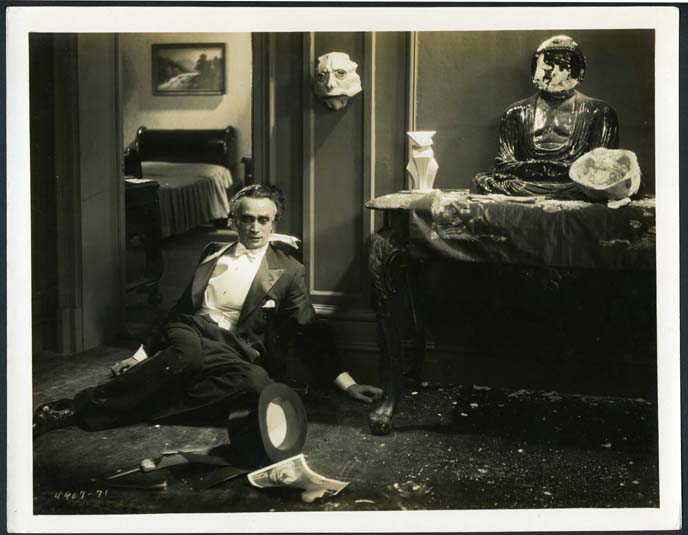
THE LAST PERFORMANCE

Paul Fejos, 1929
Starring: Conradt Veidt, Mary Philbin, Fed MacKaye, Leslie Fenton

Conrad Veidt stars as Erik the Great, an aged, charismatic stage magician who falls in love with (and becomes somewhat obsessed with) his young, lovely assistant (Mary Philbin from Phantom of the Opera). One night a young vagrant breaks into his hotel room to steal food and Julie, his assistant, insists that they take him in and Erik trains him to be a new assistant. Unfortunately for Erik, Julie falls in love with this unsavory character. Erik’s other assistant, the jealous Buffo, figures out what is going on and tells Erik. Soon after Buffo is found dead and Erik blames Mark, the young thief. 

Though this is not really a horror film, it fits more in line with a lot of Universal’s silent output from the ‘20s that are typically categorized as horror. There are some melodramatic elements, unrequited love, and murder, making this more of a mystery with horror leanings due to Veidt’s mesmerizing performance as the magician Erik the Great. The film is also very stylish, thanks to director Paul Fejos, and is worth seeing due to its speedy space and short running time (it clocks in at almost exactly an hour). Fejos’s work here is particularly notable for including some early zoom effects which make an otherwise static film much more dynamic. After making a number of films in Hungary, Fejos travelled to the U.S. for a few years to make a handful of exceptionally lovely and stylized films for Universal and MGM, such as The Last Moment and Lonesome, a very different kind of love story with a carnival setting. Soon after he returned to Europe and made a number of well regarded films, including Spring Shower. Afterwards he began making ethnographic documentaries and ended his life with a successful career in anthropology.

This is Conrad Veidt’s last silent film for Universal before returning to Germany, though he would be back in a few years to make films in the U.K. and the U.S. due to the outbreak of WWII. Veidt completely carries the film on his shoulders and is fantastic, as usual. The young Mary Philbin is very charming and photogenic, though her character is somewhat two-dimensional (as unfortunately all her silent film characters were.) As with some other films from the end of the ‘20s, such as Paul Leni’s The Last Warning, this film was primarily shot on parts of the wonderful and very expensive set built for Phantom of the Opera. 

Also known as Erik the Great, the film is available as a special feature on the excellent Criterion Lonesome release or for free on Youtube. There are actually two versions, a totally silent film, which is the one available in the Criterion release, and a semi-sound version with sound effects and some dialogue, which was typical of the transitional period between silent films and talkies. Beware that the print looks very aged, though it is worlds better than some of the unrestored silent films from Universal like The Last Warning. Recommended primarily to fans of Veidt and anyone with an interest in some of the themes Tod Browning would explore throughout his career: sideshows, performance, carnivals, etc. 

Thursday, May 2, 2013

THE LAST WARNING


Paul Leni, 1929
Starring: Laura La Plante, Montagu Love, Margaret Livingston, John Boles

Paul Leni’s follow up to The Cat and the Canary, The Last Warning, is a riff on the “old dark house” subgenre. During the production of a play, an actor is murdered. Five years later, a producer decides he is going to solve the mystery once and for all by re-staging the play with the surviving cast members. There are an absolutely litany of suspects and a lead actress who several men are fighting over. Unfortunately, after a number of ominous accidents, someone else dies and everyone hastens to find the killer before they too are murdered, though some believe they are being haunted by a ghost. 

Though this is not strictly a horror film - it’s really more of a murder mystery - its connection to Universal horror may make it of interest to genre fans. Star Laura La Plante also starred in The Cat and the Canary and was one of the most popular silent film actresses of the period. German Expressionist filmmaker Paul Leni brings some lovely, imaginative scenes to what otherwise would likely have been dull proceedings. Leni was on loan from Germany, along with a number of other actors and directors who moved to Britain or the U.S. during the late ‘20s through WWII. The deep shadows, stark angles of the old theater, hidden passageways, expressionist like shots, and sets recycled from The Phantom of the Opera certainly make this a horror-tinged murder mystery. During one wonderful shot in particular, Leni makes the front of the theater seem like a leering, evil face, which would be reused countless times in the later horror films. And as with Leni’s The Cat and the Canary, there is also a certain sense of dark humor at work and part of what makes this film entertaining is its refusal to take itself seriously. 

The film is not perfect and suffers from a clunky script. Many horror films from this period were based on stage plays (this is based on a play by Thomas F. Fallon, who adapted it from Henry S. Wadsworth Camp's novel Backstage Phantom) and, as a result, have a different structure. Dracula, for example, is light years from its source novel and feels more like a parlor room talkie with brief moments of supernatural terror. The Last Warning suffers from similar issues, with simply too much exposition and talking to fill the running time, though Leni makes the absolute best of it. He is saddled with tropes and stock characters like much of this genre, but lightens things up with clever headlines and inter-titles that mark much of Leni’s work. This is also one of the few silent horror/mysteries films that give us a glimpse of the jazz age, which gives the plot a little added dimension. The conclusion is lackluster, particularly after Leni has spent so much time effectively building us up to consider that the culprit may be supernatural. 

Though The Last Warning is by no means a must-see, it has many enjoyable moments. If you love The Cat and the Canary, The Bat, The Old Dark House, or spooky mysteries, then this is definitely for you. The film moves at a brisk pace and has some enjoyable action, mild scares, and plenty of twists and red herrings. It has not yet been restored and released on DVD, but it is available on Youtube because it has become part of the public domain. Be forewarned: though this is a silent film, like other films from the transitional period in the late ‘20s, certain sound elements are included, like crowd noises early in the film. Apparently Universal released three versions of the film, all with different soundtracks, including a partial talkie that is now lost. 

Unfortunately this was Leni’s final film before he died of blood poisoning later the same year. It was remade a decade later by Joe May as The House of Fear. Like Leni, May was a German expatriate and a pioneer of the German/Austrian film industry. May also went on to direct a Universal horror film, The Invisible Man Returns. 

Wednesday, May 1, 2013

Conrad Veidt (1893 - 1943)


Born Hans Walter Konrad Weidt in 1893 in Berlin, Germany, Veidt rose to fame as one of the highest paid actors in pre-war Germany, one of the most important figures of German Expressionism, and a key player in early Hollywood horror and British fantasy/action films. He will be forever remembered for his starring roles in The Cabinet of Dr. Caligari and The Man Who Laughs, along with parts in Waxworks, The Thief of Baghdad, Casablanca, and many more. He got his start in acting during the first World War, when he was drafted into the German army. He contracted pneumonia and while recuperating, began working at a theater with his then girlfriend, actress Lucie Mannheim (The 39 Steps). After his eventual discharge, he returned to Berlin to further train in acting with the famous Max Reinhardt at the Deutsches Theater. 

Beginning in 1916, Veidt starred in a number of German silent films, though the first to bring him fame was Robert Wiene’s The Cabinet of Dr. Caligari (1920), where he starred as the somnambulist Cesare. This has gone on to become the most famous and iconic film of German Expressionism. It went on to influence early Hollywood horror films and the later noir genre. He appeared in other German Expressionist horror classics like Waxworks, Der Januskopf, The Student of Prague, and The Hands of Orlac. During this period he became one of the highest paid actors of Germany’s top studio, Ufa. 

He rose to international fame and attracted the attention of directors and producers in the United States and Britain. John Barrymore tempted him to travel to England to appear in The Beloved Rouge (1926) and he stayed on in England to make a few more films and practice his English. By this time many members of the German film community, such as directors Paul Leni, Ernst Lubitsch, and Fritz Lang had emigrated to Britain or Hollywood. Soon Veidt temporarily moved to Hollywood to star in a number of Universal films, including Paul Leni’s classic, The Man Who Laughs (1928). He returned to Germany, but his time there was limited due to the rise of National Socialism.

Veidt was enormously outspoken against the Nazi regime. He took a stance by supporting Jewish and gay rights and even allegedly registered as a Jewish refugee at once point. One of his most important, though little seen pre-wars films is the tragic drama Anders als die Andern (1919, Different from the Others), where he boldly played a gay violinist in love with his student. Part of the purpose of this controversial film was to overturn German laws against same sex relationship. The stigma of this film followed him into the Nazi regime, though Joseph Goebbels attempted to win him over due to his fame. Due to his outspokenness, his Jewish wife, Ilona Preger, and threats made against Veidt’s life, the couple was forced to flee in 1933, where they emigrated to Great Britain and eventually the U.S. He donated much of his salary - particularly when he was forced to play Nazis - to the British war cause, determined to fight National Socialism up until his death. 

In England he worked with the great director Michael Powell on The Spy in Black (1939), Contraband (1940), and The Thief of Bagdad (1940), which won three Academy Awards. In Hollywood he was often type cast as a Nazi or a spy, and he was given roles like Nazi commander Major Strasser in Casablanca (1942), with another German expatriate, Peter Lorre, and as a spy alongside Humphrey Bogart in All Through the Night (1941). In Nazi Agent (1942), he was able to play twins, one an evil Nazi, and the other an honest immigrant who pretends to be a Nazi to wipe out as many spies as possible. His final, very fitting role was as the leader of the German resistance in Above Suspicion (1943) with Joan Crawford. Like several other figures of German Expressionism who emigrated to the U.S., such as directors Muranu and Leni, Veidt died young, suffering from a heart attack while golfing at age 50.

He will forever be remembered for his diverse, early roles in German Expressionist cinema and his later contributions to Hollywood and British film. This amazing actor also deserves to be remember for his great humanitarian effort and determination to fight for his beliefs, even at risk to his own life. If you want to learn more about Veidt, check out some of his amazing films - he was in well over a hundred - plus there is a biography and there are also a number of heartfelt fan pages worth checking out (even though some of them aren’t very professional looking).