Showing posts with label Universal horror. Show all posts

Monday, September 30, 2013

THE INVISIBLE MAN RETURNS

Joe May, 1940
Starring: Vincent Price, Cedric Hardwicke, Nan Grey, Alan Napier

Almost a decade after the events in The Invisible Man, Dr. Griffin’s brother, also named Dr. Griffin, attempts to save his friend from prison by injecting him with the invisibility serum he inherited from his brother. His friend, Sir Geoffrey Radcliffe, has been unjustly imprisoned and sentenced to death for the murder of his brother. His newfound invisibility will give him time to escape and search for the real murderer, though he must do so before the serum’s side effect takes hold: insanity. Unfortunately the police force, wiser than in The Invisible Man, hunt him down with increasingly clever methods and his cousin, Richard, is trying to steal Radcliffe’s business and his girlfriend. 

This is not Vincent Price’s finest hour, as he is young and inexperienced here in his first ever horror role, but fans of the wonderful actor will not want to miss his turn as one of Universal’s most memorable monsters. His appearance definitely helps make this an above average sequel, though he acts mostly via voiceover or from behind bandages. Though he does not begin to give Rains a run for his money, his makes the part his own and is more human and sympathetic. While this is Price’s most major contribution to a Universal horror film, he also worked with Frankenstein director James Whale on his jungle adventure film Green Hell (1940), during the same year as The Invisible Man Returns. He would also later briefly lend his voice to the Invisible Man character in Abbott and Costello Meet Frankenstein (1948). 

One thing I can say about The Invisible Man Returns is that it benefits from a much stronger and more dynamic supporting cast than its predecessor. Nan Grey (Dracula’s Daughter) is a more interesting leading lady and the script is definitely strengthened by showing her revulsion and fear when Radcliffe first removes his bandages to expose emptiness underneath. While most Universal horror films suffer from some very annoying police/detective characters, particularly those chosen to be the plucky comic relief, Cecil Kellaway (The Mummy’s Hand, I Married a Witch, and many more) is excellent as Inspector Sampson and certainly gives one of the most compelling detective performances in Universal horror. He nearly steals the film from Price several times. As a side note, many of the actors from this film, including Kellaway, appear alongside Price in the Gothic murder mystery The House of the Seven Gables (1940), which was also directed by Joe May. 

The antagonists, Alan Napier (the Batman TV series) and Sir Cedric Hardwicke (The Ghost of Frankenstein, Invisible Agent), are fittingly slimy and unsympathetic, though both this sequel and The Invisible Man suffer from the issue of trying to make the film’s protagonist (Griffin and now Radcliffe) both the bad guy and the good guy. This inevitably makes the overtly villainous characters less effective, though the script in The Invisible Man Returns works harder to rectify that. 

Another positive thing to consider is that unlike the sequels to The Mummy, The Invisible Man series makes a solid attempt to at least write a new story for each film. Though The Invisible Man Returns certainly treads on some of the same ground as The Invisible Man, it is more than just a simple re-hashing and was penned by Universal regular Curt Siodmak (The Wolf Man). The Invisible Man Returns also builds on the previous script. We know that Radcliffe is going to go insane, but we don’t know when. The need to solve a murder mystery before this happens gives the film a rushed, somewhat breathless feeling that is typically lacking in Universal’s usually slower paced horror sequels. 

Special effects, again from John Fulton and again Oscar-nominated, are also built upon. Though the black velvet on black background technique is still used, the sequel forgoes the snowy setting of the first film and employs smoke and rain to help reveal Radcliffe throughout the film. The conclusion is also more effective. Radcliffe is dying because of a bullet wound, which Griffin is unable to operate on simply because he can’t see Radcliffe’s body. When he successfully gives him a blood transfusion, the new blood brings Radcliffe back to visibility, beginning with the circulatory system and moving outward in a lovely and impressive sequence. 

This is certainly not a perfect film. It is a bit plodding in parts and suffers from some lackluster direction from Joe May, which pales in comparison to James Whale’s work on The Invisible Man. The many wonderful comedic and sometimes zany moments from the first film don’t appear as often in the sequel, though there is a nice sequence where the police department attempts to root out Radcliffe with a smoke machine. In response, he dons one of the full body police uniforms and gas masks and simply walks out the front door. 

This film is available as part of The Invisible Man: The Legacy Collection, which includes a documentary and all of the sequels, The Invisible Woman, Invisible Agent, and The Invisible Man’s Revenge. Anyone who enjoyed The Invisible Man or is a serious Vincent Price fan will find a lot to like here. Also, anyone skeptical that Universal could make a competent later-period sequel should check this out. 

Friday, August 16, 2013

THE CREATURE WALKS AMONG US

John Sherwood, 1956
Starring: Jeff Morrow, Rex Reason, Leigh Snowden, Gregg Palmer

Though I watched Creature from the Black Lagoon several times growing up, I didn’t get a chance to see either of its sequels, Revenge of the Creature or The Creature Walks Among Us, until I was in my late teens/early twenties. I knew about them (and their reputations) from reading horror movie books in my early teens and for whatever reason, my kid brain decided that The Creature Walks Among Us was one of my favorite  Universal horror titles. Whatever movie I fantasizes this was, the actual Creature Walks Among Us sadly pales in comparison, though there are some interesting ideas at play. 

Though he was shot and killed in both Creature from the Black Lagoon and Revenge of the Creature (they really couldn’t have thought of a better second ending?), the Gill-man returns for a third time and, also for a third time, scientists are desperate to capture and study him. Dr. William Barton leads a team through the Everglades, where the Gill-man is hiding out after the events of the second film. Accompanied by a guide, Jed Grant, some other scientists, and his adventurous young wife, Marcia, Barton manages to capture the Gill-man by setting him on fire. Yes, you read that right. They set him on fire, despite the fact that he is battling them in the water. He suffers from some severe, life threatening burns and, to the scientists’ surprise, begins shedding his gills and exhibits the use of a secret, secondary set of lungs. Barton wants to transform him into a more human creature, attempts to tame him, and gives him clothing, despite his obvious misery at being on land.

Meanwhile, Barton is having some trouble with his wife, Marcia, whom he believes to be cheating on him with their guide, Jed. Though Barton is abusive and smothers Marcia, he doesn’t realize that she is innocent and Jed is aggressively pursuing her against her wishes. Overcome with jealousy, Barton kills Jed and blames it on the Gill-man. Conscious of what is happening to Marcia and what he is being blamed for, the Gill-man goes on an insane rampage, destroys everything, and kills Barton. Dejectedly, he walks into the ocean, even though his gills no longer function and he won’t be able to breathe underwater. 

As I said, there are some interesting ideas at work here, but unfortunately the film is mostly filler either related to the subplot with Barton and his wife or to Barton’s lengthy conversations about the meanings of science and evolution. There is pitifully little action, though the Gill-man’s giant tantrum at the end of the film is pretty impressive. I was also surprised by the depressing, hopeless ending. It’s a shame the rest of the film didn’t take this tone as well, though proceedings are fairly mean-spirited between the treatment of Marcia and the Gill-man by just about everyone else involved. 

The sociopathic Barton is played by Jeff Morrow (This Island Earth) who would have been a lot better with a more interesting script. Rex Reason (also This Island Earth) is the most sympathetic figure as Morrow’s fellow scientist Dr. Morgan, but is also left with precious little to go on from the script. Leigh Snowden, who plays Marcia, has the most complex storyline, but is sadly the least charismatic of all the blonde scream queens in the Creature trilogy. 

I don’t know if I can recommend this film, but fans of Creature from the Black Lagoon or ‘50s creature feature horror should definitely check it out, simply because it’s such an odd little film. For some reason The Creature Walks Among Us was not filmed in 3-D, as its two predecessors were. This is available as part of the Creature from the Black Lagoon: The Legacy Collection DVD set.

REVENGE OF THE CREATURE

Jack Arnold, 1955
Starring: John Agar, Lori Nelson, John Bromfield

I’m sure it will surprise no one that the sequel to Creature from the Black Lagoon isn’t a particularly good film. For starters, the Gill-man was gunned down at the end of the first movie when he tried to kidnap the beautiful Kay and it’s a little implausible that he is still swimming about the Amazon, in perfect health, at the start of Revenge. And that’s another frustrating element: the Gill-man doesn’t get revenge on anyone in this film. If anything, it should be called Capture of the Creature or something along those lines. 

A new group of scientists travels to the Amazon in search of the Gill-man, once again led by the wizened captain from the first film on his ship, the Rita. They locate and capture the Gill-man with surprising ease and he is sent to the Ocean Harbor Oceanarium in Florida without incident. An animal psychologist from a local university, Professor Ferguson, travels there to study the Gill-man. He meets a young ichthyologist, Helen, and the two begin to fall in love. But the Gill-man also develops an interest in Helen and becomes obsessed with her. He escapes from his tank, kills his handler, and follows Ferguson and Helen on a romantic vacation. He kidnaps her, desperate to take her and return to the sea. Can Ferguson rescue her in time?

First of all, the Gill-man is from a fresh water lagoon, but in this film he is suddenly a salt water creature and lives in the aquarium’s largest salt water tank with a number of other fish. And then tries to escape into the Atlantic Ocean. Revenge also has the audacity to have the same exact ending as Creature of the Black Lagoon, where the Gill-man is gunned down immediately after the blonde damsel in distress is rescued. These elements would seem less flagrant if the entire middle section of the film was a little more interesting. Instead, we have a lot of very talkie scenes in and around the aquarium. Though the Gill-man is more present than in the first film, he isn’t given a lot to do other than swim around and look downtrodden. 

Aside from Helen, played by the adorable and somewhat believable Lori Nelson, the human characters are simply annoying. John Agar, a regular character actor from the period, is (surprise) incredibly haughty and self-important as Professor Ferguson. Some of his dialogue with Helen - or, more accurately, at Helen - is just teeth grindingly misogynistic, but it is a ‘50s movie. Most of the other scientists are outright cruel to the Gill-man, which makes it difficult to side with any of the human characters. Clint Eastwood has his first small role here as a bumbling scientist.

In a certain sense, Revenge of the Creature bears a lot in common with one of my favorite aquatic horror sequels of all time, Jaws 3-D. In both films, the titular monster is involved with a theme part in Florida and eventually escapes. Both films were also shot in 3-D, though Revenge of the Creature is the only 3-D sequel to a 3-D film. It’s a shame that Jaws 3-D is so much more ridiculous and entertaining, though Revenge of the Creature was featured in an episode of Mystery Science Theater 3000, and deservedly so.

Revenge isn’t a terrible film, particularly if you’re not expecting much more than a B monster movie sequel. There are some entertaining moments with the Gill-man, but it obviously can’t compare to the first film. Revenge is available as part of the Creature from the Black Lagoon: The Legacy Collection DVD set. This is followed by a third film, the excellently titled, but disappointing The Creature Walks Among Us (1956).  

Thursday, August 15, 2013

CREATURE FROM THE BLACK LAGOON

Jack Arnold, 1954
Starring: Julia Adams, Richard Carlson, Richard Denning, Antonio Moreno

I was on the fence about whether or not to include Creature from the Black Lagoon in my Universal classic horror series, as it was made almost a decade after the final Universal B horror movie, The Brute Man (1946). In many ways, Creature is more in line with ‘50s-era atomic horror, but the Gill-man is considered one of the seven Universal monsters (Dracula, Frankenstein, The Mummy, The Invisible Man, The Wolf Man, and Phantom of the Opera being the other six) and represents an important link between the classic monsters of the ‘30s and ‘40s and the oversized, nuclear or space-related terrors of the ‘50s. 

After an introduction explaining the formation of the universe, we are brought to what is presumably present day and a geological expedition in the Amazon. Scientists there discover some interesting Devonian fossils that hint at a sort of fish-man, with a human hand, but webbed fingers. The head of the expedition, Dr. Maia, temporarily leaves to collect more funding and his friend, an ichthyologist, Dr. Reed. They return to the Amazon on a ship, the Rita, with the captain and a few others, including Reed’s girlfriend Kay. They discover that Maia’s former team has all been killed in his abscence, but regardless of the danger, he is desperate to find more fossilized evidence. Soon they find the Black Lagoon, which is home to a living Gill-man, a humanoid amphibian, who killed Maia’s team and has developed an unpleasant interest in Kay. 

Allegedly the story is based on a South American legend about a half-fish, half-human creature living in the Amazon that killed nearby humans. This led to a story, “The Sea Monster,” from Creature’s producer, William Alland, and eventually inspired the film. As with many of Universal’s earlier horror films, they worked within in a pool of regular cast and crew members and hired regular creature feature director Jack Arnold. Arnold is responsible for some of their most beloved sci-fi horror films from the period, including Tarantula (I may be the only one who loves this movie), It Came From Outer Space, and The Incredible Shrinking Man. 

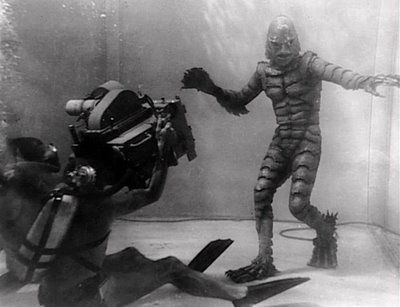
Arnold was in top form for Creature. Though there are some slow, talkie moments, the underwater scenes are incredibly beautiful and atmospheric. The Gill-man also looks best while underwater. Design by Millicent Patrick, though she wouldn’t get credit for years, and artists Bud Westmore, Jack Kevan, and Chris Mueller, Jr. helped create the beast. The Gill-man was played by two actors: Ben Chapman on land and Olympic swimmer Ricou Browning while underwater. Though the very tall Chapman does an excellent job with the Gill-man on land, it is unfair that he received sole credit for so many years (though in the films credits, no one is listed). Browning absolutely steals the film in his underwater scenes as the Gill-man, giving the creature an eerie, menacing beauty. Browning’s scene were filmed separately in Florida in a newly designed tank. 

There are some good performances outside of Chapman and Browning, namely Julie Adams, who is an excellent scream queen. There are a lot of scenes of scantily clad men competing with each other (both intellectually and physically), but that’s in keeping with other genre films from the period. Nestor Paiva is fitting as the grumpy captain of the Rita, and Richard Carlson and Richard Denning are good leading men, not that they can really compete with Gill-man. 

I think the reason I love this film so much is because of what the Gill-man represents: a deep-seated fear of the unknown. Like the earlier Universal monsters, he is humanoid and his level of destruction is relatively restrained, compared to, say, Godzilla or giant, rampaging tarantulas. But unlike the other classic monsters, he is not a creature created by man’s misuse of science (Frankenstein, The Invisible Man) or by something supernatural (Dracula, The Mummy, The Wolf Man). The Gill-man, unlike any of his movie monster brethren that I can think of from the time period, is a product of nature. Unlike the monsters of ‘50s atomic horror, he is not a mutation created by use/misuse of atomic power (or later pollutants), nor is he from outer space. He represents the unpredictable, threatening power of nature and there is something delightfully Lovecraftian about the Gill-man. 

Originally filmed and released in 3-D, this was Universal’s second 3-D film after It Came from Outer Space. This certainly adds to the ‘50s, drive in style charm of the film. While it is one of my favorite Universal movies, there are some silly moments and anyone watching this for the first time as an adult may not be as head over heels for it as I am. The pleasant sense of creepiness and otherworldliness may just be nostalgia, but I’ve simply seen the film too many times to tell. This was followed by two increasingly ridiculous sequels, Revenge of the Creature and The Creature Walks Among Us.

Creature from the Black Lagoon comes highly recommended and is available as part of the Creature from the Black Lagoon: The Legacy Collection, which included all three films and some special features. The film is also available on Blu-ray as part of the Universal Classic Monsters: The Essential Collection with Dracula, Frankenstein, The Mummy, The Invisible Man, The Bride of Frankenstein, The Wolf Man, and Phantom of the Opera. There are also rumors of a potential remake (god I hope not) and more rumors that Guillermo del Toro may take on the project (small favors). 

THE BRUTE MAN


Jean Yarborough, 1946
Starring: Rondo Hatton, Tom Neal, Jane Adams, Donald MacBride

House of Horrors was the first film to star Rondo Hatton as the Creeper, though he also appeared in the Sherlock Holmes film The Pearl of Death and Captive Wild Woman film Jungle Captive in side roles. Though I enjoyed House of Horrors far more than I expected, I don’t have a lot of good things to say about The Brute Man. While it is certainly unpleasant that Universal exploited someone with a disorder (acromegaly in Hatton’s case) and attempted to turn him into their latest monster character, The Brute Man goes even further by including biographical elements from Hatton’s life. I found this to be pretty tasteless (and not in the good, John Waters sort of way). 

In this film, which is sort of a sequel/prequel to House of Horrors, the Creeper is desperate to get revenge on those responsible for his hideous deformities. He commits a few murders by snapping the spines of a local professor and a woman. While eluding the police, the Creeper comes across a blind piano player, Helen, who is the only person not afraid of him. Though he bonds with Helen, he continues killing people and the police discover his hide out. They learn that the Creeper, really named Hal Moffet, blames his (now married) college friends for his deformities, which were the result of a chemistry accident. Hal learns that Helen needs an expensive surgery and is determined to help her even while he gets revenge. 

Hal’s back story, namely being a handsome and popular football player in high school, is based on Hatton’s life. Universal tried to dress up Hatton’s history a little (as Hollywood studios often did with their stars) by claiming that his acromegaly came from mustard gas poisoning in WWI. This is simply not true and was the result of a pituitary gland disorder, though he did serve in the war. On one hand it seems that the film tries to make the Creeper more sympathetic, by sort of providing him with a love story in the form of Helen, the blind pianist. As other critics have written, this is similar to the plots of a few other films from The Man Who Laughs to Bride of Frankenstein to Chaplin’s City Lights. But at its core, the film essentially pokes fun at Hatton, either because of his deformity or his incredibly bad acting. There are some entertaining moments, but overall this is a pretty depressing, mean-spirited affair. 

The rest of the cast is average at best, but I imagine the script is mostly to blame. Tom Neal (Detour) is decent as the lead and Jan Wiley (She-Wolf of London, among others) is alright as his wife. Jane Adams (House of Dracula) is likable as Helen, though she has probably the most unfortunate and unbelievable role outside of Hatton’s. The old Universal stand by - bumbling police officers as comic relief - are also annoyingly present. 

Though I can’t recommend it, the film does look great, full of noirish cinematography and plenty of stylish fog. This is actually Universal’s last B horror movie and they were apparently so embarrassed with it that they sold it to Producers Releasing Corp, a Poverty Row studio who distributed it briefly. The Brute Man was considered lost until the early ‘80s, when it emerged on VHS. It also made its way onto an episode of Mystery Science Theater 3000 in 1996. If you’re really curious, you can find it online or here on DVD, though it is out of print and a little pricey. Watching the Mystery Science Theater episode does take out some of the sting, though, and that is currently available on YouTube. 

Wednesday, August 14, 2013

HOUSE OF HORRORS

Jean Yarbrough, 1946
Starring: Rondo Hatton, Robert Lowery, Martin Kosleck, Virginia Grey

A poor and struggling sculptor, Marcel, can’t afford food or his electric bill and is relieved when a patron arrives to buy his latest sculpture. Unfortunately the man is accompanied by a famed art critic, who slams Marcel’s work and convinces the patron to go home empty handed. Depressed and desperate, Marcel goes to the river, determined to throw himself in and commit suicide. Instead he finds the body of a near dead gangster/murderer, the Creeper, brings him home, and nurses him back to health. They form a strange bond and the Creeper begins to murder anyone who offends Marcel, beginning with the art critic. His preferred cause of death is spine snapping. Marcel hopes his career will turn around with new sculptures modeled on the Creeper, but it seems like not all the local art critics agree and the Creeper pays them a visit...

Also known as Murder Mansion and Joan Medford is Missing, none of the titles really make any sense, as the Creeper travels around the city to murder people. Less of a horror film than a horror-tinged crime thriller, this is more entertaining than some of the other duds Universal released during this period. The real star of the film is Martin Kosleck, who plays the deranged sculptor Marcel, both a sympathetic and wholly unlikable character. Kosleck’s restrained yet demented performance made me wonder why we didn’t see him in more Universal horror films from the early ‘40s. And then I looked it up and realized he is in She-Wolf of London, The Frozen Ghost, and The Mummy’s Curse, though generally in small side roles. Having escaped Poland during WWII, Kosleck was sadly typecast as a Nazi during much of his Hollywood film career. He also appeared on Broadway and in a lot of cult television shows, and supported himself as a painter.

Co-star Rondo Hatton was outrageously exploited by Universal, who wanted to use his unique appearance for a series of films based around the character of the Creeper. Hatton suffered from acromegaly, a pituitary disorder, which made him look like a Universal monster without needing any make up. Hatton originally played a similar character in Jungle Captive, the third film in the Captive Wild Woman trilogy, and in The Pearl of Death, one of Universal’s Sherlock Holmes films with Basil Rathbone. House of Horrors was followed by The Brute Man, the second in a planned series, but Hatton died of heart failure (due to his acromegaly) before he could make anymore films. Despite being a lesser known horror actor, his legacy includes being the namesake of a series of annual horror awards known as the Rondo Hatton Classic Horror Awards. The actual award is a small bust of Hatton (as opposed to the large, sculpted bust present in House of Horrors). 

This film is surprisingly entertaining, despite some slow, talkie scenes involving characters no one cares about. Female lead Virginia Grey is a little annoying, but delivers some quick dialogue as best she is able and wears some absurd hats with aplomb. It’s a shame the script writers clearly found her (and her character’s artist boyfriend) much less interesting than Marcel or the Creeper. There’s also a nice side role from Alan Napier of the original Batman TV show. (Kosleck also had a small side role on the show.) House of Horrors is well worth seeing for Hatton and Kosleck’s performances and for a script that at least tries to be interesting. It is part of the wildly expensive Universal Cult Horror Collection, but I would recommend finding and watching it online. 

THE CLIMAX

George Waggner, 1944
Starring: Boris Karloff, Susanna Foster, Turhan Bey

I was really hoping to like The Climax, partly because of its ridiculous name, but when I prepared to watch it, all I knew was that it starred Boris Karloff. I had no idea that it was originally supposed to be a sequel to the much maligned 1943 Universal version of Phantom of the Opera. When Claude Rains declined to return and other things fell through, Universal simply re-imagined this as a stand alone film, but it has essentially the same plot as their remake of Phantom of the Opera. 

Dr. Hohner, the Vienna Royal Theatre’s on staff physician, was once obsessed with the Opera’s star soprano. When she refused to give up her career and sing only for him, he murdered her. Years later, a new star, Angela, arouses similar feelings in him. Though she has a fiancé, Hohner attempts to hypnotize her so that she can only sing for him. When this fails, he is determined to murder her like his past love. 

When Boris Karloff is on screen, this isn’t actually a bad film. It’s essentially a psychological thriller and he brings out as much of his suave creepiness as he is able for the role of Dr. Hohner, which is basically a shadow of his chilling performance as Hjalmar Poelzing in The Black Cat (1934). Unfortunately though, Karloff does not have as much screen time as is necessary to make this a good film and we are forced to sit through a lot of very talkie love scenes and numerous scenes of singing, a la the Phantom remake. Susanna Foster, who played Christine in that film, returns and plays exactly the same role here. Jane Farrar also returns from Phantom; in both films she plays the older diva forced to retire to make way for the younger, upcoming star. 

Turhan Bey, the strange looking leading man of Universal B movies in the ‘40s, plays Angela’s scenery chewing fiancé. He goes so far as to actually chew up a program, because his rapture at seeing her performance is so intense. I’ve asked it before and I’ll ask again: why are all the male characters in these Universal horror films so creepy?

The film does look fantastic, thanks mainly to the Technicolor process and sets from the original Phantom of the Opera, which were recycled for the 1943 remake and for this film. The Climax was nominated for an Academy Award for Best Art Direction, which seems an odd choice despite the fact that the film looks lovely. It is sort of reminiscent of Britain’s later Hammer Horror output, full of ornate drawing rooms and elaborate gowns. 

I can’t recommend this film, but I can’t really decided whether or not this is better or worse than the 1943 version of Phantom of the Opera. As I said earlier, both films suffer from a shortage of horror and an abundance of singing and melodrama. Despite two compelling leading men/villains (Claude Rains in Phantom and Karloff here), these represent two of Universals least interesting efforts from the early ‘40s. One wonders what George Waggner, director of the acclaimed Wolf Man, did to get this assignment. Upon its release, The Climax was a box office dud and time certainly hasn’t done it any favors. This is available in the Boris Karloff Collection aside a wide range of some of his more obscure films, including Tower of London, The Black Castle, The Strange Door, and Night Key. 

Tuesday, August 13, 2013

THE MAD GHOUL

James P. Hogan, 1943
Starring: Turhan Bey, Evelyn Ankers, George Zucco

Yet another crazy scientist, Dr. Morris, is experimenting with a nerve gas used by natives (the internet says Mayans, but I don’t remember the film specifying) during ancient rituals of human sacrifice and dissection. His assistant, Ted, is a medical student, and unfortunately for Ted, Dr. Morris falls in love with his girlfriend Isabel. Meanwhile, Morris focuses his experiments on a monkey, who he kills with the gas, but revives with aortic fluid from other animals. Isabel accidentally makes it clear to Morris that she is unhappy with Ted. A traveling musician and singer, she is secretly in love with her partner, Eric, but Morris misinterprets the information and plans to do away with Ted and take Isabel for himself. 

He exposes Ted to the gas, which turns him into a zombie-like ghoul unless Morris gives him the aortic fluid of recently dead humans. Morris and Ted follow Isabel on tour and, while Ted is in ghoul form, kill a number of people to keep Ted alive and put the police on their trail. Morris wants Ted to kill Eric, so that he can have Isabel for himself, but when Ted is in his conscious form, he is determined to protect her at any cost. 

Directed by James P. Hogan (The Strange Death of Adolf Hitler), The Mad Ghoul feels much more like a Poverty Row horror film than a Universal classic, though by 1943 the two had basically merged. Universal were all about reusing sets, plots, and many of the same actors. After The Wolf Man and much of the Inner Sanctum series, Evelyn Ankers is again the female lead. She’s not particularly good, particularly bad, or particularly memorable, but stands out in these films for the sheer number of them she was cast in. Another Universal regular, Austrian actor Turhan Bey, known as “the Turkish Delight” to his fans, appears as her partner and love interest, Eric. 

Of course George Zucco is really the show stopper and almost manages to surpass the middling plot. Whether in Universal horror, Fox, MGM, or Poverty Row films, the British Zucco nearly always appeared as a villain, taking roles as varied as Dr. Morris in this film to Professor Moriarty in The Adventures of Sherlock Holmes (1939) alongside Basil Rathbone. He appeared in dozens of horror, cult, and adventure films. If you’ve never had the pleasure of watching his barely contained ranting and raving, this isn’t a bad place to start. He’s excellent as Dr. Morris and this was one of his first starring roles. 

The Mad Ghoul does contain a number of horror tropes that were popular in the ‘40s: the mad scientist, the luckless protagonist and his damsel-in-distress girlfriend, a suspicious police inspector, a meddling reporter, annoying comic relief, murder, grave robbing, and highly illegal scientific experimentation. This probably could have been a bit more compelling if Universal put more work into the script, but as it stands, it is a mostly dull affair and can’t compare to other early zombie films like Bela Lugosi-vehicle White Zombie and Val Lewton’s melancholic I Walked With a Zombie. It’s also a shame that the heart removal is so tame and zombie/ghoul Ted mostly shuffles about unimpressively. The overall proceedings feel more like an old school comic book than like a compelling horror film. 

If you really want to watch The Mad Ghoul, I would advise looking for it online. There’s an overpriced DVD-R for sale on Amazon and a very expensive box set of some rare Universal horror films. The Mad Ghoul is definitely more of a rental than a purchase, so neither of these options seem worth it. I do really wish Universal had cast Zucco more often, though. 

Monday, August 12, 2013

CAPTIVE WILD WOMAN

Edward Dmytryk, 1943
Starring: John Carradine, Evelyn Ankers, Milburn Stone, Acquanetta

A blend of circus drama, mad scientist movie, and werewolf film (except there’s an ape woman instead of a wolf man), this ridiculous outing represents a pretty solid example of what “B movie” meant both to Universal and to American audiences in the early ‘40s. It’s hard to image that the biggest war the world has ever seen was going on during the filming of Captive Wild Woman.

Fred Mason, an animal trainer at the local circus, has recently returned from a safari with a number of new animals. His prize find is a female gorilla named Cheela (unmistakably a man in a suit), who exhibits unusual intelligence and strangely human behavior. Meanwhile his fiancée Beth is concerned because her sister Dorothy has been experiencing a number of health problems and is currently staying at the clinic of renowned endocrinologist, Dr. Walters. Walters meets Cheela and is desperate to buy her, but when the owner of the circus won’t sell, he has her kidnapped. Working with Dorothy’s “over-sexed” glands, Walters injects Cheela with an experimental serum (and a freshly stolen human female brain) that transforms her into a beautiful human woman. Calling her Paula, Walters takes her to the circus where she saves Fred from the big cats. As a result, he gives her a job, but she falls in love with him. His relationship with Beth arouses insane jealousy and her animal instincts, transforming her back into her natural form and resulting in a few murders. 

For two reasons, I can’t really say that this is a good movie. First of all, it mercilessly rips off Jacques Tourneur and Val Lewton’s haunting were-cat film The Cat People (1942) -- but it strips away the elements of dread, atmosphere, and psychological terror and only uses the idea that a jealous woman transforms into a beast when her sexual jealousy is aroused. The second reason is that I hate movies with evil apes and monkeys. Though Cheela the gorilla is far from evil and merely acts in accordance with her instincts, I’m just not a fan of simian horror. 

There are some other rough spots, namely the fact that the film is padded with footage of animal taming sequences, especially big cats, from other films like The Big Cage (1933). Though these aren’t exactly on the level of Italian movies like Cannibal Holocaust (1980), the scenes still serve as a reminder of how cruelly circus animals were once treated (and still are). It makes no sense to fill out the plot, which practically races by, even though there are a number of things that could have been further developed, such as Cheela/Paula’s character. 

The cast does a decent job and is packed with Universal regulars. John Carradine steals the show, as always, as the absolutely frothing-at-the-mouth scientist. Evelyn Ankers (The Wolf Man, much of the Inner Sanctum series) is an average actress, but looks great, thanks to the Vera West costumes, and has a decent command of the female lead role. Acquanetta, dubbed the Venezualan Volcano by Universal despite the fact that she was from Wyoming, is lovely to look at, but is an appallingly bad actress. It makes a certain amount of sense that she’s playing a character who isn’t actually human. Her human-ape transformation scenes are decent and definitely benefit from being designed by Jack Pierce (Frankenstein, The Bride of Frankenstein). 

I really don’t think I can recommend Captive Wild Woman, but there are probably plenty of people who will get a kick out of it. There are two sequels, far worse than this film: Jungle Woman (1944) and Jungle Captive (1945), which I couldn’t bring myself to review. In Jungle Woman, Ankers and Aquanetta return and the film sloppily explains that Paula/Cheela didn’t really die, but was revived by an unsuspecting doctor, this time played by the delightful J. Caroll Naish. Paula falls for yet another man and her jealousy again emerges. The less said about the third film, which features none of the original cast, the better. 

If you’re really curious, you can find Captive Wild Woman as part of the Universal Horror: Classic Movie Archive, which includes other rare/forgotten horror films like The Black Cat (1941), Man Made Monster, Horror Island, and Night Monster.

PHANTOM OF THE OPERA (1943)

Arthur Lubin, 1943
Starring: Claude Rains, Nelson Eddy, Susanna Foster

While I absolutely love the 1925 Lon Chaney version of Phantom of the Opera, I’m not sure what Universal was thinking when they decided to remake the film in 1943 with a completely revamped plot (other than, of course, profit). Produced by The Wolf Man director George Waggner and directed by Arthur Lubin, who helmed a number of the Abbott & Costello films, this version of Phantom of the Opera is unfortunately not really a horror movie and certainly lacks the tragic weight of the original film. 

The new plot, which bears little in common with its predecessor or Gaston Leroux’s source novel, focuses on a violinist, Erique Claudin (Claude Rains), who is fired from the Paris Opera House after his left hand stops functioning properly. Unfortunately for Claudin, he is totally broke, because he has been secretly funding voice lessons for the young Christine, an understudy at the Opera. Claudin tries to sell a concerto he has written, but kills the publisher when he believes the man is trying to steal his work. The publisher’s assistant interrupts this and, horrified, throws acid in Claudin’s face, permanently scarring him. The police are on his trail and he is forced to hide in the catacombs under the Opera and wear a mask to hide his gruesome scars. 

Claudin has now completely lost his mind and throws all of his focus into his obsession with Christine. She is already in the middle of a love triangle with Raoul, an inspector, and Anatole, a singer at the Opera house. Claudin manipulates things so that Christine replaces the leading lady for a major performance and she steals the show. He soon kills the woman so that Christine can permanently take her place. During a performance, Claudin causes chaos in the Opera and kidnaps Christine. She is soon found by Raoul and Anatole and the three of them escape as Claudin’s lair collapses on top of him. 

It is hard to deny that the visuals are lovely and may be the film’s strongest point. Many of the sets are borrowed from the original film, particularly the auditorium, which was a replica of the Opéra Garnier, built in France in the mid 1800s. Though the original Phantom of the Opera included some color sequences, this version was totally filmed in Technicolor. Though it looks great, it's upsetting that the masked ball sequence that was so incredible in the first Phantom is missing here. Weirdly, this is the only Universal classic monster film to be nominated for an Academy Award. It was nominated for Music and Sound Recording and won two awards for Art Direction and Cinematography. 

After his many appearances in Universal horror films, it is amazing that Claude Rains was never type cast and essentially went on to be remembered for Casablanca. In addition to his role as Larry Talbot’s father in The Wolf Man, Rains was also the titular character in The Invisible Man. His role as Erique, the Phantom, in this remake helps solidify his status as two of the seven Universal classic monsters (including Dracula, Frankenstein, The Mummy, The Wolf Man, Creature from the Black Lagoon), a feat only mirrored by Boris Karloff. It’s a shame Rains, one of my favorite actors from this period, was basically wasted here as the raving, unsympathetic Phantom. The script strips his character of all the sympathy we feel for Chaney’s Phantom and it’s difficult to see him as anything other than an unhinged stalker. 

In addition to misusing Rains, the film’s biggest fault is that it abandons most of the horror elements and is essentially a musical, or at least some kind of musical-drama hybrid. Fans of Andrew Lloyd Webber’s incredibly famous musical or its film adaptation in 2004 will likely find the 1943 version of Phantom dated, less spectacular, and with far less memorable music. Anyone who regularly worships at the altar of Lon Chaney, such as myself, will find this remake a bland, confused mess compared to the wonderful, iconic original. And let me tell you, the love triangle that takes up much of the plot is just tremendously boring. In the movie's oddest move, Christine winds up ditching them both to focus on her career. A plot point like that just goes to show you that no one, not even the heroine, cares about either of the male protagonists.

If you’re a huge Claude Rains fan or simply curious about this remake, it is available on DVD and on Blu-ray. I can’t really recommend this version, but it isn’t completely terrible. If you enjoy musicals, you will probably be less annoyed than I was. Though I sometimes do enjoy them, I generally have to be in a specific mode to endure 90 minutes of people singing about their feelings, and I was really expecting this to be a classic Universal horror film. 

Friday, August 9, 2013

NIGHT MONSTER

Ford Beebe, 1942
Starring: Bela Lugosi, Lionel Atwill, Ralph Morgan, Irene Hervey

I was actually starting to get bored with Universal horror in the early ‘40s, many of which are comedic mystery films simply advertised as horror movies, but then along came Night Monster. I’m not sure how this insane, bizarre little film got made at all, but it was churned out in 8 days and has been sadly forgotten over the years. Fading Universal horror stars Bela Lugosi and Lionel Atwill received top billing (Lugosi’s first top billing since Dracula in 1931), though they both only really have small side roles. 

A number of murders and other odd things begin to happen near an isolated, spooky mansion in a swamp. The owner, wheelchair-bound Curt Ingston (Ralph Morgan, Weird Woman), has summoned three doctors to his home to show them that he has found a cure where they have failed. His sister, fearing she is succumbing to the family madness, has brought a psychiatrist in to observe her against the wishes of her family. A mystery writer has accompanied the psychiatrist after rescuing her from car trouble. On staff Ingston has a strange butler (Lugosi), a creepy chauffeur, a gruff housekeeper, a hunchbacked guard, and a yoga-practicing mystic, Agar Singh (Nils Asther). Ingston declares that the doctors are responsible for his current state (he’s a quadruple amputee) and one by one, they drop dead. Meanwhile, the psychiatrist is being kept away from Ingston’s sister. 

Lugosi is sadly wasted here. He would probably have been great as Singh, the Eastern mystic, but is forced to play the butler, a role Universal regularly cast him in towards the end of his career with the studio. Coincidentally, the actor cast as Singh, the Swedish Nils Asther, was known as the male Garbo he was considered so attractive. He seems an odd choice for a swami, though he does the role justice. Atwill, though not with us for very long, fares much better as the doctor, at least until he is murdered. The rest of the cast is decent, particularly Ralph Morgan as the devious Ingston. 

Probably the film’s strongest point is the atmospheric, shadowy swamp and mansion scenery, some of which was apparently borrowed from The Wolf Man and The Ghost of Frankenstein. Though I’m not sure specifically which set pieces were borrowed, it was standard for Universal to share sets between horror films, particularly their later, low budget efforts. Fog is of course in generous supply and there are plentiful hints of the mystery genre that Universal was so reliant on during this period, though this is fortunately a solid horror film. 

The film’s major issue is that it simply tries to be too many things and showcase too many side characters. I read another review that described the film as “Universal horror by way of David Lynch,” which makes a certain amount of sense considering the random inclusion of yoga and Hindu mysticism in the plot. This isn’t just a red herring, as any sort of supernatural mystery typically is in Universal films from this period, but has an integral and kind of amazing role to play in the film’s conclusion. There’s also a romantic subplot involving the mystery writer (Don Porter) and the psychiatrist (Irene Hervey), which is a little annoying.

I think this really could have been a great, bizarre little film if Universal had put more care into it, but by the ‘40s they almost completely abandoned their horror films and just kept churning out some pretty generic crap. An interested piece of trivia is that Alfred Hitchcock enjoyed the film, particularly the maid (who quickly gets murdered), played by Janet Shaw, who he later cast as a waitress in one of his finest films, Shadow of a Doubt. 

If you enjoy weird, unexpected older horror films, this comes highly recommended. It isn’t a perfect movie, but it has plenty of surprises and will definitely delight anyone who dislikes the staid, boring mystery films and dried up sequels that Universal squeezed out in their later classic horror years. You can find it as part of the Universal Horror: Classic Movie Archive, which includes other rare/forgotten horror films like The Black Cat (1941), Man Made Monster, Horror Island, and Captive Wild Woman.

Thursday, August 8, 2013

HORROR ISLAND

George Waggner, 1941
Starring: Dick Foran, Peggy Moran, Leo Carillo

Horror Island feels much more like a black and white, live action, feature length episode of Scooby Doo than it does like a Universal horror film, but that is potentially part of its charm. Bill Martin, the owner of a small island off the coast of Florida, Morgan’s Island, smells success when an old sailor gives him half of a treasure map indicating that famous pirate/buccaneer Sir Henry Morgan’s treasure is buried somewhere on his island. Soon after he learns that the map is a fake, but his entrepreneurial spirit takes hold and Bill decides to advertise and sell a treasure hunt vacation on the island. 

After Bill prepares the island for his fake cruise, he manages to attract a diverse gang of people: a socialite, Wendy, and her boyfriend, a gangster and his wife on the lam, a private investigator, and a few others. The trip is immediately plagued with trouble, including a faulty compass to ensure they get lost, and it is obvious someone is trying to sabotage them. There are a few near misses before someone is actually murdered, the castle on the island appears to be haunted, and someone known as The Phantom seems to be after them. Some of the characters think it is all an elaborate joke until the boat disappears, they are stranded, and everyone begins to suspect everyone else. 

Director George Waggner had a busy year in 1941, churning out this film, Man Made Monster, his first collaboration with Lon Chaney, Jr., and their more successful outing, The Wolf Man. Horror Island is certainly one of his more minor efforts. The cast is average and none of them are particularly recognizable, though leads Dick Foran and Peggy Moran reunited again after the recent Mummy sequel, The Mummy’s Hand. Horror Island was actually released as a double feature with Man Made Monster, though the latter is a more serious sci-fi horror film, though of course with some ridiculous B-movie elements.

There are a number of mystery tropes at work here, such as the killer leaving notes counting down the remaining survivors, a la Agatha Christie’s And Then There Were None, red herrings galore, a spooky castle, secret passages, a treasure chest that contains only a skeleton, and much more. Of course there is a happy ending, where Bill and Wendy wind up together and the government buys the island from Bill at a ridiculous price, allowing them to live happily ever after. This borrows a lot from the old dark house subgenre and feels very much like a campy haunted house movie most of the time. The humor can be pretty grating and script seemed lost at the conclusion, trying to find as many ways to wind up the proceedings as possible. 

The film often tries too hard, adding too many twists and red herrings, but quickly killing off suspects and dissolving the potential that something supernatural could be at work. It’s difficult to care about any of the characters (or occasionally to remember who they are), but this is pretty standard fare for crowded murder mysteries.

While this is by no means a great film, it is a lot of fun if you like campy, older murder mysteries. You can find it as part of the Universal Horror: Classic Movie Archive, which includes other rare/forgotten horror films like The Black Cat (1941), Man Made Monster, Night Monster, and Captive Wild Woman.

Wednesday, August 7, 2013

THE BLACK CAT (1941)

Albert S. Rogell, 1941
Starring: Basil Rathbone, Alan Ladd, Hugh Herbert, Bela Lugosi

Much maligned in comparison with Edgar G. Ulmer’s Karloff-Lugosi vehicle The Black Cat (1934), easily one of the best horror films of the ‘30s, the 1941 Black Cat is more of a spooky murder mystery than a horror film. As with the 1934 film, both versions only borrowed the title and the inclusion of a few felines from Edgar Allen Poe. Otherwise neither version has anything to do with Poe’s story. 

A crazy, rich, old cat lady, Henrietta Winslow, is surrounded by her family members while on her death bed. All of them are anxious to learn the contents of her will. When her health suddenly takes a turn for the better, someone does away with her. Unfortunately her will stipulates that while her housekeepers lives and remains to take care of the cats, none of the money will go to her greedy family. This results in more murders, a number of secrets, a twist ending, and, as you can imagine, a pretty convoluted plot. 

Basil Rathbone, Alan Ladd, and Bela Lugosi should be the star power in this film, but really only have supporting roles here and are all criminally underused. This is yet another example of Lugosi being relegated to side roles by Universal later in his career. Rathbone is charming when he is on screen and there’s a nice joke about how his character thinks he’s Sherlock Holmes. This is a reference to Rathbone’s signature role, which he began playing around this time. He would go on to play Sherlock Holmes in 14 films for Universal. Amusingly, he was also in Tales of Terror, a Roger Corman-directed Poe anthology film with yet another Black Cat segment. Gladys Cooper (Rebecca) plays his wife. 

Broderick Crawford, the real estate agent, and Hugh Herbert, the antique dealer, are the biggest stars of the film, though unfortunately much of their screen time is wasted on some ineffective comedy that seems to be an attempt to copy Bob Hope’s The Cat Creeps. Lugosi’s female counterpoint is Gale Sondergaard (The Cat and the Canary, The Invisible Man’s Revenge) as the surly housekeeper. The screenwriters, Robert Lees and Frederic Rinaldo, would go on to write the much funnier Abbott & Costello Meet Frankenstein and Hold That Ghost. It’s a shame the comedy falls flat most of the time in The Black Cat.

As I said, this is more of a murder mystery than a horror film, much in the same vein as The Cat and the Canary, The Bat, and The Old Dark House, with similar moments of comedy. There are some genuinely spooky moments, wonderful set pieces, and some very atmospheric cinematography courtesy of Stanley Cortez (The Magnificent Ambersons, Night of the Hunter), replete with cats, secret passageways, stormy nights, and the shadowy mansion. Despite Cortez's typically wonderful work, overall this is a pretty dull affair and will only interest fans of classic mystery films or Lugosi completists. You can find it as part of the Universal Horror: Classic Archive set along with Man Made Monster, Horror Island, Night Monster, and Captive Wild Woman.

Tuesday, August 6, 2013

MAN MADE MONSTER

George Waggner, 1941
Starring: Lon Chaney, Jr., Lionel Atwill, Frank Albertson, Anne Nagel

An adaptation of Harry J. Essex’s story “The Electric Man,” Man Made Monster is the surprisingly enjoyable first collaboration of soon to be horror star Lon Chaney, Jr. and director George Waggner. The two would reunite later in the same year for Universal’s classic The Wolf Man. Despite the weird and kind of aimless title, Man Made Monster aka The Atomic Monster aka Electric Man is yet another of Universal’s mad scientist films, this time with scenery-chewer Lionel Atwill taking the lead. 

Sideshow performer Dynamo Dan, the Electric Man, is the only survivor during a bus accident where all the other passengers were electrocuted to death. It seems Dan is mostly immune to electricity and attracts the attention of Dr. Lawrence, who plans to study him. But Lawrence’s partner, Dr. Rigas, has other ideas and wants to do some very unorthodox experiments. Namely, he wants to turn Dan into an electrically brainwashed zombie, from which he plans to create a master work force. (No, this doesn’t make any sense to me either.) He manages to get Dan addicted to electricity (at least they are consistent about not making sense) and destroy his brain. For some reason this changes Dan and he temporarily has a permanent electrical charge, allowing him to electrocute people to death just by touching them. As part of the experiment, Rigas has him convinced for murder and sent to the electric chair, though he does not know what the consequences will be... 

If you can pause your brain long enough to stop thinking about the insane plot, there is certainly some fun to be had with the Man Made Monster. Chaney plays what is basically his token role as the lumbering, sympathetic, down on his luck protagonist. Lionel Atwill immediately steals the film away from him as the near raving Dr. Rigas, creating a mad scientist role that is far more memorable than anything done by Bela Lugosi or Boris Karloff. Though the latter two are more remembered for playing classic monsters, they both had numerous roles as mad scientists in obscure Universal horror films. Man Made Monster was originally supposed to be a Lugosi-Karloff vehicle, but was shelved for a few years. 

One of the things I like about these early sci-fi horror films is that they feel so out of place and would belong more with the ‘50s boom of atomic horror. Still, they are interesting experiments and reflect changing ideas about science and popular misconceptions/understandings about what was possible. Oddly, Man Made Monster also has echoes of M. Night Shamalamadingdong’s much later Unbreakable (2000). Though I intensely disliked that film (and all of his films), the parallels about the train/bus accident with a sole survivor are interesting. 

There are a few moody shots and John Fulton (Werewolf of London and The Invisible Ray, which this film bears some things in common with) delivers some nice special effects, despite the obviously small budget. Unfortunately the hero (Frank Albertson) and the leading lady (Anne Nagel) are completely forgettable, but that’s par for the course with these later Universal films. On the positive side, Man Made Monster pretty much dispenses with a major romantic subplot, or at least spends little time on it, and also ignores the irritating attempts at humor that other Universal horror films often suffered from. 

Out of all the mad scientist films I’ve reviewed so far, this probably comes with the highest recommendation (outside of Frankenstein or Bride of Frankenstein, of course). You can find it on DVD as part of the Universal Horror: Classic Movie Archive along with a couple of other titles from the early ‘40s, such as The Black Cat, Horror Island, Night Monster, and Captive Wild Woman. 

BLACK FRIDAY (1940)

Arthur Lubin, 1940
Starring: Bela Lugosi, Boris Karloff, Anne Gwynne, Stanley Ridges

Surgeon Dr. Ernest Sovac illegally saves the life of his best friend, Professor Kingsley, when Kingsley is involved in a car accident. Gangster Red Cannon was responsible for the accident and though he barely has a scratch on him, Sovac murders Cannon and transfers some of his brain into his friend. Kingsley makes a miraculous recovery, but seems to have developed some new personality traits. When Sovac realizes that part of Red Cannon’s brain lives on in Kingsley, he brings him to New York in that hope that he will remember the location of the $500,000 Red Cannon hid before his death. Meanwhile, they are being pursued by Kingsley’s wife, who is desperate to know what’s wrong with her husband, and rival gangsters who also want the money. Unfortunately for Sovac, Cannon is more interested in murderous revenge than uncovering the loot. 

Arthur Lubin directed a number of the Abbott and Costello horror comedies and seems ill suited for a solemn-toned horror-gangster-science fiction hybrid. The pacing is off and though the film does have some promising elements, it seems unclear about exactly what kind of film it really wants to be. There are a few sci-fi/horror elements, namely the ridiculous and illegal brain transplant surgery. Karloff’s Dr. Sovac outright kills Red Cannon to save his friend’s life, but overall seems more interested in the results of the surgery -- his experiment -- and Cannon’s money than he does in his friend’s life. Possibly the worst best friend a person could have. This also borrows way too much from Dr. Jekyll and Mr. Hyde. Screenplay author Curt Siodmak, a regular Universal horror script writer, visited the theme of duality many times throughout his work in films like The Wolf Man and in the similarly brain surgery themed Donovan’s Brain, among other brain-themed horror/sci-fi films.

For some reason this is listed as a star vehicle for Lugosi and Karloff, despite the fact that Lugosi appears in maybe 7 minutes of the film as a disgruntled gangster. Karloff has a bigger role, but even he is pushed to the side by Stanley Ridges, who has the starring role as Professor Kingsley/Red Cannon. Initially, Lugosi was supposed to play Sovac and Karloff was supposed to play Kingsley/Cannon, but director Lubin allegedly replaced him because he thought the role wasn't appropriate for Karloff. Ridges is compelling and certainly steals the film away from everyone else, but the constant and completely unbelievable personality switches throw off the film’s suspense and rhythm. It makes little sense that Red Cannon’s brain/personality seems to be taking over Professor Kingsley, but maybe it's my mistake to assume this film is remotely interested in making sense. 

Overall what could have been an interesting genre effort is pretty lazy and borrows heavily from gangster films that were popular in the '30s, but shifting to film noir in this period. During the early '40s, Universal was desperate to make a buck in anyway possible. There are a couple of atmospheric proto-noir shots, such as when Kingsley/Cannon goes into the water works to retrieve the hidden money. I don’t think I can recommend Black Friday, but it feels more like a long episode of The Twilight Zone or Alfred Hitchcock Presents than Universal horror, so if that interests you, you may want to check it out. Oddly this film is available as part of the Bela Lugosi Collection, even though Lugosi barely appears in the movie. 

Friday, August 2, 2013

PILLOW OF DEATH

Wallace Fox, 1945
Starring: Lon Chaney, Jr., Brenda Joyce, J. Edward Bromberg, Rosalind Ivan

Despite my general misgivings about the six-film Inner Sanctum mystery series as a whole, I enjoyed the Val Lewton-esque second film, Weird Woman, and was pleasantly surprised by the fifth entry, Strange Confession, which totally broke the series’ predictable formula. I expected the final film to be absolutely terrible -- it’s title, Pillow of Death, doesn't really inspire a lot of confidence -- but overall I think things ended on a high note. As with Weird Woman and Strange Confession, Pillow of Death was based on a pre-existing story (the others were based on a novel and a play, respectively), which I think did wonders for the overly predictable series. 

Borrowing significantly from ‘old dark house’ films of the ‘20s and ‘30s like The Cat and the Canary, The Bat, and The Old Dark House, Pillow of Death has a lot of surprising haunted house elements, though overall this is a melodramatic mystery film that typically ends with a human, not supernatural, culprit. An attorney, Wayne Fletcher (Chaney), is having an affair with his secretary, Donna, and hopes to divorce his wife and marry her. Donna’s family, the Kincaids, are less than pleased with this arrangement, because the family is wealthy and they want to avoid both scandal and a gold digger. Unfortunately for Fletcher, his wife soon turns up dead, suffocated to death (I wish the murderer was an animate, malevolent pillow like the tire in Rubber). Fletcher is the main suspect and things get a lot worse for him when other bodies pile up and a local medium (and his wife’s former psychic) claims he knows Fletcher is guilty. A very stressed out Fletcher is driven to the brink of madness and begins to think his dead wife is trying to contact him. Meanwhile, there is a ghost in the Kincaid home. 

Weirdly, this is the only film in the series to lack the signature opening with a head floating in a crystal ball that introduced the other films. This is also a bit more comedic than the other entries, which lightens the usually tedious tone. Though it is slowly paced and often overly talky, there are some interesting things going on here, like missing bodies, secret passageways, a peeping tom/stalker, and a few mental breakdowns. The number of red herrings is kind of dizzying, though many side plots that are introduced don’t really go anywhere, such as the Kincaid family ghost. The supernatural elements are mostly put in place to help uncover a human killer, which is pretty standard for horror-mysteries stretching back to the ‘20s. And, SPOILER ALERT, do not read the rest of this paragraph if you don’t want to know the conclusion. The irritating thing about the first four films is that while Chaney’s characters is always the suspected killer and the evidence often points to him, Pillow of Death pulls a total reversal and actually makes Chaney the killer. The explanation is that he is schizophrenic and has no idea that he’s been committing the murders. This moment feels like a fitting end to the series, though it is pretty silly. 

Pillow of Death (I can't help silently chuckling every time I type that) is a surprisingly good entry in the series, though keep in mind that it is good by comparison and doesn't hold up as a totally solid film in its own right. If you’re going to watch any of the Inner Sanctum mysteries, it should either be this or Weird Woman, which are definitely the highlights of an otherwise persistently mundane, frustrating, and underwhelming series. All six films can be found in the 2-disc Inner Sanctum Mysteries collection. 

STRANGE CONFESSION

John Hoffman, 1945
Starring: Lon Chaney, Jr., J. Carrol Naish, Brenda Joyce

Though the fifth film in the Inner Sanctum mystery series isn’t a particularly good one, it at least breaks from the plot mold of the first four films. A scientist, Jeff Carter (Chaney), is experimenting on a new break through vaccine for influenza, but things go horribly wrong. He shows up at the home of a lawyer friend with a bag and announces that he must make a confession. It turns out that the bag contains the head of his former boss, greedy businessman Roger Graham, who took credit for Carter’s vaccine and stole all the profits. While Carter was in South America, perfecting the formula, Graham tried to steal his wife and killed his young son by releasing the vaccine before it was ready or fully tested.

Strange Confession definitely benefits from mixing up the tired old plot formula. Though Chaney is again downtrodden for basically the entire film, at least he isn’t surrounded by a gaggle of women desperate to get in his pants, something that made the  premises of the first four films difficult to accept. I also tend to enjoy films that begin with the ending and Strange Confession delivers in that department - Carter confessing to murder while holding a decapitated head in a bag is fairly lurid. The use of flashbacks is refreshing, considering that all the other films have been mostly linear and relied mostly on silly voice overs. 

Lon Chaney, Jr. stars, yet again, but the wonderful J. Carrol Naish returns and Brenda Joyce joins as the leading lady, a role she would reprise for the final film in the series, Pillow of Death. Naish is certainly the main reason to watch this film and though he is also in Calling Dr. Death, the first film of the series, this entry has far more to offer than that dud. While this is still fundamentally a mystery-melodrama, it has a sense of atmosphere only equalled by the second film in the series, Weird Woman, and the final final, Pillow of Death, which is partly a haunted house movie. 

Also known as The Missing Head, this film was essentially unavailable until the ‘90s due to an issue with the rights to the story. Strange Confession was basically a remake of Claude Rains’ vehicle The Man Who Reclaimed His Head (1934). Though Universal had the rights to use the story for that film (from a play by Jean Bart), there was a dispute about whether or not they had the rights to make a second remake, so it all but disappeared until its video release in the ‘90s. 

You can get all six of the Inner Sanctum films in this two-disc set. While neither the set nor Strange Confession comes highly recommended, they might be of interest to fans of early mystery films or fans of Lon Chaney, Jr. 

Thursday, August 1, 2013

THE FROZEN GHOST

Harold Young, 1945
Starring: Lon Chaney, Jr., Evelyn Ankers

I’m sure no one will be surprised to learn that the fourth film in the Inner Sanctum mysteries series has absolutely nothing to do with ghosts, frozen or otherwise. Gregor the Great, a stage performer actually named Alex, accidentally kills an audience member one night after the man heckles him and accuses him of being fake. The man dies while Alex has him in a hypnotic trance and though it is ruled a heart attack, Alex is wracked with guilt and it begins to ruin his life. He confesses to murder and breaks up with his fiancée. He takes a job at a wax museum run by Madame Monet, but because it is a wax museum, there are a number of questionable, potentially spooky things going on there. The demented sculptor, Rudi, who used to be a plastic surgeon, becomes immediately jealous of the attention Monet and the other women at the museum pay Alex. The women soon feed into the hysteria and Madame Monet disappears after fighting with Alex. Predictably, he becomes the main suspect and must reunite with his fiancée to clear his name. 

This is a pretty standard murder-in-a-wax-museum plot where the insane sculptor is using (or trying to use) human bodies in with his sculptures, though here Rudi just stores the bodies near his incomplete wax sculptures. It also contains basically the same plot outline of every Inner Sanctum film. Chaney plays a down on his luck guy that every woman on the planet is obsessed with. Someone dies in questionable circumstances and he is suspected for murder, usually by an inept police inspector. The culprit is never actually Chaney, but either a jealous woman or someone after his money. The third time around it was a bit predictable, but by the fourth time, it’s just tedious. 

Though Reginald Le Borg directed the first three films in the series, Harold Young (The Mummy’s Tomb) took over the reins here, not that it made much of a difference. Lon Chaney, Jr. returned again to star and I can’t help but wonder why Universal insistently put him at the helm of each of these boring, or at best mediocre films. The series probably would have been more interesting with some lesser known actors, but alas. At least Evelyn Ankers returns to co-star, though, as always, she is unable to make a dull script interesting. 

This is certainly superior to the boring third film, Dead Man’s Eyes, but fails to produce any convincing red herrings or twists, as in the second film, Weird Woman. Frozen Ghost oddly introduces us to the killer, Rudi, and attempts to use his overt guilt and obvious mental instability as a red herring, along the lines of “he is so obviously guilty,  you will never believe he is really the killer.” It’s a tired and lazy concept, but this still could have been far more interesting than it wound up being, which is a shame.

I can’t recommend Frozen Ghost, but if you really want to watch the most subpar wax museum film made before 1960, you can find this in the two-disc Inner Sanctum Mysteries Collection along with the five other films.

Wednesday, July 31, 2013

DEAD MAN'S EYES

Reginald Le Borg, 1944
Starring: Lon Chaney, Jr., Jean Parker, Paul Kelly, Acquanetta

After enjoying the second Inner Sanctum mystery, Weird Woman, far more than I expected, I really tried to like this third entry in the series. As one other reviewer put it, (I believe he was quoting the American Gothic book) the series as a whole is “stubbornly underwhelming.” I wish I could find a better, more optimistic way to describe these films, but it’s almost as though Universal purposefully didn’t want anyone to like them. With the combination of an average-at-best director, Reginald Le Borg, responsible for the first three Inner Sanctum films, and star of all six, Lon Chaney, Jr., it’s hard to expect much. 

Dave Stuart, an artist, is accidentally blinded by his model, Tanya, which ruins his life and career. His fiancée’s father offers to donate his eyes to Stuart (!!!) upon his death, so that Stuart can get an eye transplant operation. Soon after, the man drops dead and Stuart is the main suspect. As with the other Inner Sanctum films, this has basically the same premise. Chaney plays a down-on-his-luck moper who mysteriously (and preposterously) attracts loads of women. Someone is murdered and the evidence points to Chaney, but a jealous woman is usually the real culprit. While this film and Weird Woman have somewhat interesting, imaginative premises, they don’t really go anywhere. The characters are also all completely unlikable from Chaney to his ice cold fiancée and her obnoxious ex-boyfriend. As with Weird Woman, many of the characters are creepy and sexually obsessive -- men and women both -- and we are somehow expected to care about a series of love triangles that typically point the way to the real perpetrator. 

There are some completely ridiculous leaps of reason in the script, such as an eye transplant surgery, which is shown in the cheapest way possible with shots of Chaney’s eyes squinting. Though Tanya is supposed to be guilty for blinding Stuart, he’s the one who kept a bottle of corrosive acid not only on the same shelf as his eye drops, but right next to them. 

Jean Parker (Edgar Ulmer’s Bluebeard) is not quite a replacement for series regular Evelyn Ankers, but she does her best. I think. She at least does a lot better than model-turned-actress Acquanetta (Captive Wild Woman), who is lovely to look at, but has the emotional range and acting skills of a goldfish. It is sadly easy to see how her character could have confused a container of eyedrops with acid. Paul Kelly is believable as Stuart’s doctor and the only likable character on hand, but can’t be expected to save the film on his own.  

 If you’re really curious about Dead Man’s Eyes, you can find it on the two-disc Inner Sanctum collection, though I would recommend a rental above a purchase. It’s certainly one of Chaney’s lesser roles, though that isn’t saying a lot. Son of Dracula, here's looking at you.