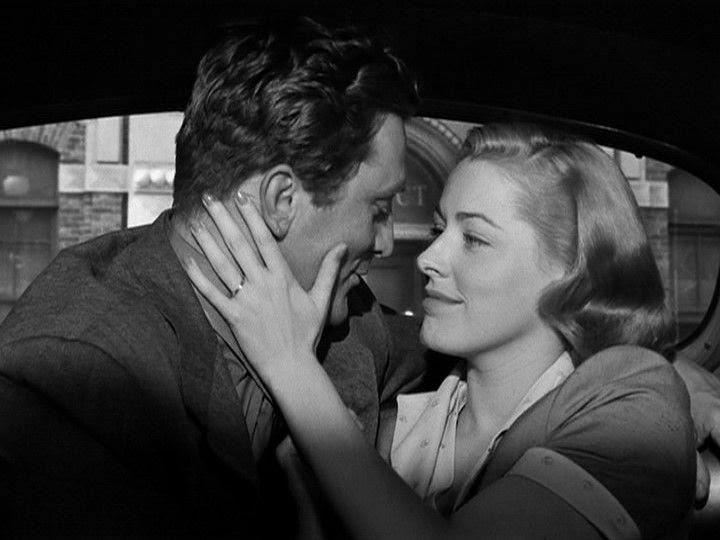
William Wyler, 1965
Starring: Terence Stamp, Samantha Eggar
Freddie, a lonely young lepidopterist, finally decides to pursue the distance object of his affections, an art student named Miranda, after winning a sizable lottery pool at work, which allows him to retire and purchase a home in country. Courting Miranda involves stalking her, memorizing her schedule, and then kidnapping her with the use of chloroform. She wakes up in a basement shelter hidden behind Freddie’s home to find that he is in love with her and hopes she will come to return his affections. Freddie is not violent with her and she hopes to gain his trust in order to escape, faking an illness, and later attempting to seduce him, though all of it is in vain. Miranda begins to realize that he will never allow her to escape and she will probably die in captivity…
Based on John Fowles’ novel of the same name, this is technically an American-British coproduction, but I’ve included it as part of my lengthy British horror series, because it was shot in England and with English actors. Famously, the wonderful William Wyler gave up The Sound of Music for the chance to direct this film, his only title that could really be described as a horror film or thriller, and it is certainly a masterpiece in an already rich and dazzling career. With The Collector, Wyler actually subverted the very romantic tropes — which he used in a variety of flexible ways — that made him famous in films like Jezebel, Wuthering Heights, Roman Holiday, How to Steal a Million, and even Funny Girl.
As Hannibal Lector would tell Clarice Starling decades later in The Silence of the Lambs, “We begin by coveting what we see every day.” And though The Collector exists seemingly on a different planet than the British horror films produced by Hammer, Amicus, or Tigon — it has far more in common with Michael Powell’s Peeping Tom — it is still rife with subtle themes of class division and cultural tension that appears as a subtext in many of the country’s genre films of the late ‘60s and ‘70s. There is the sense that Freddie wants to possess Miranda — who he watched grow up, as they are from the same home town — because she represents all the things he did not have. Strangely, he never attempts any sexual violence and her attempts to seduce him are met with outright disgust; her value seems to be more as a social and economic possession.
There is also a connection to Lolita (published in 1955, just eight years before Fowles’ novel) in the sense that The Collector is all about a man preserving and sustaining an impossible romantic fantasy; he’s not consumed by remembering a love lost, but a love that never really existed in the first place. Like Humbert Humbert, Freddie is perhaps monstrous and is certainly strange, but he’s fundamentally sympathetic, even likable. Lepidoptery is of course another connection between Nabokov, Lolita, and The Collector; like one of Freddie’s butterflies pinned in a glass case, he can only truly appreciate beauty in a fixed form, as an immobile object over which he has absolute control.
This is not to say that Wyler devalues Freddie’s love for Miranda in any way, despite his strangeness. Stamp, who didn’t think he was right for the role, but who was eager to work with Wyler nonetheless, is perfectly cast against type as the sensitive, if disturbed romantic hero. His unusual handsomeness and often dreamy expression work far more effectively than someone like Anthony Perkins — who Stamp apparently thought was going to win the role — though of course I’m biased. I would watch Terence Stamp watching paint dry and be riveted. The more disturbing aspects of Freddie’s character are established early on, thanks to a lengthy stalking ritual that takes up much of the first part of the film and a very subtle performance from Stamp. Additionally, Wyler’s refuses to share Freddie’s backstory, making him something of a figure of mystery and unpredictability.
Admittedly, I find Eggar repellent as an actress, though this works dramatically in Wyler’s favor; my dream script change of a happy ending — where Miranda realizes she does love Freddie and doesn’t want to return to her mundane normal life — would only have worked with Julie Christie, who was originally considered a shoo-in for the role. Stamp was ordered to remain cold and aloof from the actress throughout the shooting schedule and her sense of unease and distrust is palpable. To make matters worse for Eggar, she had rejected Stamp’s romantic overtures in the past and was fired immediately after production on The Collector began; she was only rehired and allowed to return, apparently, after agreeing to work with an acting coach.
The best (or worst, depending on your perspective) thing about this film — at least from where I’m sitting — is that the combined talents of Wyler and Stamp make it seem feasible that Miranda will come to return his love. Of course, this would be difficult at best, but something similar happens in films with complicated issues of consent like Kidnapped Coed, The Night Porter, Straight on Till Morning, and to a different degree, some of Walerian Borowczyk’s efforts like The Beast, where a victim falls for a perpetrator, or a rape turns into an act of mutual pleasure. In some ways, this is the ultimate expression of romantic fantasy taken to a particular extreme, and it’s easy to read it as a darker evolution of fairy tale themes, where a prince bestows a lifesaving kiss on a cursed, sleeping princess (obviously without her knowledge or consent), and this act alone ensures her love and devotion. Personally, I much prefer The Collector to Sleeping Beauty or Snow White and the Seven Dwarves.
Of course, The Collector comes with the highest possible recommendation, thanks to the combined talents of Wyler, Stamp, and Fowles. Pick it up on Blu-ray, though I’m desperately hoping it will get the special edition restoration treatment it so richly deserves. The film was supposed to be shot in black and white, but Wyler changed to an oddly dark, subdued use of Technicolor, allegedly because of Eggar’s red hair, which means someone should really pull out all the stops for a high definition restoration. While this fictional person is at it, I’m also dying to see the original three-hour cut, which Wyler was forced to slim down for the theatrical release. I’m sure this additional footage is lost, but a girl can hope.