Showing posts with label Robert Wise. Show all posts

Wednesday, November 5, 2014

THE HOUSE ON TELEGRAPH HILL

Robert Wise, 1951
Starring: Richard Basehart, Valentina Cortese, William Lundigan

In Belsen concentration camp, a young woman, Viktoria, is grief-stricken when her friend Karin dies. She knows that Karin is an heiress with a young son and a wealthy aunt living in California, so she steals Karin’s identity papers, hoping to use them if she survives. After liberation and time in a displaced persons camp, she eventually makes her way to New York. She learns that Sophia, Karin’s aunt has died, but is determined to reunite with Karin’s son, Christopher who is the heir to Sophia’s fortune. She meets Christopher’s guardian, Alan, and agrees to marry him after he falls in love with her. They become a reasonably happy family – Karin/Viktoria, Alan, and Christopher – living in Sophie’s magnificent house in San Francisco. Christopher’s governess, Margaret, dislikes Karin/Viktoria and soon she becomes paranoid that someone in the house is trying to kill her.

Robert Wise’s final entry in the classic film noir roster is not one of his best films – it’s difficult to compete with films like The Body Snatcher, The Set-Up, The Day the Earth Stood Still, The Haunting, or The Sound of Music – but it still has a lot to offer. Though many films in the noir series focus on the aftermath of war and the struggle of adapting to life on a dramatically changed home front, few of these films directly address the concentration camps. Orson Welles’ earlier film The Stranger (1946) is a key example and concerns an escaped Nazi pretending to be a professor in a small New England town. This idyll is interrupted when a Nazi hunter sniffs out his trail and he grows increasingly paranoid and violent.

The House on Telegraph Hill, unfortunately, takes another approach with similar material. Viktoria, a concentration camp survivor, steals the identity of her friend and – like Orson Welles’ Nazi – hides herself in a suburban family. Karin’s real identity disappointingly fades away and I think the film would have been much stronger if her trauma came back to haunt her in a more substantial way. Instead, there are hints of it. The bombed-out playhouse, where Christopher was nearly killed and where she almost falls to her death, remind her of bombed-out buildings in Poland. This seems to trigger her paranoia and for a sizable chunk of the film, it is unclear whether Karin is succumbing to madness or someone is actually trying to kill her.

There are plenty of moody, Gothic elements and the film focuses on a heroine gradually succumbing to paranoia, along the lines of Gaslight, Rebecca, Suspicion, or The Two Mrs. Carrolls. The central plot mirrors several of these films, in which a husband – the mask of handsome, charming sanity – is actually trying to kill his wife. The House on Telegraph Hill unfortunately glosses over the important plot element that Viktoria has survived the horrors of a concentration camp, stolen another woman’s identity, and married a man she does not love in exchange for comfort and financial security. Though she does quickly come to love Christopher and regard him as a son, she is living a lie. It seems that the Production Code would typically require her to be punished or at least to come clean, but her false persona is basically ignored by the film’s midway point.

Italian actress Valentina Cortese (Thieves’ Highway) is fittingly sympathetic as Viktoria, strong and fragile in turns. Richard Basehart (He Walked by Night) nearly steals the film from her as the increasingly creepy husband and, perhaps oddly, the two married just before filming began and would remain together for the next decade. William Lundigan (The Sea Hawk) is pleasantly handsome, if a bit dull as Viktoria’s white knight and love interest, Major Bennett, though Fay Baker (Notorious) has perhaps the least screen time as the nanny, Margaret, but gives a wonderfully icy performance.

The House on Telegraph Hill is available on DVD or streaming on Amazon. It comes recommended for fans of female-themed noir movies or Gothic thrillers. Keep your eyes peeled from the lovely shots of the house and the San Francisco setting, which were captured by cinematographer from Lucien Ballard (The Wild Bunch). Robert Bassler, the film’s producer, also worked on Gothic serial killer thrillers The Lodger and Hangover Square, and The House on Telegraph Hill would make a nice triple feature with those two films.

Friday, September 19, 2014

THE SET-UP (1949)

Robert Wise, 1949
Starring: Robert Ryan, Audrey Totter, George Tobias

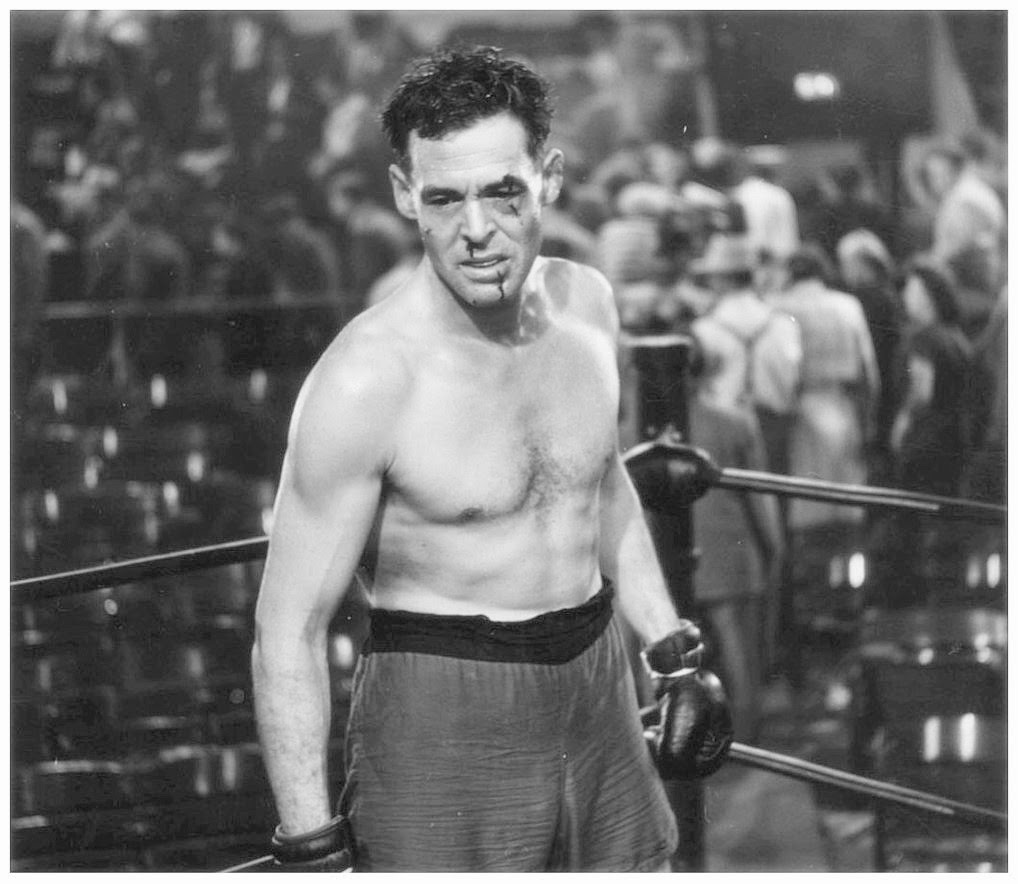
A washed up boxer past his prime, Stoker Thompson, is determined that one night he will win and change his fortunes. His wife, who can’t bear to see him beaten again, walks off her anxiety around the city. His manager, Tiny, has taken money from a local gangster, Little Boy, to guarantee that Stoker will lose the evening’s fight. Tiny is so confident that Stoker won’t win, that he’s neglected to mention the bet and the set-up, spelling doom.

Based on Joseph Moncure March’s epic poem about boxing and the sports underworld, The Set-Up is a rare boxing-noir film and is one of the finest boxing films ever made. Though it lacks some of the key noir tropes – the isolated antihero and the femme fatale – it has a pervasive atmosphere of gloom and defeat. Stoker is introduced as a defeated man. Even his loving wife doesn’t believe he will win and has obviously been hiding this from him for such a long time that she has reached a breaking point and – it is implied that this is for the first time in their marriage – she can’t bring herself to attend one of his fights. Noir regular Audrey Totter (The Unsuspected) is at her best here as Stoker’s genuinely concerned wife. The film occasionally cuts to her walking through the city (giving the action a break from the locker room, on occasion) and her sense of anxiety is a palpable undercurrent throughout The Set-Up.

Robert Ryan gives one of his best performances (which is saying a lot) as Stoker, a unique chance for him to play a good guy. The film adaptation strips away the poem’s racial issues (the boxer is black and deals with a variety of prejudice) and also removes the character’s moral ambiguities. Stoker is a decent guy, happily married, and hardworking, while the poem’s hero is a murkier fellow. It is perhaps Stoker’s good-hearted, honest nature and hard-working determination that makes the film so bitter sweet. It is obvious that he probably will win the fight with Tiger, a much younger boxer, but even if he wins, it’s a shallow victory.

Alan Baxter (Saboteur, Judgment at Nuremberg) is memorable as Little Boy, the film’s token bad guy. Little Boy is notable for not giving into the fit-throwing, scenery-chewing, or snappy dialogue of other movie mobsters from the period – thing James Cagney or Richard Widmark – but he’s quiet, with an icy resolve. Organized crime does not play a major role in the proceedings, and is little more than a useful plot element to insure that no matter what Stoker does, he will fail in some way.

One of the first films to make use of a “real time” structure, The Set-Up is incredibly tightly paced and not a moment of its running time (short at 70-some minutes) is wasted. Though much of the film takes place in the locker room, director Robert Wise turns it into a dynamic set where the grime and grittiness of the underworld boxing scene comes through, as do the personalities of the numerous hopeless, helpless boxers, men trying to make a name for themselves in a hostile world. Though I’m generally not a fan of boxing and find films about the sport particularly dull, the fight scene is gripping, despite the fact that it is shot close to the real duration of a boxing match, with excellent pacing and suspense. The film was also shot at the Hollywood Legion Stadium, incredibly famous for its boxers and star-studded audience.

The Set-Up comes highly recommended. It’s available on single-disc DVD or in the excellent Film Noir Classic Collection Volume 1 along with The Asphalt JungleGun Crazy, Murder My Sweet, and Out of the Past. Director Robert Wise had a long, varied career that includes everything from The Body Snatcher and The Haunting to West-Side Story and The Sound of Music. His work on The Set-Up is undeniably excellent and if you find most film noir too predictable, this moving, pensive work might just change your mind. It’s a true classic, thanks to Wise and what is maybe the best performance of Robert Ryan’s career, where he channels the spirit of post-war rage and violence into a character full of pathos and humanity.

Friday, August 22, 2014

BORN TO KILL (1947)

Robert Wise, 1947
Starring: Lawrence Tierney, Claire Trevor, Walter Slezak, Audrey Long

Helen Brant prepares to leave Reno after finally obtaining a divorce, but the night of her departure she finds the dead bodies of her pretty young neighbor, Laury Palmer, and Laury’s boyfriend. Instead of calling the police, she flees back to San Francisco. On the train, she meets Sam Wilde, the man who murdered Laury due to his insane jealousy, bad temper, and impulsive violence. Though Helen’s engaged to the mild-mannered, wealthy Fred, she is attracted to Sam. He imposes on her, soon meeting Fred and Helen’s wealthy, though generous half-sister and roommate, Georgia. Equally attracted to Sam, the innocent Georgia soon marries him and is unaware that Helen and Sam have begun an affair. Unfortunately for them, Laury’s close friend and landlady, Mrs. Kraft, hires a private detective to track down Laury’s killer. He is hot on Sam’s trail and soon arrives in San Francisco…

This was director Robert Wise’s first film noir, though he would rise to much greater heights after this with Blood on the Moon (1948), The Set-Up (1949), and The House on Telegraph Hill (1951). Wise got his start doing editing work on Citizen Kane and then began directing films for Val Lewton at RKO – Curse of the Cat People (1944) and The Body Snatcher (1945). His varied career includes landmark haunted house film The Haunting (1963), and a fair amount of science fiction – The Day the Earth Stood Still (1951), The Andromeda Strain (1971), Star Trek: The Motion Picture (1979) – and so much more.

While I can’t find much fault with Wise, the script is a different story. Though often known as a minor noir classic thanks to the explosive, psychopathic relationship between Sam and Helen, I was thoroughly let down by this film. There's something completely implausible about it – it almost becomes an amour fou type of film, but never rises to these heights. Claire Trevor (Murder, My Sweet) delivers a coldly impassioned performance, but she’s not able to save a bad script or make Lawrence Tierney a more complex actor. There’s certainly something compelling about him, but it’s too difficult to believe that every woman in the film is overcome with sexual hysteria in his presence. I could see a number of other actors pulling this off, so it could just be a question of miscasting.

Sam and Helen’s relationship has great potential, but overall it is frustrating. Born to Kill has far too much imbalance between moments of psychopathic terror and melodrama, which mirrors the script flaws in their relationship. The film starts out powerfully: Laury’s murder is brutal and unexpected and Helen’s discovery of the crime and subsequent attraction to Sam hints at a sexual preoccupation with violence (more eloquently articulated in Fritz Lang’s Secret Beyond the Door). But these two elements – sex and violence – soon wither away to a number of humorous scenes (with Mrs. Kraft and the private detective) and melodrama (Sam’s marriage to Georgia and Helen’s breakup with her fiancĂ©). Though it is clear that Sam and Helen are having an affair, almost none of this is displayed on screen. Without the explicit reminder of this relationship and scenes of its development, the characters’ collective motivations make absolutely no sense.

For example, if Sam is willing to murder his friend due to a misunderstanding that the friend was sexually interested in Helen, why does Sam not bat an eyelash over her fiancĂ©? Sam’s tendencies toward sudden, inexplicable violence verge toward the childish and make Tierney’s character impossible to relate to or sympathize with. Perhaps this would have worked if Sam was a teenager instead of a middle aged man – it certainly would be more subversive.

There are some enjoyable moments, namely the film’s sheer campiness. Aside from the jarring opening scene with the double homicide, the quieter scenes of domestic drama are at least well shot and competently acted. There are also some fantastic side characters, including Sam’s absurdly mild-mannered friend (another welcome appearance from noir’s whipping boy, Elisha Cook Jr.), the drunken yet endearing Mrs. Kraft (Esther Howard from Detour, Sullivan’s Travels, and Murder, My Sweet), and an eloquent, literary, and thoroughly shifty private detective (Walter Slezak of Lifeboat).

Born to Kill only comes recommend for fans of film noir and the work of director Robert Wise. It is available on DVD, though, as always, I’d love to see a Blu-ray box set of all Wise’s films noir, loaded with special features.

Wednesday, November 9, 2011

THE HAUNTING (1963)


Robert Wise, 1963
Starring: Julie Harris, Claire Bloom, Richard Johnson, Russ Tamblyn

One of the greatest films about a haunted house based on one of the greatest novels about the same subject, Shirley Jackson's The Haunting of Hill House, this film is included in my trilogy of greatest classic haunted house films ever made, along with Legend of Hell House and The Changeling.

Paranormal investigator, Dr. Markaway, is trying to prove once and for all the existence of the supernatural. He takes a couple of research subjects to a mansion that is allegedly the most haunted house in America, Hill House. He brings the future owner of Hill House, Luke, who is the rational skeptic of the group, as well as two women, Eleanor and Theo, who are "sensitive" and have had documented paranormal experiences in the past. Eleanor -- aka Nell -- is particularly drawn to the house. She has spent almost her entire adult life caring for her sick mother, who has recently died, and seeks adventure and liberation from the shackles of the past. The house calls to her and a number of macabre events unfold. When his wife makes a surprise visit, Dr. Markaway realizes that Nell has to be taken out of the house, but it may be too late.

One of the most influential haunted house films ever made, The Haunting is chilling, suspenseful, and also manages to be a sensitive portrayal of one woman's trauma. Julie Harris's pathetic, almost tragic Nell is truly the driving force of the film. While she is not always a likable character, she is sympathetic and curious enough to pull us along with her as she gets sucked further and further into the psychic aura of the house. I really can't say enough good things about the film. It has complex characters, a simple plot, and absolutely beautiful visuals. Wise balances everything perfectly and does justice to Jackson's remarkable novel, even if he has to change a few minor details along the way.

While I tend to hate feminist horror -- "The Yellow Wallpaper" can absolutely fuck off -- Jackson does an amazing job combining a terrifying yarn with real issues of the time, namely the difficult expression of sexuality and domestic life as a prison. Between the insecure, neurotic Nell and the sexually confident but troubled Theo, Jackson presents two believable and sympathetic female characters.

Twin Peaks fans, prepare to have your minds blown by a very young Russ Tamblyn as the skeptical, greedy Luke. If you haven't seen this film... for shame. Pick up the very basic Warner DVD and school yourselves. As a final note, absolutely ignore the 1999 remake. I have no idea why that travesty was ever visited upon the earth.