Thursday, December 31, 2015

BLOOD FROM THE MUMMY'S TOMB

Seth Holt, 1971
Starring: Valerie Leon, Andrew Keir, James Villiers, Hugh Burden

A group of archaeologists searches for the cursed tomb of beautiful Princess Tera, an evil witch who turns out to be miraculously preserved despite the thousands of years since her death. (Concerning her appearance, perhaps the writers don't understand what the process of mummification actually entails.) Fuchs, the professor in charge of the expedition, takes her sarcophagus home to study it and becomes obsessed. Almost two decades later, his daughter Margaret comes to bear a striking resemblance to Tera and begins to have strange dreams that seem like they come from another time and place. Ancient Egypt, perhaps?

Soon Tera's dormant consciousness bleeds into Margaret's personality and she fears she is going mad. Corbeck, a member of Fuchs' archaeology group, wants Margaret to help him restore Tera to life. He convinces Margaret that Tera was wronged all those millennia ago by the priests that cut off her hand and then murdered and mummified her. Bodies begin to pile up and Fuchs realizes that he will have to choose between Princess Tera and his own daughter.

An average, if silly entry into the Hammer horror canon, it should come as no surprise that they had to explore their own version of The Mummy, but the script by Christopher Wicking is a bit of a mess. Based on Bram Stoker's novel The Jewel of Seven Stars, Blood from the Mummy's Tomb is the first film to actually adapt this novel, though it was a direct influence on several earlier mummy-themed horror films. And to its credit, it’s undoubtedly the best film in Hammer’s four-film Mummy series, leaving The Curse of the Mummy’s Tomb and The Mummy’s Shroud in the dust (a little desert humor for you) and nearly going toe-to-toe with The Mummy.

There are plenty of worthwhile elements to this film, namely the lovely cinematography and trademark Hammer atmosphere. If you are a fan of mummy films or Hammer productions in general, this is a worthy entry in the genre and it manages to be a lot more fun than any number of other mummy-themed films that spring to mind. Also, if you are a fan of boobs this is the movie for you. Valerie Leon's rack is so prominent as to be completely distracting. There were actually moments I was unable to focus on plot or dialogue and had to rewind.

You aren't even reading this review anymore, are you?

This was a rare starring role for the busty Leon, though she also appeared in The Italian Job, The Spy Who Loved Me, Revenge of the Pink Panther, Never Say Never Again, and several Carry On films, though it’s really a shame Hammer never used her again. 

Blood from the Mummy's Tomb was intended to be a companion piece for the superior late-era Hammer film Dr. Jekyll and Sister Hyde, which in turn was riding the coattails of the very creepy Hands of the Ripper. Blood from the Mummy’s Tomb had a troubled production history, namely the re-casting of Peter Cushing who originally signed on as Fuchs, but left due to a family illness. It is undeniable that the film would have benefited from his presence — he actually could have helped this to be even better than Hammer’s original The Mummy. There was also the sudden death of director Seth Holt, who had a heart attack during filming. Mummy's curse indeed...

There's a nice Hammer Collection DVD from Anchor Bay that is out of print, but readily available online. It includes some trailers and interviews, but what more can you expect from a latter day Hammer effort? Out of all the Hammer Mummy films, I think I would have to recommend this one the most highly. While the first does include Christopher Lee (as the titular mummy) and Peter Cushing as the protagonist, Blood from the Mummy’s Tomb is colorful, fun, and very campy, and no doubt was at least a little inspired by Bava’s Black Sunday.

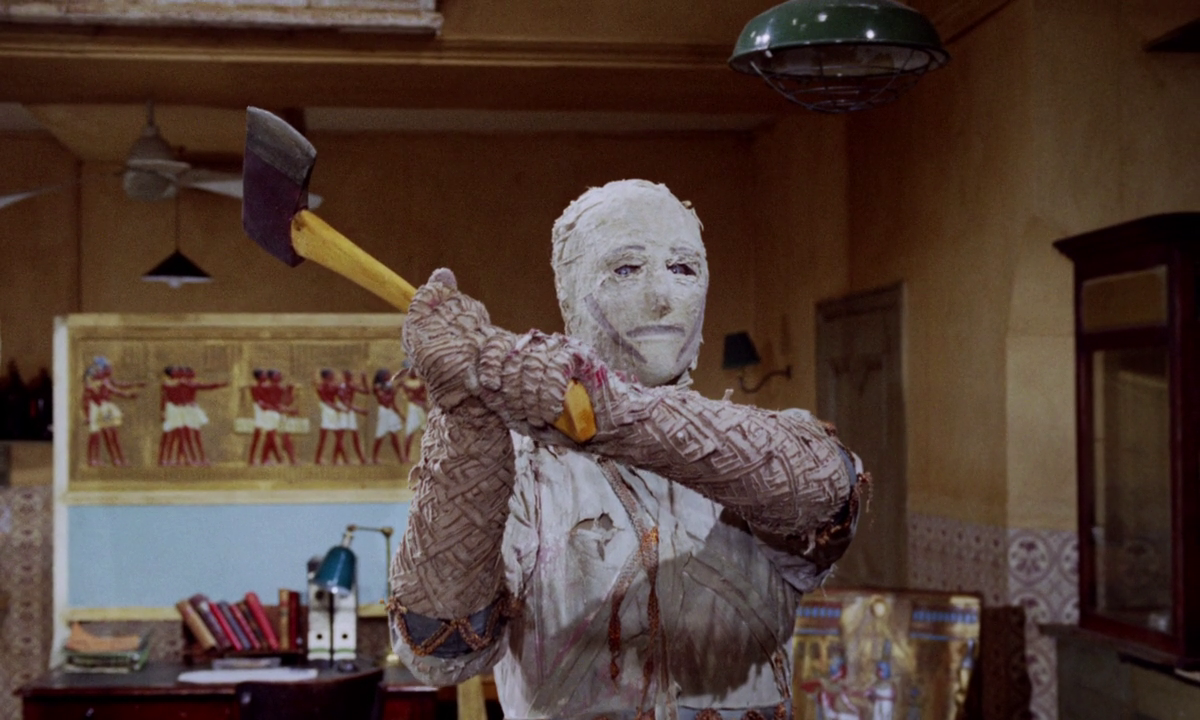
Tuesday, December 29, 2015

THE MUMMY’S SHROUD

John Gilling, 1967
Starring: André Morell, John Phillips, David Buck, Maggie Kimberly

In Egypt in 1920, a group of archaeologists uncover the tomb of Kah-To-Bey, a child Pharaoh who was spirited away by a servant after a violent palace coup. Though a local warns the men — including scientist Sir Basil Walden and entrepreneur Stanley Preston — to stay away from the tomb, the mummy, and its sacred burial shroud, they ignore this advice and disaster strikes almost immediately. Sir Basil is bitten by a snake and, while he is ill, Preson has him committed to an asylum to take full ownership over the find. But the mummy — Prem, Kah-To-Bey’s guardian — awakens and goes on a killing spree.

Released as a double bill with the superior Frankenstein Created Woman, it’s a shame that this doesn’t measure up with some of director John Gilling’s other efforts for Hammer. Not only did he write the script for one of my favorites,The Gorgon, but he helmed unusual later-period entries like The Reptile and The Plague of the Zombies. This was Hammer’s last film shot at the legendary Bray Studios before they moved over to Pinewood and in this sense it’s sort of an early “beginning of the end” film. Though it’s not a terrible film, perhaps its biggest offense is a sense of just going through the motion, phoning it in to flesh out the studio’s Mummy series.

The third out of four films in Hammer’s Mummy series is better than the deplorable second film, The Curse of the Mummy’s Tomb, but it’s still too run of the mill and not far enough outside of the standard Mummy formula. In general, Hammer’s Mummy series had two main problems. For starters, it’s not a cohesive series and none of the films have anything to do with each other, unlike the Dracula and Frankenstein series. Even most of Hammer’s vampire films unrelated to Dracula were loosely connected to each other, which makes this choice with the Mummy films so baffling. While The Mummy is the most solid of the bunch, The Curse of the Mummy’s Tomb and The Mummy’s Shroud are tired riffs on the same formula. 

Another issue is that — again unlike much of Dracula and Frankenstein — different directors were used on all four of the Mummy films, giving a widely out of whack sense of style. While the story hits a wall, hard, and is packed with cliches, Hammer can usually be counted on for breathtaking visuals. This one isn’t terrible in that regard, but it’s definitely not a success, even though the mummy costume is based on actual mummies taken from the British Museum. The budget seems to be relatively low and the film gets off to a sluggish start with a lengthy opening sequence that takes up almost 10 minutes of the film to explain the identity of the mummy and the boy king.

With that said, there’s a surprising amount of gore and some enjoyable death scenes, including one where someone is immolated with photographic chemicals and another where the great Michael Ripper (a Hammer regular) is defenestrated. He, of course, steals the film, even though he is only in a side role. The acting is hit or miss and again suffers from a lack of any really charismatic stars. Roger Delgado (Doctor Who), the Egyptian local who warns them not to disturb the tomb, has a great scene where he raises the mummy, but overall the performances drag a bit. Hammer regular André Morell (The Shadow of the Cat, The Plague of the Zombies) disappears all too quickly and the villainous John Phillips (Village of the Damned) and innocent David Buck (The Dark Crystal) are not an adequate substitute.

And — surprise — the women of the film fare even worse. Though she has a commanding presence, Catherine Lacey (The Sorcerers) is stuck with a role that’s little more than a fairly racist depiction of a vengeful fortune teller, while Elizabeth Sellars (The Barefoot Contessa) is a melancholic wife and mother who has an intuitive sense of impending doom. Maggie Kimberly (Witchfinder General) fares worse as archaeological assistant Claire. Kimberley is strangely aloof and often seems like she’s wandered onto the wrong set and is surprised about the dialogue she has to deliver. The character’s psychic abilities are admittedly confusing, though this sort of nonsense is often thrown into Mummy films with no explanation.

I can’t recommend The Mummy’s Shroud — though at least this time the title makes sense — and I honestly can’t wait to be finished reviewing Hammer’s Mummy films in general. Frankly, today the only thing I really care about is the fact that Lemmy passed away yesterday and now the world will never be the same. The Mummy’s Shroud cannot compare, but if you’re really gaga about horror films set in Egypt or you’re a Hammer completist, this will be up your alley. Otherwise it’s only worth watching for the sequence where Michael Ripper is thrown out a window to his death. Love you Michael. Pick up The Mummy’s Shroud on DVD, if you dare.

Tuesday, December 22, 2015

THE CURSE OF THE MUMMY’S TOMB

Michael Carreras, 1964
Starring: Terence Morgan, Ronald Howard, Fred Clark, Jeanne Roland

Archaeologists Eugene Dubois, John Bray, and Sir Giles Dalrymple uncover a mummy in Egypt. With the help of Annette, Dubois’ daughter and Bray’s fiancee, they take the whole find — including a number of artifacts — back to London to display and for further study. But during the grand unveiling, the mummy turns out to be missing, has somehow revived from death, and begins killing off the archaeologists and other exhibition members one by one. And a mysterious man begins to woo Annette away from John, but may have sinister motives…

Produced, written, and directed by Michael Carreras — usually just a producer for Hammer — this second film in their four-film Mummy series is completely unrelated to The Mummy and, honestly, is one of my least favorite out of all the studio’s output. I wish I had nicer things to say about it, but, really, it’s dreadful. For starters there is just no making up for the absence of Christopher Lee and Peter Cushing who teamed up for The Mummy, and between Terence Morgan (Hamlet) and Ronald Howard (Sherlock Holmes, son of Leslie Howard), it’s hard to imagine someone being a less likely romantic lead than either of them. 

And don’t get me started on Jeanne Roland (You Only Live Twice), who is adorable and nice to look at, but who is also one of Hammer’s flattest actresses. She has a cloying French accent apparently dubbed over her own voice for some reason that is the equivalent of nails on a chalk board every time she delivers some of her inane dialogue. Her character, Annette, effectively dumps her fiancee because her wealthy, mysterious beau — Adam Beauchamp — tells her that while he sympathizes with her brains and drive for a career in archaeology, her real place is in the home (!!!). She agrees and says that this is something John, her work obsessed fiancé, has never been able to understand. ¡Ay, caramba!

The film is essentially another retread of the standard Mummy formula — white, upper class archaeologists are told not to unearth a tomb, so they do it anyway and disaster strikes, while the murderous mummy is inexplicably obsessed with one of their wives/daughters/girlfriends — but this one has a particularly insane twist that must be seen to be believed. SPOILERS: It turns out the Adam Beauchamp, the wealthy art collector who woos Annette and has an inexplicable knowledge of Egyptian history, is actually the brother of the mummy. I’ll give you a second to wrap your head around that one. His father, the Pharaoh, cursed him with eternal life and for some insane reason, only his brother can kill him.

This headache inducing twist is actually pretty hilarious, once you manage to absorb where the plot is trying to go — and all in the last five to ten minutes of the film. Like most Hammer productions, it looks fantastic and the colors and set design are the most memorable aspects of The Curse of the Mummy’s Tomb. The mummy is far less compelling that Lee’s portrayal of the creature in the previous film, but this has a bit more gore, including two sequences that bookend the film where hands are chopped off.

The dialogue is truly terrible — including a hilarious moment where someone says something to the effect of, “The legend has passed down through the centuries, therefore it must be true.” The standard flashback sequences that occur in literally every film about an undead mummy also show up here, but this is one of the worst I’ve ever seen and manages to be visually unimpressive while also running roughshod over Egyptian mythology. I can’t recommend The Curse of the Mummy’s Tomb, but if you’re compelled to see the bizarre twist at the end — or you’re just a Hammer completist — pick it up on DVD here.

Thursday, December 17, 2015

THE MUMMY (1959)

Terence Fisher, 1959
Starring: Peter Cushing, Christopher Lee, Yvonne Furneaux, Eddie Byrne

In 1890s Egypt, archaeologist Stephen Banning teams up with his son John to attempt to uncover the lost tomb of the legendary Princess Ananka. Thanks to an injury, John isn’t present when his father opens the tomb, which he does despite stern warnings from a local named Mehemet Bey. Apparently there is a curse on anyone who desecrates the tomb. John’s father accidentally awakens a mummy, Kharis, a high priest who loved Ananka thousands of years ago. And Kharis has one mission: to kill all those who desecrated the tomb. With some help from Mehemet Bey, Kharis follows the Bannings to England and begins to prey on them one at a time.

After Hammer tackled Dracula and Frankenstein, they turned their attention to The Mummy. And fortunately, like those first two films, The Mummy isn’t a mere remake of Universal’s film, but a new take on familiar, beloved material. It also borrows far more from some of Universal’s Mummy sequels — like The Mummy’s Hand and The Mummy’s Tomb — but doesn’t descend quite as fully into camp as those oft derided ‘40s films. Honestly, Universal’s original version of The Mummy will always be my favorite and it’s confusing to me that — perhaps more than any other monster to get a film series — studios seem to be unable to nail any satisfying formula when it comes to horror movies about mummies.

All of these Mummy films — including Hammer sequels The Curse of the Mummy's Tomb (1964), The Mummy's Shroud (1967), and Blood From the Mummy's Tomb (1971) — essentially follow the formula of a local Egyptian saying “guys, don’t to the thing,” and the upper class British characters exclaiming, “OK, let’s do the thing!” Here it makes a certain amount of sense, as rational men probably wouldn’t believe in an ancient curse, but there is definitely subtext about whether or not the archaeologists have any right to desecrate Egyptian property and remove items of historical value. A lot of Hammer films have subtle class commentary and this one is no exception, leaving behind the faint understanding that maybe these callous plunderers got what they deserved.

But nonsensical plot aside, The Mummy does have plenty working for it. It’s fast paced with lots of different elements to keep things interesting. Director Terence Fisher puts an emphasis on suspense and atmosphere over blood and gore, while production designer Bernard Robinson keeps things stylish and lovely, as always, with some wonderful visuals — though I’m a sucker for anything related to ancient Egypt. There’s a nice contrast between Kharis’s Egypt, the present day desert, and swampy, Victorian England, with a few choice flashback sequences, including a funeral rites presided over by a forbidding-looking Christopher Lee. An keep an eye out for some nice cinematography from Jack Asher, which includes a Bava-like sense of color in some scenes.

As with Hammer’s Dracula and Frankenstein, the real draw of The Mummy are performances from Christopher Lee and Peter Cushing. Cushing’s John Banning is a cold bastard more interested in science than human emotions, like so many of Cushing’s early characters for Hammer. His struggle to overcome his father’s legacy provides some effective drama, while his relationship with his wife Isobel (Yvonne Furneaux) is just unbearable. She’s an example of Hammer’s occasionally pitiful attitudes towards its female characters, as she has basically no role here other than to be a damsel in distress. Of course Isobel happens to look exactly like Princess Ananka, Kharis’ lady love, which provides some frustrating tension. Technically, Isobel is the only protagonist in the film to wield any power, as she is the only one who can keep Kharis from snapping spines; because he thinks she is Ananka, he obeys her every command. But she’s so pathetic and hysterical that it makes Cushing seem like the hero instead and she has to be rescued by a host of policeman who shoot Kharis until he dissolves into a swamp. Sigh.

Though Lee’s mummy is the most recognizable monster in the film, Mehemet is the real villain. As with Frankenstein’s monster, Kharis is just a powerful tool that falls into the wrong hands and despite being swaddled in makeup and bandages, Lee makes him wholly sympathetic. He’s also incredibly fast moving compared to Karloff’s mummy and Lee’s performance was so athletic that he was apparently injured multiple times on the set. Fortunately this is one of the last times that Hammer’s tallest star would be stuck with lots of makeup and little dialogue, but he is definitely compelling.

The Mummy is far from being a bad film, but it’s also really not one of Hammer’s best. The conclusion in the swamp is just baffling — thank Universal’s absolute bonkers The Mummy’s Ghost for that one — but if you like mummy films or you’re a Hammer fanatic, there’s plenty here to make this worthwhile. And it was recently given a fantastic Blu-ray, complete with lots of special features and an informative commentary track from British horror scholars Marcus Hearn and Jonathan Rigby.

Wednesday, December 16, 2015

CAPTAIN KRONOS – VAMPIRE HUNTER

Brian Clemens, 1974
Starring: Horst Janson, John Carson, Caroline Munro, John Cater

Two professional vampire hunters — Captain Kronos and his sidekick, a knowledgable hunchback named Hieronymus Grost — are called upon to examine a series of strange deaths in a small village where the victims are young women found rapidly aged. Kronos and Grost believe that the perpetrator is merely another type of vampire, one who feeds on youth instead of blood. With the help of their new assistant, a girl named Carla that they rescued, Kronos and Grost are led to the trail of an aristocratic family who may not be what they seem.

Written, directed, and produced by The Avengers primary scriptwriter Brian Clemens, Captain Kronos — Vampire Hunter was yet another, late in the game attempt by Hammer to revitalize their vampire films. After they tried moving Dracula to present-day England (Dracula A.D. 1972), adding kung fu to the mix (Legend of the 7 Golden Vampires), lesbian vampires (The Vampire Lovers), and even Satanism (The Kiss of the Vampire), this blend of swashbuckling adventure flick and supernatural horror film is surprisingly one of the studio’s last great efforts. It’s a shame that Hammer’s financial situation didn’t allow them to make any sequels, because I imagine the further adventures of Captain Kronos could have been a lot of fun — sort of a precursor to something like Hellboy.

And one of its best elements is the completely new use of vampire folklore. Grost, a font of supernatural knowledge, explains that the world is full of many types of vampires and part of the challenge of hunting them is that it’s necessary to discover their vulnerabilities. He says, “There are as many species of vampires as there are birds of prey.” Their friend Dr. Marcus is actually turned into a vampire and there is a scene where they run him through a gamut of tortures, trying to figure out what will kill this particular variety of the undead. Of course Marcus begs to be put out of his misery, but the scene is absolutely hilarious, as he’s tied to a chair with some flimsy knots and run through conventional ways to kill a vampire with a near farcical tone.

Despite — or maybe because of — its unintentional humor, Captain Kronos is light-hearted and entertaining. The stern Kronos is little more than a comic book character that bests monsters and beats up bullies and there is plenty of sword fighting, decent effects, and fun action sequences. There’s also a fair amount of gore and Hammer’s trademark lush visuals, complete with lovely rural shots and ornate period scenery. This is also one of Hammer’s most visually poetic films, with moments that build off the supernatural aspects of the plot, such as flowers shriveling and dying in the path of the vampires, time slowing down when they attack their victims, and blood inexplicably dripping from inanimate objects.

Prolific German actor Horst Janson has gotten a lot of guff for his wooden acting and lack of charisma, but I actually love him in the role of Captain Kronos. That could be mostly nostalgia based, but I also find his performance to be a mix of endearing bravado and a pleasing source of unintentional humor. Caroline Munro (Dracula A.D. 1972) basically steals the film as Carla, the girl Kronos rescues from the stocks. She had been imprisoned by her own village for DANCING ON A SUNDAY and while she does become his love interest, her courage and tenacity keep her from being another milquetoast Hammer heroine. There’s also a nice supporting cast that includes Wanda Ventham (The Vampire Beast Craves Blood), Shane Bryant (Demons of the Mind), and the always enjoyable Ian Hendry (Theater of Blood).

Despite the messy plot, accidental humor, and plenty of campy moments, Captain Kronos — Vampire Hunter is one of Hammer’s best final films. This unique take on vampire mythology should please anyone tired of the same old formula and chances are you might find a lot to love even if you don’t consider yourself a typical Hammer fan. Pick it up on DVD or Blu-ray, particularly if you like a healthy blend of action and horror.

Tuesday, December 15, 2015

VAMPIRE CIRCUS

Robert Young, 1972
Starring: Adrienne Corri, Anthony Higgins, John Moulder-Brown, Lalla Ward

In an Austrian village, a woman leads a little girl to the castle of Count Mitterhaus, a vampire, who kills the girl. In revenge, a group of villagers attack the castle and kill the Count, putting a stake in his heart. Before dying, Mitterhaus curses the village, vowing that their children will die and restore him to life. Anna, his human lover, is whipped by the villagers, but runs back into the castle to be with Mitterhaus, who tells her to find his cousin Emil. The villagers make sure the castle burns to the ground. Fifteen years later, the village is quarantined due to plague, but they receive a visit from a small, traveling circus. It turns out the circus is full of vampires, including Emil, who vows to get revenge on the villagers by killing their children and resurrecting the Count.

This stylish, imaginative film eschews typical vampires tropes -- for instance, vampires are unharmed by sunlight, their victims don’t return from the grave, and many of them shape shift into animals. This is also one of the sexiest productions with plenty of nudity, particularly the circus’s erotic tiger woman, who dances while only wearing body paint. The eroticism is intertwined with more gore and violence than any of the Dracula series: decapitations and impalements abound and the majority of characters are killed, villagers and circus performers alike. The tremendous opening scene with Mitterhaus is a perfect example of this powerful blend of sex and violence. In fact, the opening scene is so successful it almost detracts from the rest of the film, which is unable to fully reach this robust level of spectacle again. 

Though there aren’t many familiar faces from Hammer, there are some solid performances. Robert Tayman (House of Whipcord) steals the film as Count Mitterhaus, the best lead vampire in a Hammer production since Christopher Lee. It’s a shame his Count Mitterhaus was never reused, though this makes a fun double feature with Pete Walker's House of Whipcord, where he plays a seductive sleaze ball named Mark E. De Sade (yes, they went there). The normally charming and film-stealing Anthony Higgins (The Draughtsman's Contract) does his best as Emil, but is unfortunately fighting an uphill battle against a flimsy script and weak role. There are some great supporting roles from Skip Martin as the circus dwarf (Masque of the Red Death), David Prowse (who would go on to play Darth Vader) as the strongman, Lalla Ward (Doctor Who), and the lovely Adrienne Corri (A Clockwork Orange).

Vampire Circus suffers from a few flaws, most of which are overshadowed by the imaginative visuals. The set is cheap, but director Robert Young makes the most of it, leaving behind a brooding, bloody, and sometimes grotesque atmosphere. The plot inconsistencies and early abundance of exposition is drowned out by the fairy-tale like tone, which puts as much emphasis as possible on the circus characters and their magical, strange performances that spell doom for the isolated village. 

Vampire Circus is one of my favorite Hammer productions and is surely the most bizarre and colorful of their vampire films -- or any of their films in general -- and it comes highly recommended. Once upon a time, all I was able to get ahold of was a grainy bootleg VHS tape, as this film sadly languished in obscurity for several decades. Synapse recently rescued the film with a lovely 2-disc Blu-ray/DVD combo from Synapse Films. This was Synapse’s first Blu-ray release and the first Hammer horror film available on Blu-ray (which is a little baffling if you think about it). I applaud Synapse for rescuing such an obscure, wonderful film and for the excellent treatment. There’s a solid visual transfer and a slew of extras, including a making-of, “The Bloodiest Show on Earth,” a short about circus-themed horror films, another about The House of Hammer magazine, an interactive comic book, a trailer, and an image gallery. 

Monday, December 14, 2015

COUNTESS DRACULA


Peter Sasdy, 1971
Starring: Ingrid Pitt, Nigel Green, Sandor Eles, Maurice Denham

Based on the story of Erzsébet Báthory, the "blood Countess" who bathed in the blood of hundreds of virgins to keep herself young, Countess Dracula tells of an aged noble who has discovered that the blood of virgins will make her young again. After her husband's death, she discards her old lover, the faithful Captain Dobi, for the newest member of court: the lovely Imre Toth. The cruel, selfish Countess becomes obsessed with him, stopping at nothing to appear young and beautiful. Her daughter Ilona is due to return home from abroad, but the Countess assumes the younger woman’s identity to cover for her altered appearance. This, of course, leads to problems for the real Ilona, who must be kidnapped and hidden away. But the castle historian grows suspicious and the local villagers soon notice that their daughters are disappearing at an alarming rate.

Countess Dracula is a later Hammer effort, certainly one of their last gasps, and while it’s enjoyable, it’s far from one of their best. The unfortunate title is a cheap attempt to tie the film to Hammer's Dracula series — or possibly to its Karnstein trilogy — but Countess Dracula is far more of a historical melodrama than it is a Gothic horror film. Bafflingly, most of the running time is spent on the Countess’s romantic drama — particularly her love triangle with Dobi and Toth — and slight political intrigue in the sense that that she is a single woman trying to maintain control of the court and her own fortune.

I think this is a real missed opportunity, because the story of the historical Countess Bathory is far, far more gruesome and horrific. Responsible for the torture and deaths of hundreds of young girls around the Hungarian countryside over a period of 20+ years, Bathory is undoubtedly history’s most famous female sexual sadist. She’s even in the Guinness Book of World Records as the most prolific female murderer. While Pitt’s portrayal of Countess Nadasdy is certainly cruel, there are only a few shots of her committing acts of violence. Compared to later era Hammer films like Hands of the Ripper or even To the Devil a Daughter, it’s oddly restrained and, more than anything, frustrating.

The supernatural twist — where the Countess is magically transformed into a younger woman when submersed in virginal blood — is also never further explored or explained, which is a little confounding. It’s equally strange that none of the other characters experiment by taking a dip in a bathtub full of virginal blood, despite the fact that several of the major characters are of advanced years. For instance, it would solve a lot of Captain Dobi’s problems with the Countess if he could suddenly be young again too. These sorts of plot holes and lazy writing peppers the film, leaving many questions unanswered or unexplored.

Even more frustratingly, it’s also unclear who the film’s real protagonist is. Countess Dracula doesn't have a proper focus and struggles with making the Countess evil and sympathetic in turns, with focus also thrown on Imre Toth and the Countess’s daughter Ilona. But Ingrid Pitt is always enjoyable and gives the dual roles — the old and young Countess — plenty of charm and color. It was Pitt's last film for Hammer Studios, which is unfortunate, as it clearly marks the end of an era. It’s also a little strange not to see the cast packed with Hammer regulars, but there are solid supporting performances from Nigel Green (The Masque of the Red Death) and Sandor Elès (And Soon the Darkness).

Despite its flaws, Countess Dracula is still enjoyable and actually makes a solid double feature with the somewhat superior Rasputin, another of Hammer’s efforts that straddles the line between historical drama and Gothic horror. Like most Hammer films, Countess Dracula is a lovely production full of vivid color and lush costumes. It greatly benefits from borrowing sets from Anne of a Thousand Days, which helps to gloss over the film’s lower budget. Countess Dracula is available as part of the MGM Midnite Movies double feature with The Vampire Lovers, or on Blu-ray. Both releases contain some nice special features including commentary from Ingrid Pitt. If you aren't a seasoned Hammer fan, skip this one, but otherwise it is at least worth a rental. There's nothing quite like seeing Ingrid Pitt give herself a nude sponge bath in a tub full of blood.